Maybe, say maybe let us get forward some legislation, adding criminal liability to the executives ignoring such things, explicitly.
Because if Purdue taught anything to the U.S. is that their voters do not care. We should prove them wrong I suggest. (Related to the events.)
If you think your vote doesn't count: congratulations, the entities you complain about convinced you wrong, and are doing their job. Demonstrate, create groups and demand things from your representative, pick someone from the group you have to run against your representative. There is no democracy otherwise. Time we start caring.
These might be called rights on each constitution, but that is a misnomer: they are jobs each citizen needs to do. Sorry, but that is the truth in the end.
Disclaimer: Above message is for the residents of every democratic country.
1a. Plenty of people, especially on this website, are not just scraping by.
1b. Some are of course. Many are legitimately scraping by, but many others are scraping by because they're in a lifestyle prison of their own making, and could easily have complete financial security by consuming less. For them it's an excuse, not an explanation.
2. A lifestyle that has you "making it to the end of the day" is an unhealthy lifestyle, and, yes, you've got to do work on yourself --- take charge of your free time, leave the bad job, leave the bad relationship, strike out alone, etc --- before you can work on making the world better. So there are some dependencies before you're gonna do anything important, but that doesn't mean you can't be on the path.
Re 1a. This is why I'm constantly discouraged by the lack of useful political discourse here on HN. If a well-payed anf well-educated group can't manage it, then who will?
Not really. The revolutionary class is fairly bourgeois. You basically need time, money, power and education to revolt. An oppressed underclass is already under the heel and just gets crushed when it steps mildly out line. Historically the most likely group to revolt has existing status/power/wealth and is in fear of losing it due to some type political/demographic change. You find professionals like lawyers leading revolutionary movements, not farm hands.
Students are classic bourgeoisie - often from well off families and tend to be pretty comfortable and not preoccupied by their next meal. Most student uprisings are derided for being so privileged but such is always the way. They say the 1968 French student movement was diffused because they left Paris to spend national holidays at their parent's holiday homes :)
They are also indicative of two other key predictive factors: elite over production and a demographic youth bulge.
Their lack of success is perhaps the power issue. If they waited a few years to become army officers, administrators, judiciary and such they could be much more successful than doing another sit-in!
The two notable rebellions in the US were by land / slave owners. Students are limited to basically SDS / The Weather Underground that didn't go very far.
Useful political discourse is hard. It really is; now more than ever. There's just so much to it. It's hard enough just to wrap your head around how fucked politics is.
Money insulates you from the worst effects of regressive policy, and warps your incentives toward assholeness.
Education isn't producing many savvy, media literate critical thinkers. My class rocked a D average in Civics, and it was pretty basic stuff. We didn't have any media study. We never looked at how ads work, or where money really comes from, or where it's concentrated.
'STEM' and 'politically savvy' almost seem poles apart; no offense y'all. I don't agree that things ought to be this way, but can you deny it?
Anyway, I suspect media literate critical thinkers without much money do exist on HN - but they're elusive.
If you want useful political discourse, try Scandinavia. Might learn Norwegian myself.
> Off-Topic: Most stories about politics, or crime, or sports, or celebrities, unless they're evidence of some interesting new phenomenon. Videos of pratfalls or disasters, or cute animal pictures. If they'd cover it on TV news, it's probably off-topic.
> Please don't use Hacker News for political or ideological battle. That tramples curiosity.
Why use an LLM as middle-man? If we’re all connected to the network just switch over to real-time direct democracy enabled by your brain implant ala sci-fi.
You don't need a brain implant or even a vote if everyone's influence is limited to such extend that they cant look beyond their self interest - voting is not required.
Direct democracy might be to much of a leap but we may take note of what people think and what ideas and proposals are out there.
You have ideas, you could write them down properly with sources and everything. Who is going to read it? What if you have 20 ideas? What would be the point in doing that? If it is pointless you should stop having ideas. There are countless fun, useful and interesting things to do that all have a point.
Say we all start writing down our poorly thought out ideas. Share our collective political ignorance with the void. If that could be aggregated and combined into something perhaps agreeable or just refutable, then we could at least debunk it and at best consider it.
Everyone can come up with a list of pro's and cons for any topic but if many do we can have the full list and may address the [perceived] misconceptions.
Not use LLM as a middle man (that would put it in charge) but as an aggregator. To construct the questions and answers for a poll for example.
If it works it will become worth having ideas, perhaps even good ideas, perhaps the feedback loop has to run for a while for the good ideas to happen.
Anything is better than pretending to know what the public wants while the public doesn't bother to want anything.
There is also the way we blame the representative for doing the wrong thing. They cant take positions on anything without offending some of their voters. We pretend everything is their idea.
I might be hallucinating, either way it is quite an enjoyable thought.
Of course I know no one will go along with anything until civilization implodes again.
Oh, yes, definitely; I said "plenty of people" to try to intentionally indicate that I know it's not all of them. Regardless, out of all the forums you could wander into on the internet, this is probably one of the ones with the most rich people reading it.
Ah I misinterpreted. Indeed. I think we can safely assume vast majority of users of this forum don't fall into the 'poor trap' category but rather what you described if in fact they are living paycheck to paycheck.
Most people don’t. They just go on with their lives until they hit their breaking point or die. Occasionally they lash out at people with actual power, but they usually just kill children and people buying lettuce.
Millions of people do it every day and their efforts often bear fruit, so a lot of people do! This feels like a very cynical, hand wavy response. Despite the fact that HN is full of exactly the kind of people with the time and energy to do this. I would urge you to take a step back and think about how we can help with this stuff as opposed to dissuading folks.
Hey it's almost as though we should delegate the responsibility of drafting and passing reasonable protective legislation that benefits the common good to someone else. Someone we choose by voting perhaps.
Limited (liability) corporations are a moral disaster, with no democratic or moral accountability.
Beyond a certain size they can start to pull the strings of democracy in very unhealthy and distorting ways - including "sponsorship" of lawmakers, policy lobbying, and campaigns of outright disinformation at all levels of media.
If I shoot someone in the face I will go to prison and may well face the death penalty.
If a corporation causes mass misery - death, disability, decades of lost life, economic decay, the corruption and subversion of democracy - it will very likely get off with no sanctions at all. If there are fines, they'll be token. Only the most egregious cases get more severe fines - uncomfortable, but not usually life-changing.
Criminal charges are only likely if there's fraud that directly affects shareholders.
It's almost as if the lives of ordinary people are complete disposable.
Aside from prison and fines, there should be a corporate death penalty.
If corporations are people, they should be held accountable in the same ways people are.
Limited liability corporations have been an enormous success and have tremendously improved our standards of living. Limits on liability allow me to safely invest in companies that build innovative products and create jobs while capping the potential downside. Sure, there are occasional situations where injured parties can't be made whole but that is an acceptable trade off for the benefits to society as a whole.
Large LLCs seem to be responsible for a significant amount of worker exploitation, deliberate poisoning of consumers, and environmental pollution in general. From an economic perspective they are of course successful, because they provide great shareholder value. It's a classic "privatize the profits, socialize the losses" scenario: once you get caught doing something really bad, you just go bankrupt and let the government pay for the fallout! There is literally no reason not to - at worst your shares lose their value and you've been able to extract a healthy amount of dividend from the company.
Historically many companies have been able to provide great innovations under private ownership, and I see no reason to believe that the concept of an LLC is in any way a prerequisite for improving our standards of living. They have only been around for a relatively short amount of time (especially the kind where nobody is responsible) and we've been doing quite well before that.
So tell me, what is this magical benefit for society we can only achieve via LLCs which outweighs all the damage they are doing? How did Big Tobacco improve our standards of living in such a way that they should be absolved of all responsibility for knowingly poisoning their customers?
> have tremendously improved our standards of living
Maybe in the short term, but they're shaping up to be a bit of a problem in the long run. The humans of this planet don't want to destroy it in exchange for a quick buck, but it's looking like they're not in charge anymore.
If we don't find new ways to leash our monsters they're going to continue killing us.
Yep, for cases like Boeing where their criminal negligence killed 300+ people, the CEO retired with more than a hundred million $ for that, and the chairman of the board replaced him.
> let us get forward some legislation, adding criminal liability to the executives ignoring such things
IIRC there is government legislation that effectively mandates that tobacco companies add polonium to tobacco. Something to do with the fertilizer sticking to the trichromes on the leaves.
I’m not an expert in political theory nor in practice. I also have no particular interest in politics. My only concern is that my jurisdiction allows me to conduct my private business in peace. Asking people like us to do these things is ridiculous. More likely than not, we would protest for the wrong things in the wrong way and make things worse. Politics is a complex field and should be taken care of by experts.
Because it explains why your approach is inherently flawed. If you had no interest, you wouldn't have bothered to comment. Instead you're advocating for ignorance. Whether or not you bother to read up on it, someone else might find it helpful and avoid foolish mistakes based on your bad advice.
> Because if Purdue taught anything to the U.S. is that their voters do not care.
Voters don't care because news orgs don't care (in a meaningful way). Lobbyists writing law isn't as sexy to editors as sportsball, celebs or missing pretty white girls.
> News don't care because news are owned by businessmen.
I think that could explain why David Petraeus is a valued commentator after the sort of espionage that sends people to jail.
I don't think it explains why journalists quote serially-lying IC agency dirs verbatim, as if they were a trustworthy source. I don't think that's corporate micromanaging. I think it's industry incompetence.
It's as if they're unable to suss out the core duty implied by their extra 1A protections - to hold the powerful accountable.
It's no better at the local level. Reporters consistently parrot LEO spokesbot claims without even doing a 15 second Google search that would disprove cop nonsense. I don't think the local desk is being strongarmed by overlords. I think they're being inept.
That said, in the case of Sinclair media - you'd be right. That local news is directly shaped thru corporate overlording. But there, corporate is dictating the story and providing the reporter scripting. That's a different animal than what I'm referring to.
Even when media covers it, voters tend not to care, or get mad at being asked to care - consider the meteorologist who resigned from doing TV weather reports due to the death threats from viewers who objected to being told climate change was a factor in weather systems.
> People care to such a small extent that most don’t even bother to vote.
That isn't supported by the facts:
> Approximately 240 million people were eligible to vote in the 2020 presidential election and roughly 66.1% of them submitted ballots, totaling about 158 million.
In any case, it's true that the US has lower levels of voter turnout than other Western democracies, but it's unclear how to partition the reasons (less engagement/less caring? less notion of civil duty? less ability to get to the polls, including unfriendly work laws and voter suppression?)
The bottom line is that "most" eligible voters in the US DO care about something... but I'd suggest that the problem is that people care way too much about specific things that don't matter very much. If all the calories go into the hot button issues, then everything else is starved of oxygen. Our problem is perhaps one of too much emotional engagement.
A big part of it is the two-party political system. Why bother voting when you don't like either party? The proportional democracies in Western Europe routinely have voter turnouts around 80%. There is always some party whose views roughly align with yours, and your vote never goes to waste.
And yeah, the deliberate voter suppression in the US isn't going to help either. A lot less people are going to stand in line for multiple hours, compared to the "five-minute stop on my drive to work" stuff Europe is used to - not to mention the whole hassle with voter registration and voter roll purging.
Honestly 66% is pretty good. Australia has compulsory voting, which I think is better (they have > 90% turnout). Canada was 62.2% in the last election (and they paid for it - imho), that’s roughly in line with the US. The global average is right in the middle at 63.8%.
Yes, compulsory voting is great, it removes a bunch of pathologies of democracy, to name a few: electioneering is about making people vote for me and not for others and not trying to waste effort to "fire up the base" (and therefore elections are much cheaper since the "volume of speech" required much lower); voter suppression is much harder to pull off since voting is a responsibility not just a right (still possible, just make the kill themselves, see the robodebt fiasco).
"I’ll tell you why I like the cigarette business. It costs a penny to make. Sell it for a dollar. It’s addictive. And there’s fantastic brand loyalty."
This quote is a bit out of context. Warren Buffet said this right after saying that he would not purchase rjr nabisco because it made him morally uncomfortable.
Generally berkshire hathaway has not made large equity investments in tobacco companies although they are in warrens sweet spot of famous consumer brand names.
On the other hand berkshire hathaway has invested in a lot of companies selling sugar to consumers.
You're wrong. Aspartame was added to group 2B, which is the group for "possibly" carcinogenic. It's not known whether it's carcinogenic or not yet.
Here's how they define items in group 2B:
> This category is used for agents for which there is limited evidence of carcinogenicity in humans and less than sufficient evidence of carcinogenicity in experimental animals. It may also be used when there is inadequate evidence of carcinogenicity in humans but there is sufficient evidence of carcinogenicity in experimental animals. In some instances, an agent for which there is inadequate evidence of carcinogenicity in humans and less than sufficient evidence of carcinogenicity in experimental animals together with supporting evidence from mechanistic and other relevant data may be placed in this group. An agent may be classified in this category solely on the basis of strong evidence from mechanistic and other relevant data.
The sun is considered carcinogenic, is it still moral to let your kids play outside?
I think how carcinogenic a thing is, how the thing is delivered, and what the thing is replacing, if anything, all matter, along with a hundred other factors. A highly carcinogenic habit that is addictive is morally much worse than a potentially carcinogenic sugar replacement, especially when you consider diabetics exist.
I don't see how morality comes into it when it's a choice made by adults. Marketing to children, sure. I'm a smoker and I own tobacco stocks. Hell, the dividends are helping me pay for my future cancer care. It's not like the taxes I pay on cigarettes [roughly $1800 / year, tax for my habit] are going to help with that.
> I don't see how morality comes into it when it's a choice made by adults
It's not black and white. Morality is a continuum of cause and effect.
Shooting someone is bad. Shooting bullets recklessly and accidentally hitting someone is bad, but less so. Shooting a bunch of bullets safely but leaving the lead in the ground to leach into a neighboring properties well is bad, but lesser still. Etc.
There are moral consequences to literally everything you do, it's just a matter of each individual's threshold for caring, and the social contract formed when people become part of a group. Some people care about the first and second order effects of smoking (increased burden on healthcare, land use competition, agricultural pollution, microplastic pollution, etc.) and some don't.
I mean, I hope not. But I'd be a fool not to plan for the worst.
[edit: you can phrase your question differently. I won't be offended and I'm happy to explain my view on it.]
[edit 2] FWIW . I have a friend who's dying of lung cancer right now. I was real close to my uncle who died of it. There are a lot of things that can get ya, and I try to avoid all of them. People think this is ridiculous, but cancer is a cumulative risk. I don't eat processed foods or refined sugars. I get regular colonoscopies and checkups. I sleep with an air purifier. I just love to fucking smoke. Nine out of ten things I look forward to every day are cigarettes. Addiction gets a bad name. It's one of the most pleasant experiences you can have. Like sex. I'm not sure I'd want to live without it. If it doesn't hurt anyone else, e.g. I'm not robbing people for meth or ruining anyone else's lungs or raiding my kid's college fund, etc, I'm okay with it, because I'm going to die from something anyway. I'm 43 and don't really care to live past 60. Although I said this when I was smoking at 14 and didn't want to live past 30, so, who knows. Life's a gift. Wine, tobacco, chocolate, sex and foie gras are a few of the things that make it worth living.
"If it doesn't hurt anyone else, e.g. I'm not robbing people for meth or ruining anyone else's lungs or raiding my kid's college fund, etc, I'm okay with it"
"foie gras are a few of the things that make it worth living"
... you know what they do to the duck to make your foie gras, right?
There are ethical ways to produce foie gras without force feeding. Anyway no, I don't think animals should suffer but this is beside the point about tobacco. It does line up nicely with my theory that a huge portion of the population enjoys feeling superior to others based on an off-the-rack set of identity politics masquerading as ethics, which hasn't changed much from the religiosity that preceded it.
> It does line up nicely with my theory that a huge portion of the population enjoys feeling superior to others based on an off-the-rack set of identity politics masquerading as ethics, which hasn't changed much from the religiosity that preceded it.
Worrying about that makes you a victim of the same fallacy.
You don't need to point out a vaguely defined group as bad or wrong. The same way "they" do it to look down on "you", that statement is "you" looking down on "them".
It's not a worry, that most people are trying to prove their moral superiority (religious or secular). It's what I take into account when I choose to forgive them. Nor is it moot. Choosing to overlook their zeal is a conscious decision, because I know they aren't thinking for themselves and it's not entirely their fault.
On what basis do you believe any given person is "trying to prove their moral superiority" versus some other motivation?
If it's because of some objective observation about that specific individual displayed over the course of the discussion, then your musings about some greater pattern or group are moot. If it's anything else, then you're the one not engaged in a good faith conversation.
I do understand a lot of that. I agree that many people have weird ideas about cumulative risk, in that they don't seem to believe in it. They seem to believe that the risk of a set of activities is the maximum rather than the sum.
And I do see how, if you've committed to being a smoker, reducing your risk and planning for the worst makes total sense. "I don't need to live past age 60" does sound a lot like passive suicidal ideation, and it may be worth speaking to a professional about it, but that's all I'll say on the matter, I don't want to be intrusive.
[I want to disclaim this as jawboning, I end up quiting smoking weed in this story, but I don't mean to imply anything by it and I understand quitting weed and quitting tobacco are worlds apart anyhow.]
I don't smoke tobacco anymore, but gosh I do love to smoke cannabis. I love the ritual of it, I love passing a bowl around with friends and listening to music, I love the texture of smoke, I love blowing smoke rings. It also helped to manage my anxiety. If I was having a panic attack, I could reliably terminate it by smoking. And it turned down the volume on the the anxious thoughts that I have bouncing around my brain.
Recently I've had episodes of terrible GI symptoms. Enough to briefly put me in the hospital. I'm not entirely sure, because many of the symptoms don't fit, but I think I've developed Cannaboid Hyperemesis Syndrome with an unusual presentation, the only cure for which is to quit using cannabis.
But I'm okay with it. By the time I came to this conclusion, I was making sure my will was in order, I just didn't know what was happening to me. So I was just happy that the best hypothesis seemed to be something curable.
So far, I haven't had an episode in a few days, the last episode I did have was milder. I'm starting to have more energy and feel like I just be thinking more clearly. The anxious thoughts that I smoke weed to treat are coming back strong, which has been difficult, but I'll find some other way to manage them.
I'll miss cannabis dearly, it served me well for a long time. I'm hoping I can smoke once a year at least. But man, I will do anything not to have an episode like that again.
Gee I hope you don't have that. The thing I feel the most sorry for with my friend who's stage 3 is that he can't smoke pot or eat a decent meal. I enjoy weed - it's a go-to when I want to stop drinking, smoke less and sleep better. I'm also emetophobic as hell, and I've been scared of ever developing a reaction to it, so I smoke it sparingly.
My friend who had terrible eating habits before (fried fish and chips daily) has discovered making his own pot edibles and the enjoyment of growing his own arugula salads. I think we work with what we've got, and we've got less to work with as we get older. There's no contradiction between wanting to live and wanting to enjoy life. Wanting to smoke or not caring if I live past 60 isn't a death wish - it's an affirmation to myself that I'm alive in the moment and not living in fear of age or death.
Processed meat is also a known carcinogen. Yogurt and dairy increase risk for breast cancer, but you might find them under a pink label. If you spend any time in California, you’ll notice many carcinogens are around us all the time.
Tobacco stands out above others as being a very strong, addicting carcinogen.
That is not medically accurate. There are some low-quality observational studies which show a weak correlation between cancer rates and subject-reported consumption of certain types of preserved meats. Those studies were mostly junk science with multiple uncontrolled variables.
It's specifically the nicotine in tobacco that is somewhat addictive. But nicotine isn't generally considered to be a carcinogen by itself.
Your argument reminded me of that scene from "Thank you for smoking"
Nick Naylor: Oh, this from a Senator who calls Vermont home.
Senator Lothridge: I don't follow you, Mr. Naylor.
Nick Naylor: Well, the real demonstrated #1 killer in America is cholesterol. And here comes Senator Finistirre whose fine state is, I regret to say, clogging the nation's arteries with Vermont Cheddar Cheese. If we want to talk numbers, how about the millions of people dying of heart attacks? Perhaps Vermont Cheddar should come with a skull and crossbones.
Senator Finistirre: That is lu --. The great state of Vermont will not apologize for its cheese!
Senator Lothridge: Mr. Naylor, we are here to discuss cigarettes -- not planes, not cars -- cigarettes. Now as we discussed earlier these warning labels are not for those who know but rather for those who don't know. What about the children?
Nick Naylor: Gentlemen, it's called education. It doesn't come off the side of a cigarette carton. it comes from our teachers, and more importantly our parents. It is the job of every parent to warn their children of all the dangers of the world, including cigarettes, so that one day when they get older they can choose for themselves. I look at my son who, was kind enough to come with me today, and I can't help but think that I am responsible for his growth and his development. And I'm proud of that.
The deification of Buffet is strange to see. A lot of the businesses he invests in are just not net positives for society - cigarettes, Dairy Queen, Coca-Cola, etc.
Long time ago there was a moment when the best performing stocks in my individual-stock portfolio were PM or maybe MO (cigarettes), DPS (Dr Pepper, it was later acquired), MCD, and AAPL. I joked that it makes sense, the best business is selling good-feeling, harmful crap to the gullible ;)
However, there is another side to this... Who are you (not you personally, but anyone) to decide how others should live their lives? If someone wants to drink soda, smoke and eat fast food, why wouldn't they? If selling what people want is somehow bad, then I guess restricting it should be good, so we should just take all these people we have decided are too stupid to know what's good for them, and regiment their life until we are satisfied? As much as I dislike and disagree with their choices, this line of thinking seems abhorrent to me, at most I'd argue we have some say on what they are doing if they use taxpayer-funded healthcare and such, but for me that is an argument against the latter, not the former. And in any case it has no bearing on the morality of the seller - he didn't ask or force anyone other than the buyer to deal with the 2nd order effects.
Viewed from that perspective, there's nothing wrong with selling cigarettes.
What I gather from this comment is an attempt to distance from the attachment to clearly harmful things.
I think it would do good to just internalize what's happening - the desire for personal gain, and the indifference on the ways that are employed. There is no shame in not caring about other people on a societal level, I don't think most of us do, and I do think that many who say they do, don't really actually. Calling them names like stupid or gullible, just to defend contributing to the harm of them is not successful coping attempt however. It just says that these things do bother who's saying them, and that they feel something that's not desirable to them, like shame, or fear of retribution, or something else that's negative. There's no need to do any of this, it's okay to just not care.
What I'm saying is that the GP says "selling cigarettes is bad, because cigarettes are bad for the buyer". Who are you to decide that? You are implicitly saying "the buyer of cigarettes is stupid and doesn't know what's good for them [and therefore enabling them is bad; in which case the reverse, preventing them from acting, must be good]"
I say they make a choice to buy cigarettes, and while I personally think that's dumb, it's just, like, my opinion, man. Someone might judge my choices (like, mountaineering? That's dangerous and who pays for those rescues, why not just play golf? Wait, that destroys the planet and uses up so much urban land, why not just go for a walk? Frankly you could get hit by a car, just do weights at home. OTOH free weights by yourself are injury prone, nobody can have any exercise hobbies except for stairmaster)
Maybe that's just your opinion, but a lot of people battling addiction agree that "they shouldn't be able to but that shit". So what would you do taking into account these people, many of whom don't live a great life?
Hmm, but they did get rid of those. In fact even though I grew up in society where most people smoke and used to smoke myself, after living in the US for a while, when I see someone smoking for the first time I have to catch myself as I involuntarily assume they must be some sort of a hard-living fucked-up person :) Then I'm like oh no, they are just older and from Italy, everyone smokes in Italy too! The propaganda goes the opposite way.
Same for fast food and soda, to a lesser degree... they seem to be frowned upon - yet people like them anyway.
I gave up smoking 15 years ago, after doing half pack to a pack a day for 3 years. Admittedly there's a degree here, not a bright line, but cigarettes are not THAT addictive. Plus GP mentioned Coca-Cola and DQ. Soda is not really addictive at all..
I find the amount that this worldview extends in your country to lead to very dire consequences. For example, the personal freedom to own guns.
There are tradeoffs in both systems.
The United States has always had the 2nd amendment but mass shootings are a pretty new phenomena so its wrong to suggest the 2nd amendment is the impetus for that change.
Very American mindset to assume the only problem one could have with an entire population owning guns is mass shootings. Regular old shootings outway mass shooting deaths by a long way.
What does that mean? If we want to save the money we collectively spend for their healthcare, should we also force people to do exercise? IIRC (cannot find the source right now) smokers who exercise are healthier than those doing neither, but in any case the effects are comparable.
You seem to be asking about the point to health insurance. Generally, the point of insurance is to guard against big but unlikely risks. Health insurance legitimately falls into that category. Saving money collectively pn health insurance involves incentivizing to live more healthy lives.
I was literally asking what GP meant:
"> Who are you (not you personally, but anyone) to decide how others should live their lives?
Someone who wants to socialize your health."
Does that mean that socialized medicine justifies restricting health choices? To me, that is an argument against socialized medicine, and also the point I was trying to make is, where do we stop? We could force people to exercise and monitor them via a little camera built into a device with a screen ;)
He did say something stupid about them years ago, particularly when taken out of context. If you think DQ and Coca Cola are bad for society I can see that, but you should also be able to see that plenty of people disagree with your view.
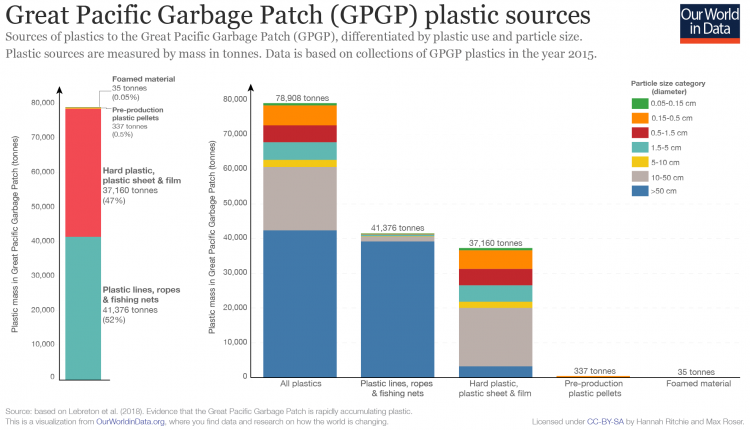
Both of these are methodologically flawed because they only sample litter that can be identified. Plastic bottles are readily identifiable and can be attributed to a company. The same can't be said for tires or cigarette butts.
> Weird. This source[1] claims that the majority of ocean plastic pollution is from fishing equipment
You're right. One is plastic on the beaches in the US, the second is great pacific garbage patch.
> Both of these are methodologically flawed because they only sample litter that can be identified.
They don't mask that (from the first article):
"The annual audit, undertaken by 15,000 volunteers around the world, identifies the largest number of plastic products from global brands found in the highest number of countries. This year they collected 346,494 pieces of plastic waste, 63% of which was marked clearly with a consumer brand."
It's flawed and not complete, but it's data. We don't have better data yet, AFAIK.
Food and drink products are going to cause the most pollution compared to other products, because food and drinks are consumed with a higher frequency than anything thing else on the planet.
However, being a manufacturer of these products is not the same thing as being a polluter. The polluters are the people doing the actual polluting, by throwing the products into the rivers and oceans.
The vast majority of plastic in the ocean comes from rivers, and a small number of rivers are responsible for the vast majority of river-borne plastic.[0]
The top 10 most polluted rivers do the lion's share of the work, and 8 of them are located in Asia. None are in the west. Even if you look at the top 1000 most pollution-causing rivers, only 1 is in the US and only a few are in Europe.[1]
These disparate results come despite the fact that the US is one of the highest consumers of Coca-Cola products. This suggests that pollution has more to do with societies than companies.
As fashionable as it is to hate on corporations and place the blame at their feet, it's not their job to police pollution, nor or they incentivized to do so. Shaming them will be ineffective, and if we truly care about the planet, we should try to be effective.
Luckily, there is an appropriate target for our ire and suggestions, a target which is both richer and more powerful than every corporation combined, and which is responsible for keeping things clean, and which is accountable to public opinion, and that target is called government.
Societies that are clean are societies that hold their governments accountable to holding polluters accountable, whether they're corporations or individuals. So, in my opinion, our efforts are best directed at governments.
Warren Buffett is not the villain here, and nor is Coca-Cola. Even in a world without Coca-Cola, we'd likely have another behemoth in its place, or (worse) a million little distributors contributing equally (likely more) to pollution, but without a single name by which we can identify them, nor a single entity by which we can effectively police them.
You're missing what was literally the entire point of my comment, which is that government action has worked. Shaming the wrong party does not work, regardless of your personal opinion on what the rest of humanity "should" enjoy consuming.
What do you think explains why America has none of the top 10 polluting rivers? And only one of the top 1000? Despite the fact that we use massive amounts of plastic relative to most other countries, and that we are the headquarters of Coca-Cola.
It's laws. It's society. It's government. It's mobilization by citizens to get the government to regulate waste disposal -- to make improper disposal of waste illegal, and to fund the creation of easily-accessible environmentally-friendly waste disposal mechanisms.
Consuming soft drinks does not pollute the environment. Throwing bottles into rivers does. Your disdain for soft drinks has you mistaking these for the same thing.
Maybe. Or maybe you export your trash to other countries, to whomever takes it for the least amount of money, and they dump it into the river. We'll never know.
I'm not against soft drinks, again. I'm against plastic pollution, be it from plastic bottles or from textiles or packaging materials or whatever.
Producing plastic causes plastic pollution, no matter how it's disposed of.
>Coca Cola is one of the main plastic polluters of our oceans.
In the unlikely event that you're correct about Coca-Cola products being the main polluters, is it their responsibility to make sure customers don't litter?
When I was a kid, coca cola products in my country came in glass bottles that you had to leave a refundable deposit to carry away, creating an incentive to keep them out of the garbage and take them back. By moving away from this, yes, they are responsible to some degree for the plastic pollution.
This exists for plastic bottles as well, your country just didn't implement it as they did for glass. According to your own argument, your country is now responsible to some degree for the plastic pollution.
There are microplastics in the contents of those bottles. Just by opening those bottles you're releasing countless microplastics into the air. Even if we'd manage to collect all those bottles, it would still pollute.
What do you mean? I can take my plastic bottles back to the seller to get 10 cents per bottle back on the purchase (that's what it was when I was a kid, a non-trivial amount back then), and the bottle will be cleaned and reused without grinding the? Because that's what I meant.
Sending plastic bottles to recycling is pointless and doesn't work, anywhere.
> It's not like Coca-Cola goes around and throws their cans or bottles in nature
They as well could.
They choose to profit from producing the stuff.
They could as well use glass as they did for decades, or sell reusable bottles and refill those. They choose to operate in countries without proper waste management knowing where that trash will end up, and are operating there anyway.
They know the damage they're causing, they've been influencing policies for decades with "reuse, recycle, reduce", even if they knew that recycling doesn't work and that just 8% of plastic ever made was recycled.
The (microplasti) pollution problem is huge, and damage they're causing is immense.
They are the (major) symptom of the problem that needs solving.
Coca Cola is the best when it comes to drinks, so naturally it's pollution footprint among the biggest. Eliminating Coca Cola tomorrow would just mean shittier soda for humanity, not less pollution.
People worship all kinds of characters, not just the morally good ones. Morality itself is debatable, and then many just like powerful people who seem to be winning at life, no matter the cost.
Morality is not universal. Different people have different values and thus different morals. There are some things most would agree on (murder=bad) but others that are up for debate.
If aliens exist, their values and morals would likely be very alien to us.
If you find the universal truth, you’ll find the universal morality. Just because people don’t share a superficial morality does not mean that there is not a deeper universal one.
Morals are being decided and dictated by those who can get most people to agree on something being moral. It's a purely man-made thing that only distracts from what everyone's born with: Actual empathy.
Morals are for people who need moral guidelines, because they lack the sense that enables them to feel what another person feels.
Morals are for every people, as we're not born with empathy. Children lack empathy, which they only develop as they get older.
Shared morals are among the top features of every culture. It's not something that's dictated, many try, but don't be fooled. And it's not a distraction either. People have a varying amount of empathy, emotional energy to operate empathy, and a different emotional intelligence and experience. So even if someone doesn't have the capacity to process a situation and act with complete empathy (the existence of which is debatable), they can still manage it well with morality "mechanically". In fact it's one of the ways to train yourself to feel actual empathy.
Morality is not just debatable, it's not universal. Look at how many different cultures there are - many of them have very different ideas about what's moral and what isn't. Even what gets categorized as morally judgeable is different, just like how different languages are in their concepts.
Dairy Queen has been amazing for society, brought a lot of happiness to a lot of people. Was a place in small towns where people could sit outside eating ice cream and socializing.
The only thing bad about Dairy Queen is the quality of the food has dropped over the decades, and there aren't enough of them.
> The only thing bad about Dairy Queen is the quality of the food has dropped over the decades, and there aren't enough of them.
Also, the drive through lines are a bit long during peak hours and I don’t really need to see the employer hold the Blizzard upside down. It’s just dumb theatrics.
That's not the entire story. People deify Buffet also because he has a comparatively clean image. The grandparent comment is just mentioning the clean image has its dark spots. (For example, the quote and the implied amorality were new to me.)
Not when it's made from dairy, and while animal agriculture is one of the most environmentaly damaging industries on Earth, worsening 5 of 7 symptoms of an ecological overshoot.
Make it from plants and it's another story, but until then ...
also note that it's one if the most delicious businesses on earth and converts otherwise inedible biomass into human food. would the industry that would take its place if it didn't exist be just as polluting to provide all those calories? it may...also no dairy, no pizza. and who would want to live in a reality without pizza?!
Ben & Jerry makes very tasty vegan ice cream, for example. Cow milk is not a necessity for ice cream, same way as dog milk, rat milk, giraffe milk, hippo milk, or cat milk isn't.
What you appreciate is fat content, not some magical taste ingredient from milk. So you could your ice cream from coconut milk or soya milk or hemp milk or almond milk and it would taste good too.
> converts otherwise inedible biomass into human food
It's also a leading driver of deforestation, one of the biggest polluters (greenhouse gases & eutrophication), responsible for soil erosion and collapsing biodiversity, etc. etc.
We could afforest and rewild those pastures and store entire 1.5C carbon budget in those forests (thus stopping climate change and biodiversity loss).
> would the industry that would take its place if it didn't exist be just as polluting to provide all those calories
And salt to make you consume more, and acids to destroy your teeth, and sugar for health problems or artificial sweeteners to damage your dna, and microplastics ...
If a natural product that isn't obviously salty has 3x the sodium, then it's probably not worth worrying about. Besides, it's 3% of DV for a 20oz bottle. You'd have to drink a hilariously high amount for the negative effects of salt to kick in.
But i'm not talking about health effects of salt in Coca Cola ... I'm questioning the reason why it's included at all.
As you said ... it's not much, you won't even notice it. So the reason it's there is to increase consumption (to keep you thirsty and to tolerate more sugar) and addiction.
Because soda contains several potentially habit-forming substances like caffeine, sodium, and sugar or artificial sweeteners, it’s easier to become dependent on soda than you might think
>I'm questioning the reason why it's included at all.
Because it makes the final product taste better. You can reframe that to mean something nefarious (ie. "it's there is to increase [...] addiction"), but fundamentally it's not any different than you adding salt when you're cooking.
>it's not much, you won't even notice it
>Because soda contains several potentially habit-forming substances like [...] sodium
Let me get this straight. You're claiming that "you won't even notice it" yet it's also "habit-forming"? What's the mechanism by which drinking 0.2g of salt per 20oz bottle gets you addicted?
> The link I've posted has links to sources for their claim (there are more):
I don't doubt that salty foods in general are delicious and make people want to eat more. I'm doubting whether the effect applies specifically for coke, which only has 0.2g it per 20oz bottle. What you're doing is like looking at a car crash and concluding that it's caused by alcohol because the driver ate some bread[1] before driving.
>It is illegal to have any measurable alcohol in the blood while driving in these countries. Most jurisdictions have a tolerance slightly higher than zero to account for false positives and naturally occurring alcohol in the body.
Hold on you think Cola company is not doing nefarious stuff? This feels like late stage capitalism. Why do you feel this much of a need to defend a corporation? I am as much of a capitalist as it gets but come on.
Obviously they don't put it in to destroy your teeth, and despite what the other replier said, it _is_ important why (in reality: better flavor), which is _why_ they went through the effort of falsely attributing why it's done (in fantasy: to destroy teeth)
p.s., phosphoric acid is delicious, that's why people like products with it in it. Back in the days of soda fountains, they'd add it in! Now it's mixed into cocktails, sometimes with various other acids (citric, tartaric, etc)
Historically, that about sums up the opium trade run by the British as well. Work Indians to death by indentured slavery, forcing them to give up food crops to grow opium. Sell in China. Costs nothing to make. Sell it for vast sums. It was addictive. (I don't know about brand loyalty, though.)
If you're wondering why this isn't a big deal in food - tobacco leaves have a huge surface area and generally are NOT washed before being dried. Nearly all food IS washed; but this is a good reminder that we live on a real planet, not a model ecosystem, you're eating trace amounts of all kinds of stuff.
The sticky stuff on the tobacco leaves (where most of the Po210 is) is important to the product.
Also worth clarifying that the tobacco plant is radiophilic, meaning it proactively takes up radioactive elements into the body of the plant and tends to grow better in the presence of radioactivity.
It’s for this reason that Big Tobacco also quietly seeks out radioactive fertilizers
It's complex, but the fertilizer itself is actually the source of the radioactive stuff. Tobacco has the odd characteristic of capturing that and the decay products are things like polonium
That doesn't say anything about Polonium being selectively taken up by the plant and used for growth. Just contamination on the sticky covering of the plants. Which doesn't make smoking tobacco good in any way, shape or form whatsoever, but it's not at all the same claim.
A quick search doesn't bring up any examples of radiophile organisms, in the sense of taking up radionuclides that are used for something. "Radiophile" bacteria exist, but that just means they are highly resistant to ionizing radiation. What are radioactive fertilizers? Potassium is radioactive to a small extent, but it doesn't seem like it's ever used for that property.
They're also grown with high phosphate fertilizers which produce a lot of decay products ending up in Po-210. THEN they aren't washed, and THEN they're dried under gas heaters which promote the formation of Tobacco-Specific Nitrosamines, which are incredibly carcinogenic.
One of the many reasons why, even though smoking anything is not great for your health, smoking tobacco is particularly harmful.
depends on what you mean by "washed". rinsed by rain sometime before harvest; at the very least.
I rinsed my tobacco leaves after cutting / before drying, but I dunno how common that is in industrial farming. I've just grown a few plants as a hobbyist interest, advised by someone who helped grow tobacco 50yr ago, specifically for "plug" chewing tobacco. That's a bit different than the bulk of production even then.
Anyways my leaves were covered with a fuzz of (dead) gnats that needed washing off. My advisor says thats normal in moisture like mine.
"Washed" = soaped and waxed and repainted like commercial vegetables; then no. It all goes in a big grinder anyway.
i got shockingly decent results from tormented plants in 2qt pots, shaded, and starved for nutrients. "brightleaf burley" almost. 6ft high at flowering.
It's a little surprising to me that no company has come out with a 'healthier cigarette'. They could claim to do the acid washing and all the things mentioned in the article in their advertising. Probably without actually saying their cigarettes are healthier but instead focusing on what other companies don't do (the acid wash) and the cancer causing carcinogens their competition's cigarettes contain that their own do not.
That would hook people who enjoy smoking but also enjoy not dying. Even if they are just deluding themselves. It would at least get me (former smoker) curious.
I've also always wondered if Big Tobbaco was working to cure cancer. It would make business sense. If we cured the types of cancer that smoking causes... A lot more people would probably smoke. (Obviously there are other issues like emphasima).
I think there's lots of regulatory and liability reasons why it's not feasible. Like they're grandfathered in to selling what they do, and nobody wants to entertain ideas of a safer thing, only prohibition.
Look at what happened with Juul. Maybe it's changed now, but they had a safer alternative and got shut down.
Also as a bit of trivia, iirc from the book "Barbarians at the gate", RJ Reynolds in the 80s was working on a safer cigarette under Ross Johnson that heated the tobacco instead of burning it. Once they got LBO'd and saddled up with debt, that got canned.
> Look at what happened with Juul. Maybe it's changed now, but they had a safer alternative and got shut down.
1. They got in trouble for marketing to teenagers, not for making health claims.
2. They are a going concern, they haven't been shut down. At least not yet.
> On June 23, 2022, the FDA denied authorization for Juul to continue selling its products in the United States, and issued Marketing Denial Orders banning any further marketing or sale of the products effective immediately. That order was blocked by the U.S. Court of Appeals in Washington, D.C. the next day.
Regardless, they are only one brand, there are many companies with nearly identical products.
3. I'm not an expert but from what I've read, it seems like the there's evidence they may be safer than smoking, but it seems like there isn't enough data to declare that conclusively. Additionally, if it makes tobacco consumption not accessible to a younger audience, it seems like that is going to cancel out the benefit (on a societal scale).
American Spirit advertises themselves as tobacco without extra nicotine or other additives added. Not the same thing, but they're...trying.
And no, they're probably not trying to cure cancer in the slightest. My grandpa was studying in the 1960s and 1970s, and big tobacco tried to fight the laboratory he worked for. The important thing he taught me before he died, from his research, was that nicotine itself interferes with your blood platelets. It's unhealthy beyond the particulates and fumes that we think of as cancerous, because nicotine is fundamentally bad for the blood. That means vaping, dip, everything affects your cardiovascular system.
They have, check out IQOS. Its been huge in Japan (and other parts of asia?) for years now. It heats the cigarette but doesnt actually burn. Same as the “dry herb vapes” that get used for cannabis.
Theyve started making moves to roll out it further internationally - big tobacco has been pushing “smoke free” nicotine products for a few years now.
Vaping is in no way quantitively safer than smoking tobacco. The amount of heavy metals you get in a cigarettes is just incredible. Plus you get more nicotine, which makes you more addicted.
Vaping is in every quantitative way safer than smoking tobacco, and this is agreed on by everyone with any knowledge about the subject, including people crusading against vaping.
> just incredible
Statistical reasoning here.
> Plus you get more nicotine
Nicotine wasn't giving people cancer or COPD.
What makes vaping dangerous is that the government refuses to regulate it, with the support of vaping companies and antismoking activists, the latter insisting that it would be absolutely impossible and absurd to inspect vape cartridges and set guidelines for (as a critical example) oils used to adulterate THC vapes which killed a few people and ruined a few lungs. The antismoking activists say the only way to regulate the safety of vape cartridges is to ban them, because otherwise they'd be allowing a dangerous thing.
A really murderous position to have, and a real government should ban all danger ideology. The kind of people whose grandparents thought it was a great idea to poison industrial alcohol during prohibition.
> It's a little surprising to me that no company has come out with a 'healthier cigarette'.
David Nutt was and is a big proponent of this. Instead of the moralistic hysteria about cigarettes and alcohol, there should be a big effort to create cigarettes that don't give you cancer, and alcohol that doesn't ruin your coordination, decisionmaking skills, and your liver.
That being said, we already have healthier alternatives to cigarettes in Swedish Snus and vaping. The nonprofits that won against the cigarette companies, now desperately looking for another thing to justify their salaries, attacked the alternatives, often in tacit cooperation with the cigarette companies that were also trying to suppress cigarette alternatives (until they were better positioned in those markets.)
Any healthier alternative would be attacked in proportion to how much healthier it was. The healthier nature of it would be characterized as making it too easy, or encouraging addiction. It's like when right-wingers were campaigning against the HPV vaccine because it made sex less risky.
> In recent years, tobacco companies have been investing in or acquiring pharmaceutical companies, which produce medications for a myriad of diseases, including tobacco-induced conditions and diseases, and emergency medicine.
The experience of smoking and vaping are dramatically different. Tastes different, feels different, there’s no easy way of measuring intake and you can do it in your house so it becomes something you do more regularly as opposed to something you take a 5min break outside for every hour. its so different that after a few weeks vaping I just quit smoking cold turkey instead. Nicotine’s addictive but the other aspects of smoking and the habit itself are much more addictive (ant least for me) and vaping doesn’t replace those.
In a way, yes. I vape instead of smoking. But it isn't the same. It's a different way to get nicotine, like dipping. And vaping was, AFAIK, more of a grass roots thing than a Big Tobbaco thing, at least at first. It felt like Big Tobbaco was caught kinda unawares when vaping became very popular and ended up buying a bunch of vape companies.
I think social media is worse for society than tobacco. Tobacco shortens peoples lives, social media is destroying society. We'd ultimately be better living harmoniously but only until seventy than in civil war and mass upheaval.
Lol if you take the number of annual gun deaths in the US each year, you arguably are still in a civil war. 40000+ of your own killed each year just from guns alone. You kill more of yourselves each year than was lost in the entire gulf War of 1990 to 91.
Your way off. Haven't seen ice cream and fast food be responsible for anywhere near as much suicide and detrimental mental health as social media. Folks generally use ice cream to bring you out of that mood not drive it home.
Reminder: cigarettes kill 7x as many people in the US every hour, day, week, and month as the "opiate epidemic" in the USA.
One is an "epidemic" and "public health crisis" and access is locked behind a prescription. One is available to anyone 18 or older on each streetcorner.
Smoking cuts your life expectancy by something like ~10 years. Most of those smoking deaths are people who've already smoked 30+ years; there's not a lot we can do to prevent those deaths now, even if they all stopped smoking tomorrow. They'd still get cancer and everything else at higher rates. We've also done a pretty good job at lower smoking rates, especially among young people. Sure, we can ban or restrict tobacco more (maybe we should) but the "public health crisis" is mostly done.
Opiate addiction cuts life expectancy by ~35 years. And getting them onto safer drugs would save lives very immediately. There's stuff that could be done, and everyone knows it, and it's not happening. That's the public health crisis.
edit: and, yes, also, opiates are also more socially destructive, due largely to the criminality.
That may be true but the people who broke into my car twice didn’t do it because they were addicted to nicotine - they did it because they were addicted to opiates.
Hmm. But is that the difference between opiate and nicotine addiction? Or the difference between the restrictions we placed on them?
In other words if we would treat tobaco the way we treat the hard drugs, would people addicted to it perform crimes to get their fix on the surely much more expensive black market?
No, they did it because the government supports the prices of opiates, which could easily be made for a nickel a dose. There's nothing intrinsic about opiates that gives you an unquenchable appetite for money. That's cocaine.
While I'm not suggesting tobacco is fine or anything; they really aren't comparable. Opiate addiction is going to completely take any quality of life away from you (tbh regardless of legality, people that were on prescription opiates still had horrendous disability and mental illness caused by the constant abuse of them, though obviously having to spend hundreds of dollars a day on an illegal supply adds a whole new dimension of horror).
Most people who smoke tobacco don't experience any significant quality of life issues until many decades in when the COPD and serious illness starts. Obviously horrible - but I would say you'd lose more than 7x more quality of life (disability adjusted years?) being an opiate addict over being a smoker.
i'm not interested in defending tobacco/cigarettes, but comparisons like this beg the question : do you see a difference between an addiction that leads to eventual chronic health issues/injury/death sometimes many many decades after first-onset versus an addiction that will many times kill even first-time users, and rarely allows for habits that last many decades?
if you want to compare the health crises, then divide the results by time to create an 'impact' score.
That's why we're focusing on opiates collectively.
I knew that my country really won't be prepared with anymore relaxation on narcotics because we smoke cigarettes much more than almost every other country in the world despite long long campaign on health issues. Heck, Big Tobacco manages to capture religious sector! That's how powerful legalized capitalized drugs are.
This is a pretty poor equivalence, I don't think I need to detail all the reasons, suffice to say a life shortened by smoking is not the same as one destroyed by opiates, either in years lost or in quality of life. Smoking is a poor long term health choice and should be discouraged, it's nothing like what's happening with opiates.
Ex-tabber here, 5.5 years clean, with some remaining ... issues.
It is bloody hard to give up, really hard but not impossible. If you want to give up then I do recommend that you prepare yourself mentally. I ended up coming up with a couple of "downside mantras" that I would repeat to myself, whenever thoughts of smoking happened.
I initially thought I would use a vape but realized very quickly that would not work for me. If nicotine is the (only) addictive substance then patches, gum, vapes etc would just work. The habit thing is relatively easy to crack but there must be other addictive components to smoking, including sensation (you need to be a smoker to understand that one). Also I didn't want to substitute one thing for another, so abstention was the way to go for me. Some may find help with gum and patches - gum is probably the best substitute, being "active" (and might even improve mouth hygiene).
I stopped mid afternoon on a Friday and had a lie in on Saturday. That got me to around 18 hours. I made it to 24 hours. Then I managed two days, then four, then a week (a landmark one day less than the next double - every little helps). Then two weeks. Visited the kids and bummed a drag on a fag and hated it.
At around a week my sense of taste and smell re-arrived with a major jolt! I can remember smelling people entering the room and other mad things. It calmed down to normal about week three and I now have a sense of smell that accords with other non smokers.
In the end, if you want to give up, then get cracking sooner rather than later and develop strategies but do not try to rely on things like vapes and gum to do it for you. You have to quite literally give yourself a massive mental kicking too.
For me I focused on two aspects I hated about smoking and I would mentally repeat this to myself whenever I thought of it:
"I don't want to smell and I don't want to die"
Even with my denuded sense of smell I could tell I reeked and the second one is pretty obvious. When I did that the craving or thought would be quashed for a while. I did have dreams where I smoked and sometimes woke up convinced I had been smoking. You do have to wrestle with yourself somewhat and decide to win!
I continued: ... then a month. Now I have saved £10.50 x 30 = £309 (I thought I smoked 20 a day but I smoked more - self delusion, probably more like 25-30). Cool.
... two months, four months (quarter of a year). Six months. Now I have realistically saved around £2000, have a functional sense of taste and smell and I no longer cough all the time.
... one year. Fuck me, how the hell did I manage that?
... pandemic etc
... 29 July 2023 - rarely think about smoking until an article on HD hoves into view.
Tobacco also loves to collect uranium and thorium in the root. As much as I want to blame the company here, they're already selling poison. What percentage of it is their fault if the poison is even more poisonous?
Collecting uranium in plant tissues won't do much to increase Po-210, since the decay chain to Po-210 runs through Ra-226, which has a halflife of 1600 years.
There are big warnings on cigarette packaging that explicitly warns you that they cause cancer, reproductive harm and emphysema. Adding a warning about radioactivity probably won’t make a difference.
Go for safer, put vaping at the top of the harm reduction list. I smoked for a long time. A good vape got me off the real tobacco. Nothing else even came close.
The difference is dramatic! Healing happened and I am in great shape today. Hard to tell anything now.
Regulate it so people can find safe vapes.
And no blame and shame. Everyone knows we sell death sticks to people for profit. Vapes are tame by comparison and offer many possibilities beyond nicotine too.
Here in Austin TX, Im told a pack of smokes at the local downtown corner mart (Royal Blue - well known for higher than necessary pricing) is nearing $20! Thats $1 per cigarette. Seems to me simple economics is coming around to address this problem. "Go ahead and keep smoking - smoke as much as you can afford!"
For the non-familiar its not uncommon to go through a pack per day between the ones you personally smoke and the ubiquitous people around too cheap to buy their own pack but happy to bum one or more of yours. So lets just say $20 x 6 days a week for $120/week. Thats about $480/month to continue being an active smoker. Take a years worth of that spending and you got yourself a pretty nice vacation.
We need to define what to optimize for. Cost-wise, a society with smokes makes sense to some.
“Well cigarettes aren’t that bad really when you think about it,” Devine said. “It might shorten a couple of years off the end of your life, but that’s a good thing. That actually saves money in the long run for the health system.”
We humans are such binary thinkers, myself included.
If we could somehow silently reduce Polonium-210 in tobacco while also lowering smoking in general, that would be ideal.
Japan did it. [0] Why can’t the rest of the world?
Smoking is huge in Central and Eastern Europe still. Sadly, I smoke sometimes out here. Wish I could find a brand with lower radioactivity for those times.
People have the gear to test for this. A brand comparison would make for a great citizen science Patreon funded video.
Damn. Makes you wonder what kinds of horrible things big companies are doing now which will only be uncovered in the next 20 years or so. What makes tobacco companies less ethical than say big pharma or big tech companies?
It's a systemic issue. At the core of this issue is the concept of a corporation. The real cancer are the legal constructs of limited liability and the concept of corporate person-hood. Companies are simply not meant to become so large; they are physically incapable of handling the kind of liability which they will inevitably be exposed to on a global scale. The scale of such companies gives them inertia which allows them to transcend ethical boundaries; with global exposure, they can always find enough people who are unethical enough to undertake the necessary cover-ups to keep things going in a way which maximizes short-term profits.
Had the tobacco industry been made up of many smaller businesses, the information would have gotten out sooner as many small tobacco businesses would have voluntarily shuttered their doors in response to the research... But with a handful of gigantic companies headed up by some of the most ethically challenged individuals that all of planet earth could provide, it's not surprising that it didn't happen that way.
Capitalism is meant to be composed of small, mostly short-lived businesses that are almost ephemeral in nature. It should be easy to start a new business just as closing an existing business should not be a big deal. Long term inter-generational wealth should be difficult but not impossible to preserve; though it could be preserved using a deflationary currency as a market-neutral store of value; its value would be derived either from trust in the institution or in the automatic mechanism which administers the currency (e.g. the government or public ledger).
Imagine what we could achieve with today's technology if only we had kept the efficient capitalist system which our ancestors had designed; a system which proved itself to be efficient during hard times of technological and resource scarcity.
Our current system evolved in a post-scarcity environment and therefore it is not optimized for resource efficiency. It's optimized for centralization of power.
It generates so many negative things for barely 1 or two positive
and yet people argue for it in the name of some "freedom"
How does destroying your and people's around health, getting an addiction, paying bonus $$ to the govt as a additional tax and stinking sound like a "freedom"
Which I think leads to two things. One is that maybe freedom isn't that good by itself. Second is that every system will have its flaws, and so, its abusers. And sometimes the system shouldn't be designed to be as abuse-free as possible. Sometimes that throws out the baby with the bathwater.
Freedom doesn’t mean making good decisions. It means having the liberty to make a decision, even if it’s not in your own best interest.
Do you have a right to destroy your own health? Do you have a right to get yourself addicted to a substance? Do you have a right to smell bad? Does the government have a right to exact a tax to disincentivize bad decisions? Do you have a right to contaminate the air in personal spaces like your own home? Do you have the right to contaminate the air in public spaces?
Do you have a right to tell someone else they aren’t allowed to make any number of those decisions?
There’s the other side of the transaction as well. Do you have a right to grow something that’s bad for your health? Do you have the right to smoke it? Do you have the right to share it? Do you have the right to sell it?
In this case, do you have the right to lie to the person you’re selling it to about whether it’s good/bad for their health? How does that change if you didn’t know it was a lie? How does it change if you did? How does it change if you didn’t know, but you could have known if you’d sought out the information?
At least in our country everyone knows that cigarettes causes cancer. Even 50% of the packet required to have warning that says cigarettes causes death. Who cares.
Is this radioactive stuff just the result of burning tobacco or is it added from another element specifically in cigarettes? If it's from tobacco, is it normal for burning plant matter to result in radioactive materials?
Polonium comes from uranium. It's on the decay chain, via radium and then radon. Soil contains uranium at about the same concentration as the underlying bedrock (typically a few ppm by mass.)
What's that you say? We need retrospective criminal charges for this. Hell yes we do! Drag those company boards out of retirement and slap em in jail and size their assets.


Because if Purdue taught anything to the U.S. is that their voters do not care. We should prove them wrong I suggest. (Related to the events.)
If you think your vote doesn't count: congratulations, the entities you complain about convinced you wrong, and are doing their job. Demonstrate, create groups and demand things from your representative, pick someone from the group you have to run against your representative. There is no democracy otherwise. Time we start caring.
These might be called rights on each constitution, but that is a misnomer: they are jobs each citizen needs to do. Sorry, but that is the truth in the end.
Disclaimer: Above message is for the residents of every democratic country.