The article is pretty clear why peoples interests in nuclear power has gone up. Natural gas prices have gone up and as a result the energy price that customers has to pay is swinging up and down based on supply and demand. It the same story as in many other places in the world. Nuclear represent a stable price of energy that doesn't get impacted by changing fossil fuel prices, and while the initial capital cost is high, stability and freedom from fossil fuels has their benefits. Especially since fossil fuel and wars tend to be associated with each other. It is a bit indicative of the global age we live in that a war between Russia and Ukraine is dictating what a Japanese citizen is paying for electricity.
"Nuclear is super expensive!" they keep screaming as I've been living in places with primarily nuclear power for the vast majority of my life. The only 3 years when I didn't, I really felt the price of dinosaur-fuel even though it was at rock-bottom prices for all 3 years. Illinois is majority nuclear and is one of the cheapest stats in the USA when it comes to electricity rates all because of nuclear. And I grew up in Cleveland which was also primarily nuclear and electricity was so cheap there, the power and gas company was paying people to switch their entire homes from LNG heating to electric heating for about 3 decades.
> An empirical survey of the 674 nuclear power plants that have ever been built showed that private economic motives never played a role. Instead military interests have
always been the driving force behind their construction. Even ignoring the expense of dismantling nuclear power plants and the long-term storage of nuclear waste, private economy-only investment in nuclear power plant would result in high losses— an average of five billion euros per nuclear power plant, as one financial simulation revealed.
Hard to buy that conclusion. 35 countries with existing or under construction nuclear power. But only 9 countries with nuclear weapons, 2 of which do not even have any nuclear power. And when you go through the history countries seeking nuclear weapons don't start by building nuclear power, they tend to go straight to fit for purpose reactors dedicated to producing plutonium (e.g. Dimona or Hanford or the French and English equivalents) or to enrichment plants (e.g. as Pakistan did long before it ever had a civilian power plant).
How does that explain countries with a lot of nuclear power plants that been operating for several decades, and yet no military application.
To take an specific example, the Swedish nuclear weapon program was decommissioned 1968 and official ended 1972. Sweden first commercial operated nuclear plant was built 1972. Sweden has shown no military interests in nuclear weapons for as long the power plants has existed, and nuclear power was built up to 50% of Swedish energy demands by around 1985, and kept nuclear power plants operated since then. 4 nuclear plants, 12 reactors, and 0 bombs, all built between 1972 and 1985.
Anchored in the previous weapons program. Sold as the energy source of the future. Which as we know today did not pan out without huge subsidies. It's like renewables from 1990-2010, the difference being they entered escape velocity and now stand on their own legs.
The ones still investing all have nuclear military ambitions and want to share the costs and industry with the civilian side.
Anchored in what way? The military did many concepts during the 1960s, like training pinniped to attack military subs. They didn't pan out. The plants that were built, especially those during the 1980, had nothing to do with the failed projects for nuclear weapons 2 decades earlier.
> Which as we know today did not pan out without huge subsidies.
Feel free to look up Swedish subsidies in the energy sector. Renewables get much more each year, as does fossil fuel. Nuclear power is currently the energy source in Sweden that get taxed highest per watt produced. Considering that those plants been operating for 40-50 years non-stop delivering consistently energy without releasing greenhouse gases, is taxed more than any other energy source, the claim of "huge subsidies" is plainly false in context of Swedish nuclear plants.
No nuclear bombs, less subsidies than any other energy source, no greenhouse gases. The military did not help fund the construction for them, nor are they using any aspect of the operation to research or build weapons. Sweden signed the Treaty on the Non-Proliferation of Nuclear Weapons in 1968, 4 years before the first commercial nuclear plant. Sweden has been an active advocate for the Non-Proliferation Treaty for 50 years now.
Countries that combine nuclear power and nuclear weapons are those who refuses to sign the treaty, like the US, UK, France, China, Russia, India, Israel, Iran, Pakistan, North Korea. Sweden is not on that list.
Nuclear is competing against solar, wind, gas, coal and oil which all get massive subsidies. Why should nuclear be the only one left out that does not?
Exelon was going to shut down the plants (instead of refueling them) if they didn't get subsidies from Illinois. They got subsidies from Ohio and New Jersey. They didn't get subsidies from Pennsylvania and shut down TMI 1. If existing, fully paid off nuclear power plants are uneconomic to run without subsidies, that really undercuts the narrative the narrative that "construction is expensive and operation is cheap".
And given that construction is so expensive, it ruins the economic case for building new nuclear plants (imho).
Operation is cheaper, but it is not cheap. The steam based thermodynamic cycle is very expensive compared to CCGT and even worse compared to gearbox into generator for wind power and solid state for solar.
In this graph you have the marginal cost of traditional generation compared to total cost of new built renewables.
I had believed that "nuclear construction is expensive, nuclear operation is cheap" got decades, and I spent a few months of pandemic downtime trying to figure out why that isn't true.
I didn't find all that much to go on. Aside from a French Court of Audit report in 2012, this information seems to be mostly non-public? Anyway, it looks like the answer is staffing and maintenance. It seems to be common for nuclear power plants to employ 500 to 1000 people. Fessenheim in France employed 700 people at the time of its closure, plus an additional 600 to 2000 during maintenance (per Wikipedia).
Meanwhile, nuclear seems to be very technically complicated with a bunch of weird Advanced Physics-y shit that can go wrong. Like, water pipes exploding because the nuclear radiation caused water molecules to split up by radiolysis and a design flaw allowed the hydrogen to collect somewhere. Or borated water eating through steel.
And now that I type this, it occurs to me that you can't just turn off the plant for safe maintenance work -- inside the dome is always going to be irradiated and probably require hazmat suits.
And, as you alluded to, nuclear plants use the steam based thermodynamic cycle but run cold because they have to maintain water in a liquid state while absorbing heat from the reactor. The power achievable from the Carnot cycle depends on the magnitude of the temperature difference: nuclear plants run at 300° C, coal plants about 570° C, and CCGT at 1000° C up to 1500° C.
From table ES3 we can see that steam based plants are expensive in pure equipment costs. Which makes sense comparing a tiny gas turbine giving direct mechanical force. Then you can use the waste heat for steam generation if that makes sense in your location.
Comparing this to coal and nuclear plants huge boiler and turbine setup with about the same output. Nuclear adding even more complexity of different loops and safety requirements.
Haven't dug deeper into that report than the executive summary though.
Nor does it include the cost of storage for nuclear. It's no accident Japan has the most pumped storage per unit of generation on the planet - it's because it has the most nuclear. Nuclear can't vary it's generation fast enough to match the daily variation in load.
Admittedly you need much less storage (until a tsunami comes along). But pumped storage only costs around $1/watt. (The unit of $/watt rather than $/kWh because the dam is only a minor fraction of the cost of pumped storage, and it drops quadratically with size.) Storage + renewable generation still costs less than 1/2 of nuclear.
> While historically large power grids used unvarying power plants to meet the base load, there is no specific technical requirement for this to be so. The base load can equally well be met by the appropriate quantity of intermittent power sources and dispatchable generation.[3][4]
Wind and solar don't anymore. They are completely self sustaining industries. In New York for example there was a bidding war to get the rights to develop off shore power.
> After three days and 64 rounds of bidding, the U.S. Department of the Interior Bureau of Offshore Energy Management (BOEM) on Friday concluded the nation’s highest-grossing offshore energy lease sale ever, with winning bids from six companies totaling approximately $4.37 billion.
> Not only does the amount raised in the New York Bight lease sale far exceed the more than $400 million raised during the previous offshore wind sale in 2018, it even surpasses the highest amount raised during any offshore oil and gas lease sale ever in U.S. history.
> The results are a major milestone in the Biden-Harris administration’s goal of reaching 30 gigawatts of offshore wind energy by 2030.
Clarification, nuclear is used for baseload power generation. It would compete with fossil fuels and hydro. Not solar and in most areas, not wind either. Offshore wind farms may be able to provide baseload power generation, but there are major maintenance issues with them right now.
Since there seems to be a lot of interest in Illinois energy subsidies, maybe we could get a tally on how much they spend each year and whom the benefactors are.
I got one news article that said they gave nuclear $130 millions each year in 2019, but then other sources say it is a number between $19 and $52 millions. Then in 2021 I find an article that they increased subsidies for renewables by an additional $350 millions per year. In one article that the total subsidies to build new solar and wind has a total of $600 millions per year. An other said that the total of subsidies for renewables are well above $1 billion per year. I couldn't find an article that estimates Illinois fossil fuel subsidies, but one said that the US spend around $20 billions per year.
Naturally each article want to either inflate or deflate those numbers to drive a political point, so it would be nice if anyone could bring some authoritative numbers that give the exact number of what Illinois actually spend in terms of energy subsidies.
I'm all for clean nuclear power. I was very disappointed when Merkel decided to go all in on banishing it for more gas but one thing that puzzles me is that Japan is seismologically active so I am curious to exactly the nature of this survey. What was the sample size and who was behind it?
The article makes it seem like most of Japan is over Fukushima disaster but in reality speaking with colleagues who are there and have better sense of the local's consensus do not reflect what is being highlighted in this survey.
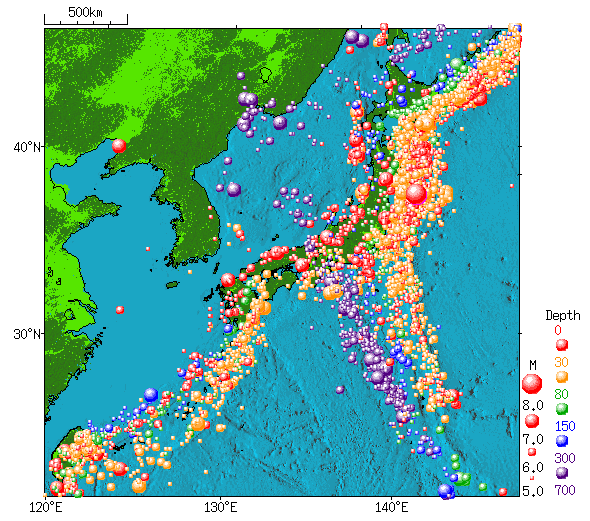
Most certainly the reactors would be located near the coast line and from this historical earthquake chart you can see why there would be widespread concern about building even more nuclear power plants.
So again I'm quite skeptical of this article and it's survey that its citing. Even more weird are the comments that seem to be completely oblivious to what the actual perception is amongst Japanese citizens, and some even seem primarily motivated financially somewhat using languages like "bulls" and "FUD". Just very bizarre to see wallstreetbet linguo discounting the very real opposition to nuclear power in Japan (due to the seismological risks).
Also Japanese Yen value is declining and no good sign to going to opposite. USDJPY is raised 11% from a year ago. Fuel cost affects trade deficit significantly. Nuclear is good for this situation because there are local nuclear industry (Toshiba, Hitachi, Mitsubishi,.. but recently they don't build due to the situation) and fuel cost is negligible. For solar, there's no longer any big solar panel manufacturer in Japan. For wind, there are not much land to build and ocean wind is now starting developing.
Title is misleading and I think many commenters are missing the point. This is support for *restarting existing reactors* and not really a support for nuclear in general. This may lead to the latter, but it is very different turning on reactors that already exist (meaning some danger already exists) compared to creating more.
Proposed title change:
> Majority in Japan backs restarting existing nuclear reactors
>Once we make X economical, we will have all the Y we want
True for like 99% of things that could ever exist. The big question is is it possible, and is that really the only hurdle. IMO Uranium extraction isn't the bottleneck to nuclear power, building and maintaining the plants is.
Correct. An even though fuel costs are significant, it's mostly the enrichment that drives up the cost. Even at the present un-economical seawater extraction rates, the overall cost increase would be negligible: https://www.forbes.com/sites/jamesconca/2016/07/01/uranium-s...
I think it's actually false 99% of the time, because as soon as we get Y for cheap, we start consuming it more, and we are back to not having enough Y.
99% of the time seems excessively high. The changes in demand are really dependent on the properties of the good in question.
Also, this phenomenon is called the "income effect"[0]: as the price of a good Y falls relative to other goods, consumers' "income" will increase in a real sense (i.e. they'll be able to consume more of all goods), so they may increase consumption of Y, depending on whether Y is "inferior," "normal" or "luxury." The definitions of these concepts have to be made carefully to avoid circularity, but suffice it to say that 99% of goods are not normal.
Energy, however, is a normal good when measured, though a 2x increase in income leads to less than a 2x increase in energy consumption for a sufficient starting level of income. (If you were living in a remote village that was only recently electrified, for instance, electricity would be a luxury good: increases in income would lead to significant increases in consumption of electricity up to a certain point.)
What's more interesting is how firms react. Decreases in energy costs could lead to significant increases in productivity for firms, allowing for economies of scale that did not exist ex ante. This isn't really "consumption" per se, as energy is being "converted" into another good. But it seems likely that firms' demand for energy could increase quite a bit as the price for energy decreases.
> can't we use many different things for nuclear though?(and uranium is just the most efficient?)
Strictly speaking, U-235 is the only fissile isotope of any element that is found in any significant amounts in nature. However, breeder reactors can also be useful. The only two starter points I'm aware of in nature for significant energy extraction are U-238 and Th-232. U-238 breeder reactors are politically complicated because they can relatively easily be used to generate significant amounts of Plutonium which is usable in bombs.
Th-232 reactors have technical hurdles that are probably surmountable; specifically the neutron economy is significantly tighter than U-238 breeder reactors (this is why you often see liquid-salt reactors proposed for Th; chemically separating the decay products gives plenty of breathing room in the neutron economy). The U-233 it generates is also usable in bombs, but since it will tend to also generate U-232, which is both difficult to work with and easy to detect, it's considered less of a proliferation risk.
This all misses my original point though. At any point in the first half of the 20th century we had enough oil to last us for centuries at then-present day usage. Yet here we are.
Not quite the same; Jevons Paradox notes that increased efficiency of use is an effective reduction in cost. The fact that when you make something cheaper to use it gets used more is just simple supply and demand.
Well, that's what it would take to make it renewable. Political will and what we have today is all it would take to make it viable. And potentially shifting the $0.5T in annual global fossil fuel subsidies to nuclear wouldn't hurt.
Nuclear has this problem too (in a lesser form though).
Most reactors mainly run at 100%.
Regulating them down takes quite some time and also wears down some materials inside.
It’s mostly a cost problem, idling a reactor for 12 hours produces 1/2 the power per day at 95% of the cost. Aka your cost per kwh basically doubles.
France largely got around this by exporting power, but that obviously doesn’t scale if everyone tries to export power on the weekends nobody wants to import it.
Finding something to use the power flexibly isn’t enough, they need to be willing to pay several times more than Solar for it or you aren’t fully offsetting costs.
Nuclear is fine with load following. Most plants run as baseload because it makes sense for them to do so, given the surrounding energy mixture and capital costs, etc, but it's not some sort of immutable law of the technology. Many existing designs have that capability even if it's not used much. They're not great for peak generation, but if you're price insensitive, or could lower the capital costs enough for it to make sense, they could do that too.
Regulating them down is done by more aggressively cooling the reactor. The thermal energy output is unchanged, but less of that thermal energy is transformed into electricity. This doesn't wear down any materials, but it does waste fuel. Grated, fuel is a tiny faction of nuclear's cost. Furthermore, the gap between peak and minimum electricity consumption isn't that large. It's usually 10-20%.
Which type of reactor are you talking about here? I’m not a nuclear expert, but the wonderful Chernobyl TV series doesn’t align with this. That reactor put out 3mw usually, peaked at 33kmw, and was idled down to 700kw using control rod insertion rather than more aggressive cooling.
Any reactor. This modulating is done with the cooling system, not the reactor itself. To clarify, the thermal output of the reactor remains unchanged, while aggressive cooling reduces the electrical output. It's deliberately reducing the efficiency of the heat engine to reduce electrical power output with the same thermal power output. That's why it's wasteful of fuel. Modulating the thermal output of the reactor is more efficient, but not all reactor designs can do this quickly.
The blast at Chernobyl was due to a positive void coefficient that meant over-heating led to a positive feedback loop (plus some other process failures that led to that initial overheating). Also those figures for the Chernobyl reactor were for thermal output, not electrical output. The figures are an order of magnitude off, the reactor would normally put out 3GW, not 3 MW and was idled down to 700MW for the test. 700 kW is, like, a beefy muscle car.
It's renewable in the sense that there's a massive geological reservoir which replenishes the uranium dissolved in the seawater. There's 4 billion tons dissolved right now in the ocean (enough to run 1,000 reactors for 100,000 years) but that is replaced as it's extracted. [1]
It's about as renewable as solar, which is to say, we will eventually run out - but at that point the heat death of the universe is a more pressing concern.
> It's about as renewable as solar, which is to say, we will eventually run out - but at that point the heat death of the universe is a more pressing concern.
Nitpicking:
The sun is expected to stop fusing helium in about 8x10^9 years [1].
The heat death will occur in around 1.7x10^106 years [2]. (if at all, there are some uncertainties around that)
Which means that while they are both far, the heat death as predicted is much much further than the other. In short, the heat death of the universe won't be a pressing concern at all when we run out of solar.
I remember reading some time ago that after the Sun runs out there's only enough energy in a state fit for fusion for like one or two more generations of stars in the universe, and after that the universe will go dark forever.
That may be true, but it's worth noting that the length of a "generation" of stars varies wildly depending on the type of star. Stars like our Sun might only live 10 billion years or so, but red dwarfs live 100 billion years or more so we could presumably live around them long after all the Sun-like stars have burned out.
If you have a bunch of matter (dead stars, planets, interstellar dust) is there some fundamental reason this can't be dumped into accretion disks, etc. in an energy-positive way?
Proper management of star lifetime actually requires the opposite approach: subtract mass from the star, so that the star "core" where actual fusion happens can steadily mix with a larger fraction of the remaining mass. The harvested mass can then be stored away as gas-giant planets, and used for miscellaneous purposes.
This is fascinating. Do you have any recommendations for sources so I can learn more about megascale engineering projects to maximize the life of a star?
Stars fail when the elements in their cores stop releasing net energy when fused. This crossover occurs at iron. Adding more mass will just make it's death more violent.
Also the sun contains 99% of the mass of the solar system. The remaining 1% includes Jupiter. I'm not sure how much effect we can have when only leveraging 1% of 1% of the solar systems mass.
The distinction is that wind/solar arrive for free without any effort. That just isn't true of nuclear fuel. I don't think that is a problem particularly. More that "renewable" is the wrong word.
You have to build solar panels and wind turbines. Then have connecting service roads able to carry heavy equipment. Wash the panels frequently or watch their performance plummet. Grease moving parts to avoid friction losses. Maintain the rotor blades at the cost of significant downtimes. Replace everything after 20 years as that is their average lifespan. Deal with all poorly recyclable waste you have created. Overbuild all transmission lines by a wide margin, to compensate for the low density and intermittent nature of wind and solar. Accept that what could have been truly space reserved for wild nature is now used for low density energy farming. I really don't see how wind and solar are renewable in the true sense of the word. From an ecological perspective the point should be to use our resources efficiently so as to return large swaths of land to pristine nature. Currently you can do this two ways: one use high density technologies like nuclear, the other is to go extinct voluntarily. My choice was made after becoming a parent.
If we ran the entire world off of nuclear reactors, we could increase the energy we used and still not worry about exhausting the amount of uranium available to us. Proliferation would be a concern though.
That said, why would we run the entire world on nuclear, or go for a nuclear-only strategy when we also have solar and wind and geothermal and hydroelectric? For that matter, why should we exclude nuclear from the energy mix available to us?
Different sources of power have different properties with different tradeoffs, but if you can cover your bases with multiple types, why wouldn’t you?
Hydro is actually not a particularly good choice in most cases. Some hydro installations can actually produce just as much global warming impact as a fossil fuel plant (largely methane produced in the flooded area - which has a far greater impact than CO2; about 80X greater). They also have significant ecological impact that isn't usually accounted for in folks mental models. [1, 2] Hydro isn't really green energy.
Geothermal I think only works in some places without causing earthquakes. [3]
From a Californian perspective, hydro and geothermal are basically tapped as far as I know, in-State anyway. The plants that are operational already is about the extent of what we can probably build.
Actually something of a dream of mine is to see nuclear reactors eventually replace some of our dams, maybe restore some of the lakes and tributaries that have been lost, but presently new reactor construction is prohibited here per a ballot initiative from before I was born.
My larger point is that society is going to continue to demand increased electricity generation, which means new plants and installations. It’s one thing to want to replace existing installations but if you’re going to service future demand, then new sources of multiple types have to remain on the table. I would take nuclear over gas-fired plants, but I would take gas-fired plants over coal-fired plants.
> From a Californian perspective, hydro and geothermal are basically tapped as far as I know
For what I understand, the California State Water Project as visioned in the 1960s, had Stage I and Stage II. Only Stage I was built. Then from the 1980s onward, there was political opposition and Phase II was never started.
True, but the Klamath River is in the grand scheme of things a fairly minor watershed in California. Some room for growth, but effectively tapped out as far as the major watersheds in the State go. We have just a lot of dams and we’re still importing more and more of our energy from other States as we make it harder to build plants here.
Non-proliferation as a movement is only as strong a movement as nuclear-equipped nations are willing to enforce it. I’m not willing to hold up deploying reactors in the US over it, but proliferation is a legitimate concern.
Really, this week? With nuclear war looming over us all?
Also lets put things in perspective, Global Warming means future generations will need to adapt to new weather patterns. Some animal and plant species will become extinct, others may thrive.
Nuclear war will end civilization and make many parts of the world completely uninhabitable.
There is nothing we can do if Putin decides to push the button. The world as we know it ends at that point because the USA won't hesitate to answer with our own nukes, and I wouldn't have it any other way. I don't worry about things that I could never have any control over. I am worried about global warming per this conversation about energy sources that won't destroy human civilization via natural disasters.
What happens when every country has nuclear weapons at the ready and dictators in power? Pretty sure global warming (Climate change) won't be as disastrous as a nuclear winter.
Wind generators aren't free. Solar cells aren't free. And (even more importantly) backing storage for when the sun isn't shining and the wind isn't blowing is most definitely not free.
Why is that an important difference? To capture wind and solar you have to build turbines and solar panels which aren't free. You also have to have batteries to store them because of seasonal nature of these sources. You also need to transmit the energy thousands of miles through electrical grid because these sources of energy are limited to certain areas. Building the electrical grid itself just needs cutting out millions of more trees. So overall, the environmental impact of going full solar/wind would be worse than a combination of solar, wind, nuclear, and even maybe natural gas.
No one is denying you need those things. We’re talking about a specific step that doesn’t exist for solar/wind akin to being able to drink water you find vs. having to make it clean.
Well it depends on the course of human civilisation. If we wipe ourselves out in WWIII then we won't run out of coal. If we continue to grow exponentially then we will quickly run out of solar.
By that definition I don't think there is such a thing as renewable yet considering you need storage/batteries for just about any "renewable" energy source out there. Energy will always cost us something imho.
One alternative approach to storage/batteries is trying to provide over 100% of the average daily demand of electricity. Excess electricity could be priced lower. Consumers & industries could use those cheaper hours for certain tasks. This is already done in many areas. Run your dishwasher, charge your car, etc. at night.
Which leads me to think storage/batteries is not the issue & that manufacturing, installation & infrastructure is. I also imagine getting land permits, regulations, politics, etc. is also a huge factor.
Are there any simulations done on actual historical weather data on how much you need for that to work.
I would be far less sceptical about massive deployment of renewables if somebody could point me to a study that shows:
Given this grid, this amount of wind, solar and storage in that areas and the historical weather data of the last 30 years it would have resulted in this amount of overproduction, blackouts....
Not all energy uses can be shifted. IT infrastructure, the pumps delivering plumbing to your house, streetlights, HVAC, all needs to be running at all times. Furthermore, if shifting energy demand is the plan, then renewables need to factor in the cost of shifting that energy demand into the equation.
Gasification of woody biomass waste streams (walnut shells, wood chips, corn stover, bigasse) is quite renewable, and can be run 24/7 regardless of weather. The CO2 emmitted comes from the atmosphere and therefore is cyclical in nature (thus sustainable). If you take biochar into account the carbon generation is actually negative, as you have carbon left over that can be used for other things or put back into the soil in a form that is stable for thousands of years and beneficial to the soil quality for life.
Nuclear will run out much, much faster, though, particularly when it comes to uranium we actually know how to extract economically. People's proposals for things like extracting uranium from seawater have not even reached the prototyping stage--we don't even know if it's possible to do at the scale required to support modern civilization--but people are already willing to treat it as a done deal. It's one of the reasons I'm not nearly as enthusiastic about nuclear as many people here. For some reason, people seem very quick to point out at extremely minor problems with solar, which is technically pretty much already there and which we know can work, and has improved by leaps and bounds in a short amount of time, or argue that it can't work because of the storage problem (even though we already know how to build big batteries--pumped storage isn't sexy, but it works and can be produced at scale without requiring exotic materials or anything like that). But those same people are happy to use as-yet-unrealized technological leaps to deflect concerns about the sustainability and expense of nuclear power, even though nuclear power is a much older and better-understood technology and many of the breakthroughs being cited (like thorium breeder reactors etc.) have been studied and promised for decades without significant progress.
We know we could extract uranium from seawater. The prototypes would scale. The reason we don’t do that is that there is no economic reason to do that: it would be more expensive than mining, so why bother? However, even at that higher cost, it would still be plenty cheap enough to use in our power plants.
You complain about people overblowing a minor concern with solar, but you do the same with uranium extraction.
Also, I take issue with your suggestion that we can do pumped storage at scale: we can’t. There are not a lot of suitable sites for that: we either lack enough altitude delta, or lack water, or would have to flood huge swaths of land, often already more productively used. I like hydro, and I like pumped storage, but unlike nuclear, you can’t do it just about anywhere.
US is actually particularly lucky when it comes to hydro: most other countries are too flat, too dry, or too short on wastelands. Even if we could pull it off, most can’t, and they need power too.
Pumped storage can be constructed out of concrete. It's not necessary for there to be a preexisting basin. This isn't often done because there's not much demand for it and it's very expensive compared to fossil fuels (which pretty much everything is), but it is entirely industrially feasible and is still generally cheaper than any other kind of battery. I realize you are arguing that extracting uranium from seawater is in the same category, but it's not: there are no industrial scale mining operations extracting uranium from seawater, and there is no evidence that existing prototypes would scale up to global power requirements (in addition to the other issues mentioned by the neighboring comment).
> but it is entirely industrially feasible and is still generally cheaper than any other kind of battery.
Really? That sounds interesting. Can you send me some materials on this?
> there are no industrial scale mining operations extracting uranium from seawater, and there is no evidence that existing prototypes would scale up to global power requirements
This is true, but again, hardly relevant, because nobody really tried to do that at scale, as there is no good reason for it for as long as mined uranium is cheap.
If I remember correctly the tested uranyl ion collectors were not very specific and they concentrated other radioactive heavy elements to a dangerous degree for the lifeforms flowing through.
Pumped storage is simply a gravity battery. There are vertical gravity batteries that can be built anywhere. Basically they are giant cranes that lift heavy blocks high up. This is the storage component and requires electricity. When we need to drain electricity they move the high blocks to a lower elevation using the crane. This generates electricity. This seems like the perfect type of battery to me for urban cities with large towers already.
The sort of battery you describe is utterly non-viable. The amount of energy you can store with solid blocks is extremely small relative to the cost of the structure. Do the math. With 100 tons weight and 100 meters lift (an enormous structure) you get something like 1 (one) dollar worth of electricity, which is bupkis.
Pumped storage works, because it pumps absolutely enormous amounts of water. You can't handle comparable amounts of solid blocks similarly easily.
Sure, nuclear will run out much faster than the sun. But that "much faster" is still on the order of magnitude as the age of human civilization.
And no, pumped storage is nowhere near on the scale required to make renewables feasible. For example, the US uses about 500 GWh of electricity every hour, but only ~20GWh of pumped storage. The pumped storage facilities take about as long to build as nuclear power plants. Storage is also just one of the challenges to making renewables feasible. The fact that renewables are geographically dependent means we'll also have to make large expansions to transmission infrastructure [1].
> Sure, nuclear will run out much faster than the sun. But that "much faster" is still on the order of magnitude as the age of human civilization.
Not with what we actually know how to economically recover, AFAIK, though sources vary widely on such figures.
And yes, pumped storage takes a long time to build, but that is not a disadvantage compared to nuclear plants, as you note. Expanding transmission infrastructure also falls under the line of boring things we know how to do, if the political will is there. I am mostly just pointing out that while both require massive infrastructure investments, making nuclear truly sustainable relies essentially on speculative research in a way that solar + pumped storage does not. Plus, nuclear has other advantages (like being usable in deep space, under the ocean, etc.), which makes it feel a little wasteful to use for power generation on a planet bathed in sunlight. So I don't really understand the strong preference for nuclear that a lot of people seem to espouse.
Massive expansions of electricity transmission, and huge energy storage projects - several hundred times the size of what we have currently - cannot just be hand-waved away "boring things we know how to do". Hydroelectric storage is geographically limited, which leaves large areas without a storage solution. The strong preference for nuclear is because it avoid these difficulties which are typically ignored when renewable plans for decarbonization are proposed.
As I mentioned in my post, people are very quick to bring up breeder reactors, despite the fact that no commercial prototypes that can recycle fuel to that degree actually exist. I have nothing against nuclear power as a short-term stopgap to deal with climate change, but we should stick to technology that actually exists if we're talking about using it as a primary power source into the indefinite future.
There are no wind or solar installations that can come anywhere close to providing the base load power for the United States, either.
According to what I'm seeing, there are only 5 solar plants that produce > 1 GW in the entire world. 1 GW is very small by the standards of nuclear or even large hydro installations.
If electricity/m^2 or per site is your metric of choice, solar isn't going to do well. However, this is an uninteresting metric in a world with so much unused land, and with a technology that doesn't gain significant efficiency improvements from being deployed at a large farm vs. in smaller installations. I don't think anybody seriously disputes at this point that solar can generate enough electricity to power the world (with suitable investments in transmission infrastructure)--and at far lower prices than nuclear for the same amount of electricity. Storage is the problem proposals for significant portions of the grid being solar has to deal with.
> However, this is an uninteresting metric in a world with so much unused land
What do you suppose environmentalists are going to say when you start covering all that "unused land" (which they call "wilderness") with solar plants?
You're shifting goalposts here.
The technology you favor doesn't exist on the scale needed, any more than breeder reactors do. The French Superphénix experimental breeder reactor produced 1.2 GW of electricity, in 1985. That's more than any solar installation in the world except for one.
> What do you suppose environmentalists are going to say when you start covering all that "unused land" (which they call "wilderness") with solar plants?
Probably "wow, thanks for using all that desert?" The environmental argument against solar is by far the weakest out there given that literally every other alternative has substantially worse externalities (whether you think the risks of nuclear waste are worth it or not--I'd imagine most of us do--they obviously exist!). I'd actually go so far as to say that the vast majority of people who claim they are against large solar deployments for environmental reasons are arguing in bad faith.
I do not understand what you're saying as far as "scalability" required of solar farms. What challenges of scale do you think will exist? Solar does not have economies of scale in terms of deployment, only construction (and it is already cheap enough, without subsidies, to undercut fossil fuels in many countries). Deploying a large or small farm scales basically linearly in the number of solar panels, until it becomes such a large fraction of the grid that storage becomes a concern (which we are nowhere close to). This is not comparable to the obvious challenges of mining and processing enormous amounts of seawater (which takes a long time to mix thoroughly and for which we still don't have a good way of actually isolating the uranium) compared to small amounts.
Again, many informed people have issues with solar, but none of their issue is that it couldn't provide the power required. The reason there are not larger solar deployments is that people have not invested in larger solar farms, not that there is some scalability or economic limit; a large farm being a fraction of the size of some nuclear plants is pretty meaningless, considering that it costs proportionally less than the same nuclear plant (which is why I bought up square footage--because that's the only metric by which trying to argue that a single nuclear plant generating more electricity than a large solar farm actually means anything). There is absolutely no technical hurdle there, and frankly I can't really imagine what you think the technical hurdle would be.
The availability of uranium really isn't the problem.
And I know the tech community loves thinking of themselves as supremely rational scientists immune to the follies of emotions. But no actual physicist (or physician) thinks a fear of radioactivity is something that needs to be overcome. Those that work with such material respect the inherent danger. They try to overcome the danger, using a bit of fear to stay concentrated (and get the funding).
Declaring your willingness to install a mini-reactor in your garden shed, as sometimes happens in these discussions, is the hallmark of scientism.
Really the whole debate is mostly scientism: nuclear power didn't lose because it was too dangerous. It lost because it is too expensive. These days, it's still too expensive, but now it also just takes too long for it to be useful for the climate emergency.
Actual scientists and competent tech people have driven the costs of solar and wind power, as well as storage, down by several orders of magnitude. But tech bros are emotional: they consider those technologies to be girly, and therefore still bring up big hairy nuclear reactors whenever anyone fails at avoiding them at parties.
Nuclear power is not a technology of the future, it is just a technology of a future, specifically the future of the 1960s or so. It's funny how your forward-looking worldview can turn all retro on you within just a few decades.
Hmm, my understanding was that when you dig into why nuclear is expensive, it can be roughly broken into two parts. One part is the intrinsic costs of building a functional power plant. The other part is making things safe, and that's where we've pushed our regulation far past "safe enough" (compared to other sources of power) and into the realm of absurdity, because we're looking at absolute safety and not relative safety. I found the post where I originally read about this (https://rootsofprogress.org/devanney-on-the-nuclear-flop) -- basically, nuclear power is required to be "as safe as possible", implying that if you have money left in your budget and you could have spent it on improving safety, you've failed, even if it's already far, far safer than any other thing humans build. Which, according to the author of the article, means that you can never try to build a more cost-efficient nuclear plant, you always have to blow all your money on safety, and that's why costs keep rising. I found it pretty convincing.
That said, it's likely we can't fix our regulation AND build new plants in time to fix climate change, so I agree with you there. I don't have any agenda about what tech we use to solve this problem -- I'm perfectly happy with solar, wind, or flower power if that's what it takes :)
The cost of doing something safely isn't distinct from "intrinsic costs". If you kill everyone in the county, maybe that's an acceptable risk and statistically, you are right. But you are also dead, and the reactor isn't running (or: is running decentralized, in the cloud).
The idea that some safety costs are entirely frivolous, obviously so, with no serious argument against that notion, just doesn't strike me as believable. Yes, government projects (and private industry projects) tend to run over budgets. The saying is "work expands to meet the budget provided", but that's intended to be cynical snark, not descriptive of reality. There are plenty of governments that care less for safety than the nations of the global north, yet they haven't found this holy sweet spot of safe efficiency, as far as I can tell.
Ok sure, I know what you mean, you can't separate out costs. But imagine we could say -- how much would it cost to produce nuclear power that killed as many people yearly as natural gas plants do, per unit of energy produced? Everything on top of that is extra safety. But really, it wouldn't even be expensive to be much safer than that. When you look at the deaths per unit of energy produced, nuclear is right down there with wind and solar: https://ourworldindata.org/safest-sources-of-energy
The reason we still have to run coal and natural gas plants is to cover the times that wind and solar aren't producing. Nuclear is a substitute for coal and natural gas, not wind and solar. Because we're shutting down old nuclear plants and not building new ones, coal plants are still going up in many parts of the world. Even if nuclear was ten times as dangerous, it would still be a net win on safety compared to natural gas and especially coal.
But also, my understanding is that a whole bunch of these deaths were at Chernobyl. From the article I linked:
The deaths from Chernobyl, 35 years ago, were due to unforgivably bad reactor design that we‘ve advanced far beyond now. There were zero deaths from radiation at Three Mile Island or at Fukushima. (The only deaths from the Fukushima disaster were caused by the unnecessary evacuation of 160,000 people, including seniors in nursing homes.)
Did you check out the article from my original comment? It does explain things much better than I can. And about your last point of the sweet spot of safe efficiency -- Jack Devaney, the author of the book that the article is about, is currently partnering with the government of Indonesia to produce nuclear power that's cheaper than coal: https://thorconpower.com/ The website is pretty generous with info, and doesn't set off my bullshit/vaporware detector. Maybe it's already happening.
>Really the whole debate is mostly scientism: nuclear power didn't lose because it was too dangerous. It lost because it is too expensive. These days, it's still too expensive, but now it also just takes too long for it to be useful for the climate emergency.
It's expensive because Chernobyl caused the whole world to develop cold feet. Innovation stopped and funding for nuclear dried up after 2-3 accidents. Solar and wind were super expensive (vis-a-vis coal or gas) in 2010 and before compared to 2022 and people were railing against solar for that reason alone. But only a decade later, the cost has fallen by an order of a magnitude, making it far more practical and a valuable source of energy because society invested money and resources to bring the cost down.
Imagine having 3 children and lavishing all your attention and resources on two of them, leaving one to fend for itself and then turning around and saying that the aloof one has no talent, skills and is basically a burden on the society.
Nuclear is not a panacea but railing against the technology because humans goofed up, then refused to pay more attention and do things correctly in the future is an irrational stance.
You're off by a decade, three-mile island, Chernobyl, Fukushima and all other accidents which "would never happen if you had actually been smart" only added dead weight to an already completely uncompetitive business.
There hasn't ever been a nuclear plant built which was not subsidized. Wind and solar needed a kick-start, now they bid to even get permission to build off-shore wind power.
> By the mid-1970s it became clear that nuclear power would not grow nearly as quickly as once believed. Cost overruns were sometimes a factor of ten above original industry estimates, and became a major problem. For the 75 nuclear power reactors built from 1966 to 1977, cost overruns averaged 207 percent. Opposition and problems were galvanized by the Three Mile Island accident in 1979.[48]
> Over-commitment to nuclear power brought about the financial collapse of the Washington Public Power Supply System, a public agency which undertook to build five large nuclear power plants in the 1970s. By 1983, cost overruns and delays, along with a slowing of electricity demand growth, led to cancellation of two WPPSS plants and a construction halt on two others. Moreover, WPPSS defaulted on $2.25 billion of municipal bonds, which is one of the largest municipal bond defaults in U.S. history. The court case that followed took nearly a decade to resolve.[49][50][51]
> A cover story in the February 11, 1985, issue of Forbes magazine commented on the overall management of the nuclear power program in the United States:
> "The failure of the U.S. nuclear power program ranks as the largest managerial disaster in business history, a disaster on a monumental scale … only the blind, or the biased, can now think that the money has been well spent. It is a defeat for the U.S. consumer and for the competitiveness of U.S. industry, for the utilities that undertook the program and for the private enterprise system that made it possible.[55]"
It's not clear to me why we should care whether nuclear is "subsidized", given that all of our dominant fossil-fuel infrastructure is also massively subsidized, in addition to it doing a great job of rapidly killing the entire planet.
Similarly, I'm not sure that for decisions in 2022-2050, we should be relying on lessons learned half a century ago in the 1970s about tech which was designed and deployed even earlier than that, during the absolute infancy of nuclear power tech.
Given the state of Vogtle, Virgil C. Summer, Flamanville, Olkilouto today and so on the lessons learned in the 1970s were the nice rosy days. Productionizing the research from the 50s and 60s.
Renewables are here and vastly cheaper. Steam based plants like nuclear and coal lost their competitiveness with the advent of the CCGT plants in the 80s. Both are dead simply due to their shared thermodynamic cycle. Renewables are pushing CCGT plants more and more towards only existing as peakers.
>There hasn't ever been a nuclear plant built which as not subsidized. Wind and solar needed a kick-start, now they bid to even get permission to build off-shore wind power.
I am not sure why nuclear needs to be perfectly competitive to be a valuable option. Govts worldwide subsidize infrastructure programs to varying degrees. Roads are subsidized. Water treatment plants are subsidized. Hell, agriculture and farming cannot survive a free market without government subsidies in most of the planet. Companies like Apple and Tesla won't build manufacturing plants without tax breaks (effectively a subsidy.) Amazon won't build an office without asking for a tax break from the cities.
The expectations of nuclear are irrationally high.
And your quotes all point to policy issues which can be fixed with proper governance. Just because it "became" non-competitive 5 decades ago is no reason to not pursue it going forward given that any help against the climate emergency is welcome. Even IPCC in a report some time back accepted that meeting the climate target is not possible without the help of nuclear and in a good policy environment nuclear can be cost competitive.
Why not put it into long-term storage for emergencies based on hydrogen instead? Why this fixation on nuclear as the one true savior?
Today you can use solar to produce hydrogen which you then burn and still economically come out ahead of nuclear. Not that it would be sane to do which is why it haven't been adopted.
> Nuclear is not a panacea but railing against the technology because humans goofed up, then refused to pay more attention and do things correctly in the future is an irrational stance.
But we didn't even become more careful with existing reactors. The companies running them kept being textbook capitalists and cut costs wherever possible. Outsource maintenance to questionable Eastern European workers. Inspections reveal unexplainable micro fractures near the reactor core? Just declare it safe and carry on. Workers on-site monitoring the operations are retrained electricians, because well, both things have something to do with electricity right?
I'm not afraid the technology is inherently unsafe. I'm worried because it's run by companies maximizing profit, and regulated (indirectly) by politicians caring about getting re-elected, and maybe about their hometown/electoral district.
The Davis-Beisse reactor in Ohio was found in 2002 to have a boric acid leak that ate through 6 inches of steeling cladding, leaving only 3/8ths inch of steel holding in the high-pressure coolant.
A few months earlier, the company had claimed that "oh yeah, we checked that, everything's fine!" and employees were later convicted for providing false information to and hiding evidence of the leak from government inspectors.
Fair point but I am not sure how it is any different from other risky industries. Aviation became safer (current Boeing fiascos not withstanding) over the past 2-3 decades where today an airliner crash makes global news.
Humans being terrible at something, at some time in the past, is not a sole reason to write off the technology. The response should be to rather focus on improving the process and policy rather than shrugging off nuclear which IPCC has admitted is necessary to meet our climate goals.
Most American's are very worried about dying from terrorism while most are actually being killed by heart attacks.
At a certain point it is a matter of what people want to believe and what is actually happening on the ground.
> they consider those technologies to be girly, and therefore still bring up big hairy nuclear reactors whenever anyone fails at avoiding them at parties.
I don't think this is really a thing, and I suspect this appeal to ridicule is being made in bad faith.
My impression is that there's currently an active and honest debate going on right now on whether nuclear is necessary or not.
Every argument I've heard about nuclear was about getting to carbon neutral or negative fast enough to avert climate disaster, and providing a stable base load in light of generation fluctuation of solar and wind, and current lack of sufficient storage to smooth load - generation curves.
To counteract fluctuating loads, you do not need a "stable base load". You need generation power that happily fluctuates at just about the same rate as the renewables do, but on command. That is not nuclear power, it is (currently) natural gas.
> Actual scientists and competent tech people have driven the costs of solar and wind power, as well as storage, down by several orders of magnitude
Yet have been incapable of offering a way to power my oven on a cold windless night without burning something.
Virtually all solar and wind installation are accompanied by a thermal power plant (usually gas) that's supposed to takeover when renewable can't be trusted. Yet the eco crowd refuses to factor in the cost of these - otherwise completely useless - backup power plants in the cost of their magical solution. They also conveniently refuse to look at the CO2 produced when using those.
In short, renewables are cheap (if you forget that you also have to create a full backup system) and produce no CO2 (if you forget to measure what's produced by the backup system). Selective memory at it's finest.
Yes, I know, batteries are coming. There is a new breakthrough that will made this practical every 5 year. We have been hearing that same song for the past 4 decades. In reality, energy storage is quite close to optimal. There are some improvements made here and there, but nothing that will be a game changer: if it does not work now (it doesn't), it probably won't in a near future.
1. the natural gas backup system already exists; it is our current infrastructure
2. batteries are already here. The US built 3.1 GW of grid-scale batteries in 2021, and utilities have filed with the EIA that they are building 10 GW of batteries in 2022-2023.
3. the market for grid-scale batteries scarcely existed before the explosive build-out of solar in the past 3 years. Before recently, the only economic use of grid-scale energy storage was to store excess electricity produced overnight by nuclear power plants at places like the Bath County Pumped Hydro plant, or the "store nuclear-produced energy and release it during commercial breaks of EastEnders" pumped hydro plants in the UK.
This means that there is suddenly a huge market incentive to develop new energy storage tech, and the market incentive simply didn't exist 10 years ago. I expect that to produce dividends.
Isn't that still a net win? If you're burning N tons of CO2 now, you're burning N-Y during the hours when you don't have to be running the fossil plant. Bonus points if your new backup plant is cleaner (say, NG vs coal)
It's absolutely a net gain when compared to running gas/coal only. But unfair to say that this produces 0 CO2, like it's often claimed. And this backup CO2 production is very far from negligible.
Similarly, the cost of running gas only should be computed as: cost of gas power plant + cost of gas. And the cost of the renewable option should be computed as : cost of renewable power plan + cost of backup gas power plant + cost of backup gas. You can't magically exclude the backup from the calculation. And suddenly the renewable option sounds way more expensive.
Nuclear has the same problem though. It takes on the order of days to change the power output of a nuclear plant. You can't just run it at night or when the wind dies down like you can with a fossil fuel plant.
“Modern nuclear plants with light water reactors are designed to have maneuvering capabilities in the 30-100% range with 5%/minute slope, up to 140 MW/minute.[7] Nuclear power plants in France and in Germany operate in load-following mode and so participate in the primary and secondary frequency control. Some units follow a variable load program with one or two large power changes per day. Some designs allow for rapid changes of power level around rated power, a capability that is usable for frequency regulation.[8] A more efficient solution is to maintain the primary circuit at full power and to use the excess power for cogeneration.[9]”
This is the best comment in the thread and it's somehow being downvoted.
Physics grad student here and I agree with this comment whole-heartedly. I love the idea of nuclear power but I also understand that it requires enormous CapEx and that the time to get a reactor up, running, and carbon neutral is much too long to address the climate crisis. We absolutely shouldn't be shutting down nuclear plants but any money spent on new plants is money that could otherwise be spent generating lower cost Wind/Solar in a shorter period of time.
Taking the view for a moment of somebody who thinks we won't have a solution until we have plenty of nuclear power,
> the time to get a reactor up, running, and carbon neutral is much too long to address the climate crisis
In that particular sense, it's not a crisis: if you think N megadeaths will occur in time T as a result of climate change (making no comment on that because I don't know much about N as a function of T), there are still (10000 - N) million humans around at time T to suffer from lack of a solution. In that situation, it doesn't make sense to say "it's a crisis, so a solution that helps after time T can't possibly help"?
So for people who think that we won't have a solution until we build a lot of nuclear power, the slogan "climate crisis" seems likely to badly damage those 10000-N million humans because it gives us an excuse to never solve the problem. People could reasonably disagree with the antecedent ("won't have a solution until we build nuclear"), but I hope you see a bit how the other side sees it?
Greetings from an ex-Physics grad student on the other side by the way! Other side both of this debate and of being a grad student I suppose. Have a nice day over there :wave:
have you noticed how the mythical future where the bulk of energy is supplied by wind and solar is always at an indeterminate point in the future? There is currently no gigawatt scale power grid anywhere in the world that supplies more than 20-30% of annual energy from variable energy sources like wind and solar.
Meanwhile, France enjoys a low carbon grid together with low energy prices as do many parts of Canada, parts of eastern europe and so on.
It is wrong to frame the argument as wind/solar versus everything else. The argument should be carbon versus no carbon. Period.
Look no further than South Australia with a 65.7% renewable utilization for the 2021. Sure you can shift the goal posts to include total energy usage instead of simply electricity, but that also makes it easier since now you have a whole load of possible smart consumers in for example the transportation industry.
With the exponential lowering of the costs of wind power, solar and storage that band should increase every year right?
South Australia sits at 25 to 37 degrees south. The longest HVDC line (in China) is 3300 km, that is 30 degrees.
Based on existing HVDC lines and South Australian circumstances we can say that we should reliably be able to supply somewhere up to 55 to 67 degrees from the equator, in general. Do you know what is at 66 degrees north? The arctic circle. That is how far north we end up.
This is not even considering that closer to the poles the wind resources are much better, especially in winter time.
The 4 million people living north of the Arctic circle might have a harder time. But it would seem that it is a trivially easy to solve edge case when the rest of the world has a solution.
With the exponential lowering of the costs of wind power, solar and storage that band should increase every year right?
South Australia is 25 to 37 degrees south. The longest HVDC line (in China) is 3300 km, that is 30 degrees.
So now based on existing HVDC lines and South Australian circumstances we can say that we should reliably be able to supply somewhere up to 55 to 67 degrees from the equator, in general. Do you know what is at 66 degrees north? The arctic circle. That is how far north we end up.
This is not even considering that closer to the poles have much better wind resources, especially in winter time.
So, the 4 million people living north of the Arctic circle might have a harder time. But it would seem that it is a trivially easy to solve edge case when the rest of the world has a solution.
Is it? This adds nothing to the discussion. If it were actually 50% and i claimed 30%, that would be a distinction worth pointing out.
Since we are being pedantic, you should really look up the figures for energy share from wind in 2021 in Ireland. It fell to 29% which completely negates your claim of it growing rapidly.
> It is wrong to frame the argument as wind/solar versus everything else. The argument should be carbon versus no carbon. Period.
I am framing it as carbon vs no carbon. A new nuclear plant's timeline to carbon-neutrality compared to the counterfactual where an equal capital investment is made in solar/wind is well over a decade. Given the time crunch we are on to lower emissions, I simply do not think we have the time to waste building new plants. That said, we should not be decommissioning plants that are still operable.
I realize that you won't be impressed, but 20% of electricity in Texas came from wind in 2019 (plus 1% solar) [1].
Texas has been building wind and solar like crazy since then, such electricity in Texas in 2021 was 24% wind + 4% solar [2].
Texas is building 6.1 GW of solar in 2022 and 3.8 GW of wind [3]. So that indeterminate point in the future where ERCOT is more than 30% wind+solar is probably 2023 or 2024. It might even be 2022.
> Really the whole debate is mostly scientism: nuclear power didn't lose because it was too dangerous. It lost because it is too expensive.
If I understand correctly, in saying that this is scientism, you're saying something like that people on the other side of this debate think science and technology are the only relevant things going on here? Another possibility is that they do think other things are relevant (cost, political considerations, ...) but that they think that the expense is not intrinsic to the technology.
While I'm sure you've heard the "but it's expensive because of the anti-nuke people!" claim many times and have your own well-considered reasons to think that mistaken in some sense -- if I'm wrong and it turns out that it being expensive has nothing very much to do with anti-nuke protests, does that really make me a scientist? "Scientist", the way you're using it, is a statement about somebody's epistemelogical beliefs, I think?
> It's funny how your forward-looking worldview can turn all retro on you within just a few decades.
This could be seen as ad hominem and could usefully have been omitted I think
Exponential growth is the true problem and most of the technologies we are currently looking towards will only be temporary solutions. Even Fusion could only solve the problems exponential growth will throw at us in both population increases and energy usage increases.
Population isn't growing exponentially and is expected to peak around 9.7 billion in the 2060s and declined by about 0.9 billion in the subsequent 40 years.
Just because the growth rate isn't constant, does not make it not exponential. I do acknowledge that there are smart people forecasting the end of exponential growth, but who is to say a cultural or technological phenomena will not change this path?
It is currently exponential, anything else is a lie, and I don't even know what the intentions would be of someone perpetuating such nonsense. Now there will easily be at least a whole generational period in which we don't really know for sure if we have leveled off, that is just the nature of human reproduction, seems safer to wait at least 1 generation before we have declared victory on our biggest enemy.
> Just because the growth rate isn't constant, does not make it not exponential.
That's literally what makes it not exponential (I.e. when it falls low enough that it is no longer proportional to the derivative). Sigmoid functions, catenary functions (hyperbolic trig), even the complex exponential (regular trig), and the like all have exponential terms. We don't use the term "exponential growth" in any of these cases unless there is growth without bounds - aka the real coefficients are positive.
Human population is obviously not strictly exponential, as there have been worldwide phenomena that lower it globally, and these will happen again in the future, but if the net growth rate is even 0.1% it is not linear, it is exponential. Only when the growth rate equals the replacement rate (deaths) will it suddenly be static, but if it increases even a hair over that its exponential at that moment (because new humans produce more new humans).
Also as we know from microbiology human population with finite resources can't be exponential in the long run as resources will limit it, so sure its not an exponential function because it obviously is a logarithmic function (likely with a whole other side to the graph once it reaches its peak). Sure maybe we are smarter than this, but it does seem like a leap to get there. So yes technically you are 100% right human population is not and cannot be exponential, it just has been for the past few centuries, and there isn't a good reason to expect it not to be in the future.
The current population growth rate globally is 1%[1], which is definitionally not exponential. World population has doubled since 1970, but the rate has been declining since.
It would be exponential if the net growth rate was 0.1%. If your savings account produces 0.1% interest that is still exponential growth. According to the rule of 70 (https://en.wikipedia.org/wiki/Rule_of_72) it would double in 700 years. That is exponential!
I think this would be a good thing, but if it were reality, I think many countries would encourage births before we got even close to net 0. This part we cannot really know.
I think asking the world to agree on something this potentially controversial, when you and I can't even agree on the nature of the increase, is asking too much.
This argument sounds rational but isn't. It ignores some huge problems - fossil fuels have been subsidised for decades. They will obviously appear to be cheaper than nuclear which is one of the few industries that designs for the worst case scenario.
Wind and solar are also subsidised - by electricity consumers. Their volatility has a price that is currently absorbed by the grid and is ultimately paid for by you and I.
I *know* that the money I've given to a gas company to cover periods of low wind and solar in the last twelve months has funded those rockets, and the emissions have turned fertile ground into desert, the latter being if anything more lethal.
That is a cold certainty.
And I came off a conference call on battery tech today. So let me say this: anyone who says batteries will replace that blood money is a liar.
So you were "on a conference call" and that makes you universally more able to assess current and near-future battery tech better than everyone else in the world combined, and also able to read their minds so as to discern whether they are "liars"?
Those are extraordinary claims. I'd require a bit more support.
My sources have been two large private investment firms, a government agency, and a university research group. None thought that 5% of my countries' GDP - an amount easily enough to fund a permanent comparable nuclear output with the second most inefficient funding structure ever devised - could, at any point in the conceivable future, cover the energy shortfall this week in batteries, even the scientists who are typically financially optimistic. This week has been a 99th-percentile week at worst, more likely 95th.
Optimised current cells, next-gen cells, and next-next-gen cells are all projected for similar price per kWh (one that makes any storage approach more than "buy us time to spin up a burner" impossible). For the record, that's now what I've heard from:
private market analysts,
government strategists,
and scientists.
As always, please show me a credible plan that says otherwise. I would be extremely happy to be proven wrong.
? In the meantime there's plenty of Uranium in Canada and Australia (and Russia) just 'sitting there', and so there's no need for complicated extraction.
It's important to remember that Cohen's renewable argument applies only to breeder reactors. Other types of nuclear reactors are not sufficiently efficient to be "renewable" (which Cohen uses to mean "lasting as long as the Sun"). Still, nuclear is a huge step forward over combustion-based generation.
Most likely the US, Canada and Australia each have enough uranium to power the world (we know for certain that Canada and Australia do, their known deposits are massive). The US doesn't even bother to look for uranium deposits, it has no intention of aggressively mining for it domestically.
Lets first consider all Uranium in Earth's crust, about 65 trillion tons. So given,
  - 65e15 kg = Uranium in Earth's crust
  - 709000 = 709,000 MJ/kg energy density of natural U²
  - 500e12 MJ = 500 million TJ annual global energy usage
  - 92e6 = 65e15 × 709e3 / 500e12
So 92 million years.
Australia has about 1.7e9 kg of reserves at current prices¹. That comes to 2.4 years.
"unlimited"? no it will just be limited by the next thing. At current rates we are what 400 years out from using all the energy that reaches earth from the Sun.
I definitely would argue we need improved nuclear power even if just for improving space exploration, but we also need to accept that our whole current way of thinking with regards to growth is doomed and we cannot just innovate our way out of it without at least changing the rules.
or just drastically slow our increase in energy usage.
Further in the same ridiculous analogy that book points out if we built Dyson spheres around every star in the Milky Way we could get along for 2500 years at our current energy consumption growth rates.
Doomed is not really the right word you are correct, because it just won't happen, we will meet the limit of physics and realize we can't keep increasing our energy usage even if we wanted to. But our desire to have GDP monotonically increasing is doomed for sure.
"Fear of spicy rocks" is an odd way of saying "one of the highest costs per GW/hr and rising despite almost a century of enormously subsidized R&D, and oh by the way, it's also a major pain in the ass to operate and decommission and there's also all this toxic waste....which catches on fire if you don't cool it for months/years first..."
Wind turbines and solar are cheaper and getting cheaper every year and they don't have anywhere near the myriad of problems nuclear does.
That's why we had 30GW of renewables deployed in 2021 in the US, while 5GW of nuclear shut down in the same time period. We're replacing nuclear power generation capacity six times faster than we're losing it, with wind and solar. Because it's cheaper and easier. Investors, industry, and governments consider "what is the way forward for generation?" solved and are focusing on energy storage and grid modernization.
You know what nobody has said in the history of mankind?
"Oh fuck, that crazy dictator is shooting his tanks at that wind farm! Will this cause a nation-scale disaster?"
"Oh fuck, terrorists are trying to steal old solar panels!"
"That country developing wind power generation will politically destabilize the entire region."
"It's so sad that thirty years after that solar farm fire disaster, kids within hundreds of miles from it still have significantly higher cancer rates."
"Oh fuck, that tsunami damaged that wind farm, we need to evacuate people from thousands of square kilometers of area around it and not allow fishing anywhere near it"*
(By the way, more than ten years later, there is still a no-entry zone approximately half the size of Tokyo.)
My understanding is that both wind and solar can't just placed anywhere, while a nuclear reactor can. A nuclear reactor is also more efficient in terms of GW per surface area.
>We're replacing nuclear power generation capacity six times faster than we're losing it
That's a rather odd metric, don't you think? "We haven't added or removed a single reactor, and we added a wind turbine. We're adding infinitely-many wind turbines for every reactor we're losing!"
>"Oh fuck, that crazy dictator is shooting his tanks at that wind farm! Will this cause a nation-scale disaster?"
The same can't be said for, say, hydroelectric dams. Those are arguably even more dangerous than nuclear plants.
>"Oh fuck, terrorists are trying to steal old solar panels!"
Oh, no. Now all they need to do is separate the uranium from the graphite in the fuel pellets and enrich it in centrifuges and figure out how to build nuclear bombs.
>"It's so sad that thirty years after that solar farm fire disaster, kids within hundreds of miles from it still have significantly higher cancer rates."
I really don't think that's true of Chernobyl.
>"Oh fuck, that tsunami damaged that wind farm, we need to evacuate people from thousands of square kilometers of area around it and not allow fishing anywhere near it"*
You need to evacuate because there was a tsunami and flooding. Look up how many people died as a result of the tsunami and as a result of the nuclear accident.
> My understanding is that both wind and solar can't just placed anywhere, while a nuclear reactor can.
A nuclear reactor has the same placement restrictions as any other thermal power plant: it needs significant cooling, which usually means a nearby large body of water. Since wind and solar need almost no cooling, they can be placed in some locations where a nuclear power plant can't. There's also other restrictions due to size and safety which limit nuclear power plant placement even more.
> The same can't be said for, say, hydroelectric dams. Those are arguably even more dangerous than nuclear plants.
Imagine a hydroelectric dam "Chernobyl".
At least the mid to longterm consequences would be softer.
I think they would have figured out a few years later how to rebuild everything.
Chernobyl (>35 years ago) on the other side is still buzzing and the rebuilding of the sarcophagus is ongoing and will be for a long time
Did you not see the predictions of what would have happened if the Three Gorges Dam had failed? A dam failing is utterly catastrophic. Chernobyl by comparison is small potatoes, even if no one had done anything.
(Also, the comparison isn't 1-to-1, since Chernobyl wasn't attacked. I have no idea what the failure modes of modern reactors are when damaged by munitions.)
It doesn't surprise me that HN is so pro nuclear but I am very skeptical about reactor safety. I know I will get inundated with comments about how modern reactors are so safe and if everything is done correctly then there is no problem. Things are never done 100% correctly and with as seismically active Japan is, I would approach this very carefully because the worst case when things go wrong is very bad. Fukushima would've been 100x worse if it wasn't for brave people sacrificing themselves.
Here's what I'll say: it's perfectly understandable to fear nuclear power. Radiation ticks all of the ultimate boxes for psychological terror: it's deadly, invisible, undetectable with human senses, and abstruse (unlike burning oil or coal).
Fear is of these things is natural, but it needs to be moderated. Specifically, it needs to be moderated against the actual danger of nuclear power plants, which is astonishingly small: the number of direct victims of nuclear power accidents is under 100, and the number of indirect victims is similarly small. This is in contrast to coal- and oil-fired power plants, which directly contribute to the deaths of over 100,000 people in India alone[1].
Nuclear power is, on face value, very scary. But it's a lot less scary than just about everything else (modulo wind and solar power) we do to generate electricity, and has far better human and environmental outcomes even in its worst cases (Chernobyl).
More people die yearly from wind and solar power during manufacturing and installation than have died directly due to nuclear energy in its entire history as a power source. And yes, those direct numbers for nuclear include the entire supply chain for it if you weren't aware.
That's a good point. I hadn't realized the nuclear numbers included the supply chain; I thought it was just operational fatalities.
It would be interesting to see whether the number of deaths in wind and solar manufacturing are higher or lower than similar heavy industries and operations (e.g. linemanning, heavy fabrication). In any case, it all pales compared to the death and diminished quality of life that we just accept with coal and oil burning.
Yeah, they always include the full supply chain for nuclear to make it appear believable but they don't do the same thing for anything else. Heck, some people include the bombs dropped on Hiroshima and Nagasaki in the numbers too just to make the comparison more "fair" to every other power source in the world. By the way, that barely moves the numbers for nuclear. We don't do that for any other power source. The closest we get is installation deaths for solar and wind. But we still ignore all of the supply chain deaths for both.
All that said, literally anything is better and safer than burning dinosaurs or biomatter. And the future really does need to be a mix of nuclear and geothermal (where available) for baseload demand with wind and solar combined with non-battery storage for peak demand smoothing.
again the parent and my concern is that Japan is a whole new ball park in terms of earthquakes and none of the examples you cite here is relevant in addressing the seismological risks that is unique to Japan.
Just have a look at the historical earthquake diagram from the official Japanese Meteorlogical Agency and compare it to its neighbor, the difference is night and day and so is the obvious risks...
I'm not sure the argument you're trying to make is as impactful as what you think it is.
It should have been avoided, and wasn't. How does that make anyone feel more secure that other plants will be any safer at all? I argue that it does not.
If anything, that statement only solidifies the other posts in this thread who talk about businesses focus on short term metrics and profit margins calling all safety into question.
The question is not whether nuclear reactors are safe. They are dangerous and cause accidents that cause death and injury.
But, that's true of literally every source of energy. You have to look at the danger posed holistically.
And the fact is, the actual realized danger posed by old generation nuclear is orders of magnitude less dangerous than every fossil fuel source, even when accounting for major disasters like Chernobyl and Fukishima. https://ourworldindata.org/safest-sources-of-energy
In light of this data, it seems to me that any decision to avoid nuclear that leads to more fossil fuel burning, which is almost always what happens when we prematurely shut down nuclear plants, is almost criminally the wrong choice.
Our World in Data included the entire lifecycle and the most pessimistic models for nuclear as part of that analysis, if you use the same methods for every single source, wind and solar are an entire order of magnitude higher. Alternatively, if you use the UN's official estimates of the same thing, nuclear is an entire order of magnitude lower than where it is in Our World in Data's chart. Gotta love when they put bias into how they present the numbers.
It does surprise me -- HN is a really skeptical audience, or at least has a highly skeptical subset. Think about how bearish HN is on autonomous vehicles: sure, there's a group who worship Elon, and believe that autonomous vehicles are perpetually on the brink of mass adoption. But most autonomous vehicle discussions come with a HUGE grain of salt, with a lot of folks pointing out edge cases that will prevent mass adoption for the forseeable future.
I think nuclear is just so complex it's too hard/easy to make viable arguments in either direction, and things just boil down to "danger" and "cost". My skeptical bone points out that implementation is always messy compared to theory, so we should expect building flaws/design compromises/flawed processes to result in failures at some small percent of nuclear facilities. And given how catastrophic those failures can be, it's hard to justify it. But the climate side of the argument is equally scary: if we don't switch away from carbon-based power sources, massive areas of our world are going to become uninhabitable, underwater, or dramatically change in ways that destroy life as we know it. So maybe that small fraction of failures is acceptable? And in all fairness, the major nuclear failures I can think of -- Fukushima, Chernobyl -- came with comparatively few deaths, and a moderate cost of now-uninhabitable land. Perhaps less than climate change will come with over the coming decades.
Most of the land is actually inhabitable but they just keep people away because it's safer to err on the side of caution. When it comes to Fukushima Daichii, more people died in the evacuation than will ever die or have ever died from the radiation exposure that occurred.
And over twenty thousand people died from the earthquake/tsunami. That's one of my pet peeves: the 2011 Touhoku earthquake was one of the first major natural disasters that was all over social media, and people in the west quickly swept it under the rug in their haste to focus on fearmongering about Fukushima Daichii and how it might somehow impact California.
A massive tragedy had just happened, and people basically ignored that and focused on the cable news hype about a total non-issue.
we should take comfort in the fact that nuclear power is one of the few industries that designs for the worst case scenario and that is actively regulated in most western countries. The quality of that regulation can be improved but it is far better than the other use case of nuclear technology - weapons. We have no idea how effective or functional the safety systems in place for the world's nuclear arsenal are or how antiquated they are.
In my lifetime, I have seen the quality of western regulation and institutions consistently decline. Particularly the more money enters into a given industry. It's one of the reasons I'm skeptical of nuclear power.
then you should be equally sceptical of the claim that wind and solar are the future. There is no scalable solution to their volatility and magical battery tech is always just around the corner.
Wind and solar do not require the same quality of regulation as nuclear. Nor do they have the same long term security and stability commitments - e.g. see nuclear reactor sites in the Ukraine conflict.
And because we have hundreds of running reactors, virtually all of them older generations than what we'd build today, and yet by statistics it's still one of the safest energy sources. Safety is just not a reason to reject fission energy.
Any discussion of Fukushima must include the incredibly destructive earthquake and tsunami that precipitated it. 20,000 people died and hundreds of thousands were displaced. The economic consequences, from Wikipedia:
Early estimates placed insured losses from the earthquake alone at US$14.5 to $34.6 billion. The Bank of Japan offered ¥15 trillion (US$183 billion) to the banking system on 14 March 2011 in an effort to normalize market conditions. The World Bank's estimated economic cost was US$235 billion, making it the costliest natural disaster in history. According to a 2020 study, "the earthquake and its aftermaths resulted in a 0.47 percentage point decline in Japan’s real GDP growth in the year following the disaster."
Yes, we can and should make nuclear power safer - but let's not overstate the risk. The reactor failures were a tiny part of an enormous disaster, and not by any means the worst part of it.
Risk is rarely phrased in terms of "100% correct" because risk-management in engineering is well aware of the "swiss cheese model" of failure. More accurately, disaster occurs not when things go less than 100% perfect, but when things start approaching 100% wrong. All of the redundant layers of safety have to fail such that catastrophic failure is the outcome.
The real question is how many layers of safety is enough? Chernobyl, clearly insufficient. Fukushima, still flawed, and folks knew so at the time. The high water mark is such that none of the mistakes of Chernobyl or Fukushima would ever be made again, and we have not one, but two generations and 50 years of improved designs since Fukushima.
It had many defects which contributed to the disaster; from the inadequacy of its seawall, to the location of its emergency power switch-gear, to the vulnerability of its seawater pumps. Every single one of these things contributed to the disaster, and you'd have had to fix all of them for it to not have occurred. I highly doubt they would have accomplished all of that in one go.
EDIT: And they were already at least 11 years behind on that work at that point.
You should look up how many people are killed per MWh produced by coal and natural gas. People overweight on rare, high impact disasters and underweight things that quietly kill people in a dispersed way.
Related fact, roof top solar actually kills more people per MWh than nuclear, and that is entirely due to installation accidents.
What worries me is that we need to have MTBF go down as the number of plants go up, otherwise we're making planet-wide safety worse. And I'm expecting full-system MTBF to be really hard to measure, let alone guarantee improvements on. Hence, I'm going to assume we're on path to making nuclear power riskier by scaling it up.
We've only been splitting atoms for a hundred years. It's very unlikely that we've seen the worst-ever accident yet, or the last bomb ever dropped. I have no idea what to do with this feeling, but I am happy my time on Earth is bounded.
TEPCO, power plant operator for Tokyo area, also operator for the Fukushima 1 plants, is still not worth to trust for safety. https://www.asahi.com/ajw/articles/14446242 Also the F1 diseaster is due to the gov and TEPCO.
This is problem because they still have much amount of stopped nuclear plants like Kashiwazaki. IMO they should give their plants to other better companies. Some other power companies passed regulation and restarted some their nuclear plants.
Is the full lifecycle of the power plant less, equal, or more risky than alternative forms of power generation? Oil or natural gas require funding terrible regimes, hydro has environmental impacts and is close to being tapped out, and coal emits tons of pollution and radioactivity. It's not enough to say "this is bad", you have to look at what you're going to replace it with.
The nearest one is 5 hrs south, near Morro Bay: Diablo Canyon. It's being shut down soon. There was a nearer one at Rancho Seco but it was shut down. There's another one in SoCal at San Onofre but that one is shut down too.
Oh and I remember that Berkeley is a "Nuclear-free Zone" (you'll see the signs as you enter) but that they once had a research reactor :D
Two not so far away, but it would take an incident worse than Chernobyl to create long term issues for the bay area (one could perhaps debate the threshold of what a long term issue might be)
Japan really is a country to watch in term of energy transition. They will have to take bold steps to meet their energy demand while curbing their CO2 emissions. I expect them to see some great projects around offshore wind but I think nuclear will have to be a part of the solution if they want to get anywhere close to the paris targets.
Unfortunately, having a majority of japanese backing nuclear is not going to be enough. Last I checked most of the initiatives to bring back nuclear were stalled. The anti nuclear sentiment in japan leads a lot of communities to go to court to try to block building or reopening existing nuclear power plants.
I know a lot of people who are worried about Nuclear energy because, "What if a plant explodes?" but are unaware that they likely live A LOT closer to a plant than they think. There are quite a few nuclear energy plants across the US. Pull up a map and check it out sometimes. It helps with that fear because people realize they have been living with that threat most of their life and just didnt know.
The big problem with older reactors is that they need active cooling for awhile after they are shut down.
That's why Fukushima exploded. The diesel generators flooded and couldn't run the cooling pumps. Chernobyl happened during an experiment shutting down the plant using the momentum in the generator to cool the plant.
Newer reactor designs can shut down safely without active cooling.
I would have to drive for ten hours to reach one, that's pretty much what I assumed anyway. There are a ton more plants in the eastern US than I would have guessed though.
Yeah. This is my point exactly. Most people don't realize there is one close by and once they do the fear of one popping up next door tends to go away.
Genuine question: why nuclear over mass solar? Panels on every house, decentralized, etc.
I was having a discussion with a friend recently about this and he was very much pro-solar and thought nuclear wasn't the right way to go from a cost/centralization perspective. Figured smart people here might be able to color this a bit better.
-edit-
Ty to everyone who responded here. It's enjoying to read these different perspectives.
It is extremely expensive to get significant amount of energy from roof mounted solar. Solar doesn’t shine all of the time. Storage is extremely hard. Japan does not have a lot of wastelands to spare on mass solar power farms.
Is storage becoming less hard with battery backup systems? And from a cost perspective won't these come down, and from a total social spending amount couldn't rooftop solar eventually be cheaper than nuclear plants, scientists, infrastructure, etc. that has to go into it?
Just to note I've been coming from the perspective that nuclear + "renewables" is the right approach, but wanted to learn a little more.
> And from a cost perspective won't these come down
No. Even discounting the explosion of prices of lithium, nickel and other materials needed in batteries due to wars and what not, there's already significant demand for batteries ( mostly to convert vehicles to EVs), which far outstrips supply. That's unlikely to change in the foreseeable future ( like a decade), so no, batteries won't continue to get cheaper.
Doesn't it take around a decade to build a new reactor? Just wondering if by the time new reactors are built, they're overtaken by cheaper battery storage and solar rooftops.
The US Navy has built hundreds of nuclear reactors in much shorter timeframes. There's nothing intrinsic about nuclear that demands such long builds. It'd need to be done at a societal level with some sort of standardization and mass industrial process. The French more or less did this for their nukes for instance.
Battery storage is still hugely impractical on the scale required to keep a grid stable, even if we assume ( huge assumptions) that battery building capacity can keep up and be affordable. Also, batteries need to be changed due do depletion much more frequently than a nuclear reactor.
I'm thinking every house has its own panels, and its own batteries. Grid is optional. You'll have to be more careful about energy usage perhaps, and maybe personally invest up-front for enough battery and power storage. Maybe the grid is still connected and you can sell excess power, or connect in an emergency (maybe it's expensive?).
I do have very little reason to doubt that costs for batteries won't come down drastically in the future. If it doesn't, it might just be an investment you make when owning a home.
Any significantly sized industry will require dense energy, situated nearby. There is a reason why China is building more nukes in the next 15 years, than the totality in existence globally today. Any other approach is Malthusianism.
Because mass solar doesn't work reliably on a grid scale without massive storage, which is impossible/impractical/extremely expensive, especially in countries with seasons.
Green hydrogen and derived hydrocarbons from areas with sufficient insolation are expected to be very much cost competitive within 3-5 years. [0] Locally produced green hydrogen in areas with less optimal insolation is projected to stay more expensive.
[0] Please do a web search for green hydrogen cost forecast .
I also think that hydrogen is going to be a big part of the future energy mix ( I've even bought stock in companies around that space).
However, today it's expensive, impractical and it would require non insignificant infrastructure investments to be brought up to "grid scale storage to cover in case of multiple days no wind and no sun" capacity. So it won't happen anytime soon ( which doesn't mean we shouldn't invest in it to being it about sooner).
The neat thing about hydrogen is that in the short term you can supplement natural gas with hydrogen using the same or similar generation plants. In the long term deploying hydrogen infrastructure is pretty similar to managing natural gas which we already do at scale.
Solar + hydrogen storage probably is the only long term mass scale alternative to nuclear short of fusion.
>In the long term deploying hydrogen infrastructure is pretty similar to managing natural gas which we already do at scale.
100%. absolutely. wrong.
Hydrogen destroys metal pipes, makes them brittle. It leaks thru solid metal steel walls. Hydrogen fires are invisible. Explosions can launch you into the orbit.
It's nothing like methane at scale, and will most likely simply be converted to some hydrocarbons.
Hydrogen is generally a problem only at high pressure. Before we had "natural gas", we had "lamp gas", hydrogen and carbon monoxide delivered via cast-iron pipes.
The usual form of stored bulk hydrogen will be cryogenic liquid at only a little above atmospheric pressure.
That said, ammonia is a more practical storage medium. Unlike methane, it only needs universally available feedstocks: hydrogen from water and nitrogen from air, and may be stored at room temperature under not very high pressure.
You can blend hydrogen in to existing natural gas infrastructure at up to 10%.
There's an Australian dual fuel plant going in to service in a couple years that can do from 5% to up to 100% hydrogen in the future.
While you can't use existing natural gas infrastructure, the logistics of hydrogen are pretty similar, otherwise blending and dual fuel systems wouldn't be possible.
If you made up your mind on this issue ten or fifteen years ago then it is probably wrong now, because things have changed.
The cost of PV solar farms dropped by 90% from 2010 to 2020. The cost of lithium ion batteries also dropped 89% in a decade.
The cost of wind has also fallen (though not as spectacularly, something like 30%) and new wind turbines produce electricity much more reliably and consistently than they used to because the new turbines are taller and access steadier winds.
Meanwhile the cost of building new nuclear has doubled in the past decade (at least in the West, for plants like Vogtle 3&4 and Flamanville and Olkiluoto).
The result is that, although imho it makes sense from a "minimize atmospheric CO2" perspective to continue using existing nuclear power plants (or to restart ones that have recently been shut down like in Japan or Germany), the quickest and most cost-effective path to decarbonization now runs through wind and solar. That is why the US built 17 GW of wind capacity last year and is building 21 GW of solar capacity this year, along with 5 GW of battery storage capacity.
For nuclear you can generate as much power as you want wherever you want whenever you want. The downsides are it's highly centralized, extremely high up front investment, and generates nuclear waste and failure concerns.
For solar generating power itself doesn't generate waste and you can do it centralized, distributed, or a mix. The downsides are you either need to pay for backup systems that can take full load or enormous energy storage facilities. If a mixed model is at play then you need specialized equipment at each distributed location and you lose economies of scale in implementation/maintenance cost as a tradeoff for flexibility but still rely on a transmission infrastructure for when the sun doesn't shine. In a full distributed model the same applies but you lose economies of scale on generation/storage and margins thereof as well at the gain of not having transmission infrastructure. In all cases it's not an option for extreme latitudes. Also panels and storage technology do not last forever resulting in waste. Depending on technologies involved that can be anything from materials in the panel to whatever chemicals are in the old batteries.
A lot of the complexity and limitation in the solar option is inherent to all renewables of today not necessarily something with solar itself. In all moving to any solution that isn't burning coal or gas is probably a net improvement though. If I were to pick a magic solution that checks every box reasonably well compared to alternatives I'd have to pick a future tech like fusion or similar that doesn't actually exist as there isn't a single answer today that has no downsides in the generation of power.
For most renewable energies, you need a baseline power plant that can stand in when the wind isn't blowing or the sun isn't shining. Often that is coal or gas.
Nuclear is cheap and has low emission, so it is a great candidate for such a role.
Distributed solar needs a huge rework of the electrical grid, if you want the panels to be able to give back power. The current power grid is setup to handle large power plants.
Context: East Japanese encountered to power shortage in this March due to stopped thermal power plants (due to bigger earthquake), very few solar worked due to cloudy weather or snow, and increase of heating usage. https://japantoday.com/category/national/Gov't-issues-warnin... . Solar itself is not much worth for the case.
We're so far behind in replacing fossils and fighting off global warming disaster, that we should do both. Nuclear has worse bang for the buck though and decades long lead times. But as long as it can be financed without displacing more capital efficient renewables we should still build nuclear as well.
With solar you need to store for use when there's no sun. Relatively doable for overnight with batteries. Outside of niche solutions like pumped hydro it's practically impossible for longer periods such as during the winter or just a string of overcast days.
Green hydrogen has some promise, we'll see over then next decade or so.
The one others haven't mentioned is that Solar/Wind can't generate enough heat to power many industrial use-cases. If you truly want to completely decarbonize, nuclear is the only option (well, and geothermal, but that's not necessarily always available).
France vs Germany is a good example of the decarbonization each has been able to attain. France is near 0 in terms of energy production whereas Germany has struggled despite having (one of?) the largest Solar and Wind installations.
Solar can sometimes reach the high temperatures needed but it's not reliable and batteries can't backfill this ever (it's not solar panels - there's concentrated mirrors to generate the heat). Nuclear reactor designs are also being explored where the waste heat from the reactor is directly used for industrial purposes. That will significantly cut down on the heavy water required to cool the reactors and make things more efficient, but that's an optimization on top of what solar already can't deliver.
I'm not an expert, but solar has to be augmented by something else or combined with extensive energy storage. Otherwise, where do you get power at night?
Layman question I have when I constantly see (what i perceive as) misguided fear towards nuclear energy: Is is "that" easy to use nuclear energy facilities to manufacture or empower nuclear weapons? My gut says no, but I feel some people think nuclear weapons are easily made from nuclear power plants just because they have a common word.
Both uranium based power plants and bombs require refining the fuel. While weapons need higher refinement, the process to refine uranium is the same for both fuel and weapons grade.
Similarly, for plutonium based bombs, reactors will naturally produce plutonium. Typically reactors produce plutonium 239 (fissable) which then absorbs more neutrons to become plutonium 240. Making the mixture not weapons grade. However, if you swap out the fuel rods frequently enough you can increase the purity of Pu239 to weapons grade.
Essentially, nuclear waste from power plants is not weapons grade, but the infrastructure of the plant and supply chain is essentially the same infrastructure you would use to create weapons grade materials.
Also, even none weapons grade materials can ge used in dirty bombs.
The process used to enrich uranium/plutonium for use in reactors is the same process used to enrich it for use in weapons, the difference is merely scope. The "waste" from nuclear plants are also problematic. Plutonium can be obtained from spent fuel rods in a number of ways and it is easier to yield "weapons grade" enrichment levels with plutonium.
Plus, once enough fuel has been accumulated, a breeder reactor can be set up to generate the necessary Pu238 & Pu239. This is something a nuclear power would want to do for legitimate purposes because plutonium yields are far higher than uranium.
So in some ways, yes, nuclear reactors make it "that easy" to manufacture nuclear weapons. Especially plutonium-based weapons. There's still the work needed to create a weapon from the source material, but that's an easier problem to solve.
As far as I know it comes down to enrichment levels of the nuclear material used (Uranium?). Nuclear power requires much lower enrichment levels.
> Most nuclear reactors that produce electricity only require fuel that is enriched to between 3-5% U-235.
> This fuel does not represent a proliferation threat primarily because of the critical mass issue — the amount of material necessary to maintain a self-sustaining neutron chain reaction. If the level of enrichment is low, then it holds that the amount of the material must go up in order for a chain reaction to be sustained. The size can quickly become impractical for weapons delivery, so low enriched uranium (LEU) is not a threat.
> Highly enriched uranium (HEU) is anything enriched above 20% and weapon-grade uranium is commonly considered to have been enriched above 90% U-235. However, some research reactors use 90% enriched U-235 to produce medical isotopes, so there are civilian applications for this fuel too.
- we need energy and people start feeling risk of blackouts;
- we can't made except for limited cases a society that live on renewables, not with today tech at least;
- it's hard to know how much "underground" resources we really have but it's clear that oil and gas will came to scarcity at a certain point in time and we need oil for too many things, from tissues to joints to lubricant, electrical insulation, plastic, ... without something able to replace it on scale.
Nuclear so far seems to be able to run for many decades, so we probably can became all-electric (except for metallurgy and few other industrial domains) with nuclear and slowly integrate renewables as needed. That's not good since that's probably the need of much nuclear now (and now means in 10+ years, no less) and then we will not profit much from it but that's is. I honestly see no other realistic options.
> we need oil for too many things, from tissues to joints to lubricant, electrical insulation, plastic, ... without something able to replace it on scale
This is right. The next thought I had in this line of thinking is: how much will it cost to extract oil when it's only for these things? What will that do to their price?
I can't answer beside the obvious hyper-inflation BUT in human history we generally have changed (almost) "in time" depending on the what we can source in nature, so if oil it's almost depleted today we are just dead, but in 40-50 years maybe we will have had enough time to substitute it gradually for almost all applications.
Actually we know how to substitute oil for most applications but nothing that scale, for instance we can just switch from plastic packaging, common containers, car's part etc with various other things, from bamboo to paper to metals and glass but we can't meet the demand, no matter the price. Perhaps in a significantly far future, but still in time the actual society have changed to a different one with different needs and basic resources, something we already see: Green New Deal is an example.
We are substituting ICEs cars for electric ones, we already state that most EVs we be just "glorified golf carts" to be "cheap enough", railroads will probably get expanded, dense cities for poor people will be even more dense etc that's already a very big shift and happen at a certain speed. Perhaps in 30 years nuclear and renewables have substituted completely the need of oil for grid-scale electricity generation and industrial electricity usage grow to cover many more usage (perhaps also for most metallurgical activities) and perhaps in 50 years nuclear fusion will be developed enough to became a common means for electricity production. That's still do not solve the oil usage for plastic etc issues BUT lower much oil usage. A new economy, less centralized, might reduce packaging much and in 100 years we will have something to substitute oil entirely just in time. I do not have the crystal ball (unfortunately) but I'm pretty sure that for a reason or another the push against oil it's here to stay and the push to renewables can't really work at a society scale. What I imaging for the not-that-short term is nuclear for industries who need near-constant 24/7/365 energy and renewables for civil usages. Speculate further is more a game than a real prediction so I have to pass...
The opinion may globally change depending on what happens to the military base, and especially munition stores, Russia has made right at the Chernobyl power plant - it is conveniently located to provide supplies to the Russian forces attacking Kiev, and is "protected" by the power plant as Ukraine, who otherwise has been tearing Russian forces supply logistics apart, is naturally not able to directly attack those stores because of the associated danger of damage to the power plant objects like for example the reactors, spent fuel storage, overall radioactive soil/dust around which you don't want to blast into the air ... And even without any military action - there are fires right now in the forests around Chernobyl, and Russian temporary as well as permanent munition stores have a history of catching fires and blowing up.
Seeing how US automakers have nearly unanimously announced a complete EV future, I don't see any other alternative options other than nuclear that will allow us to keep up with electricity demands.
The current war and gas crisis in Europe is finally underscoring one of the points that’s been ignored for a long time; depending on unstable rentier states to secure the energy required for HVAC and transit is unbelievably foolish national policy. Nuclear is really expensive to build, both in terms of money and political capital, but the benefits are more apparent once crisis hits oil producing states, which was always inevitable.
And yet again the whole conversation on HN is around alleged "irrational fear".
There are other risks to be considered: centralization.
The world is facing climate change and potential social unrest. Democratized and hyper-local energy production creates resilient communities.
Highly centralized power generation increases risks of government corruption, terrorism or just plain failures (like Fukushima) leading to power failures.
Small scale nuclear reactors (and microreactors) would be a solution to that centralization problem. I know that NuScale had some controversy a couple years ago; not sure how that shook out. Whether that design should be modified or not, in theory there's nothing stopping reactors generating community-level power, except that nobody wants a reactor in their back yard. Not saying anyone would want a coal plant in their backyard either, but given the choice it seems like they'd choose the coal because it scares them less while hurting them more. I hate to say it, but it does really does seem to come down to dealing with irrational fear a lot of the time.
Good luck operating them [safely] in case of social unrest or terrorism.
After the collapse of USSR a lot of RTGs where stripped and used a scrap metal by people completely unaware of the risks. Luckily, RTGs have moderate amounts of active fuel.
> it seems like they'd choose the coal because it scares them less while hurting them more
Who is "they"? An imaginary group of people that you disagree with?
> I hate to say it, but it does really does seem to come down to dealing with irrational fear a lot of the time.
Remember that the people here are tech focused, for the most part. Few, if any, have any experience at all with power generation, let alone nuclear power generation.
When was the last time you saw an intelligent, rational, and unbiased discussion here about something that you had intimate knowledge of? I've worked in higher ed for decades, and sister let me tell you, the threads on here about higher ed are full of very short-sighted/anecdotal/ignorant statements.
I just have to assume this thread is the same as that. It's easy to have an opinion about something when you don't know very many details.
> unbiased discussion here about something that you had intimate knowledge of? [...] threads on here about higher ed are full of very short-sighted/anecdotal/ignorant statements.
Hello, I'm the person whose comment this is in response to.
You're right that I was referring to an imaginary group of people. I am not aware of any surveys that specifically ask the question "would you rather live near a coal plant or a nuclear plant", so the best I can do is go off my intuition. I thought that was clear, but evidently I was wrong. If you disagree with my conclusion, that's fine.
That seems not relevant to my point, which is that semi-namecalling commentary is pointless. If you have a real point of any sort that would be better be it addressing the point that people prefer coal to nuclear, or changing the topic to "why oh why can't we offer an alternative base load generator?"
And this is how you spot the difference between grown-up leadership and an infantile one:
1) Japan kept its longterm energy policy goals despite of temporary unpopularity and is now reaping the rewards of having reliable energy and giving the voters what they, eventually, want
2) Germany nixed its complete nuclear energy production, because of a temporary outrage, despite having neither earthquakes nor tsunamis.
* Japan won't decide good future energy plan since 2011. They avoid wide discussion for that because utilize nuclear (meaning replacing old existing plants by new plants) is obviously unpopular opinion but other options also have problems or difficulties. So currently just burn coal/LNG. They encouraged to build solar plants but it's hated by some people due to it encourages deforestation (makes land weak for disaster), high additional fee for every electricity bill. Also it won't work much in winter (when supply crisis tend to be happen).
* Germany decided strong future energy plan, but their plan (renewables but also rely on russian gas) is failed now.
So people are stressing for no reason over wrong semantics for the (operating & abandoned) nuclear plants in Ukraine. Thanks for your valuable contribution.
Based on how little progress Russia is making and how little backing they have, with nuclear weapons out of the way I can't see Russia making any progress against the EU, let alone if you include Britain and the US.
Meanwhile China will be looking at the US and weighing up Taiwan. North Korea will be weighing up South Korea. There have been some very unhappy editorials in Pakistan after the recent misfire from India.
It's possible we're at the start of ww3 now. When do US schools say WW2 started? 1937? 38? 39? 41?
no mention of the financial support of specific sides for years before either date
In my experience they cover rise of national socialist germany, like stuff in 1932 like reichstag fire, night of broken glass
Very piecemeal and as a chronology after WW1 but not sure what level of detail is really relevant
The main parallel i could see is that the russia military advances on ukraine wouldnt be a US start date of the conflict and that it wont be over in months but maybe we’ll get an official start date in 3-5 years
The other parallel is that I always noticed it was a choice to protect nations you promised to protect, britain could have just … not backed poland, and a preemptive attack on the british to slow British retaliation maybe wouldn’t have occurred or could have been talked out of. Two months ago that would have been seen as “edgy”, but yeah nobody wants to actually back ukraine so looks like people were thinking it for some time.
"Based on how little progress Russia is making..."
I see this narative everywhere, but I wouldn't call it "little progress" when the land occupied in a mere month is the size of the UK.
It took NATO 78 days of intense bombing of a much weaker and smaller Serbia to make any kind of progress. They even avoided the ground offensive. Imagine the disaster if the US went in with the ground forces.
The US first spent months clearing out Iraq, then it spent years trying to hold it by a thread. Still we don't have the right number of casualties from that war.
Russia could have just carpet bombed the entire Ukraine like it did with Mariupul recently. Why it didn't do it, we can only guess.
>Russia could have just carpet bombed the entire Ukraine like it did with Mariupul recently. Why it didn't do it, we can only guess.
Russia wasn't looking for territory but to annex a population and possibly create a puppet state justified with the idea of ethnic strife between ukranian-speaking and russian-speaking peoples and "saving" the historically aligned russian population. I.e. to keep hearts and minds of a population on their side. You can't do that if you carpet bomb cities and a lot of the positive Russian sentiment in Ukraine is obviously gone with how the war has progressed.
Russia is now a bit stuck because Putin's power is largely based on image and support of older generations which remember a strong Soviet Union, just a reset to before this happened would be a serious blow to him and possibly the stability of Russia so they're ramping up the aggression and still not finding the easy success they expected.
Is unclear how this will end still. A Russian army full of young and demotivated people keeping control over the biggest nuclear plants is a -huge- problem.
Small wars are better than big ones. NATO getting dragged into a big war wouldn't be better so the "at the expense" bit is doubtful, these things would still happen but be orders of magnitude worse.
Actually, it wasn't a coup. The President of Ukraine fled in 2014 because of a few protesters. It was essentially an abdication.
Russia invading Ukraine to attack its capital and try to install a puppet government - now that's a coup. Although in this case, it'll be an attempted coup, because unlike Yanukovych, Zelensky cares about his country.
What do you mean? The US had practically nothing to do with that. The Ukrainian people wanted a regime change. That there might've been some contact really doesn't mean it's all the making of US in spite of Ukrainians. And they wanted a regime change much earlier than 2014 btw, they just were silenced (fairly brutally).
Nobody is arguing against nuclear power but that it's shortsighted that a uniquely seismologically active and volatile region would be the champions for it, especially in a country that takes extreme measures to safety (largely result of frequent earthquakes).
IMO it's either able to be made safe or it's not. If achieving safety requires the precondition that unsafe situations never occur then it's the solution that's shortsighted not the location it was implemented.
Really bizarre why you would continue to push this narrative, Japan isn't out to develop nuclear warheads. It certainly possess the capacity to do so if it desired and is considered a "nuclear threshold state" similar to Canada.
The odds of Taiwan and South Korea going nuclear is far more likely as something like 3/4 of SK citizens support having nuclear weapons.
The US Navy builds new nuclear reactors every year. It takes 5+ years to build commercial plants because of government bureaucrats, endless regulations and every new nuke plant is a new, non-standard design.
If we never start, we'll never finish. The "too late for climate change argument" is stupid because it's abundantly clear we're going to miss that by half a century anyway (looks at own country's politicians still spruiking coal and using tax payer money to prop up the industry).
I think a lot of the time is spent dealing with local regulatory issues, at least in the US. Non-standard models for nuclear power plants lead to long approval times, which have to be more or less restarted each time there is a design change. This is a huge contribution to the time it takes getting a nuclear power plant online.
As another commenter pointed out, it's not the same in China, where regulation is far more lax than in the US.
While public opinion swings back and forth every few decades, I guess there is an opportunity for businesses to be ready to get nuclear powerplants built rapidly as soon as public opinion swings enough to be able to get permission to build in any given location.
The USA is, by definition, the first world. First world means, USA or it's NATO allies.
The second world is USSR and associated allies.
The third world is everyone else. Implying they are too insignificant to be allied to either. Which isn't necessarily the case. Finland and Sweden are technically "third world" countries, as they are not NATO members.
bruh what I meant is obvious no need for such truisms. Third world can be intended to mean a pejorative qualiticative of weakness, here the U.S has become third world-like regarding nuclear energy knowledge and production, basically synonymous to irrelevant.
Aso your rigid and off-topic definition does not scale in a multipolar world with new powers and changing dynamics, e.g China
Last year, the 44-year-old nuclear power plant resumed generating power. But most of the nuclear plants are over 40 years old, and even worse, some of them were built on active faults.
Even after two atomic bombings and the worst nuclear accident, we still don't understand the threat of radiation.
Do they want to transition to it for energy or for weapons?
Nuclear power takes long time to adapt to. Why hurry now? It's not like the public started caring about it now. And not like renewables aren't an option.
Edit: While I think fear of nuclear power is misguided, I am against it if it will be used for more nukes.
Japan is already in the position of having nuclear-tipped ICBMs essentially "whenever it wants". The conservative time period from decision to arm with nuclear weapons and having ICBMs with usable nuclear warheads was estimated by (public) CIA documents at 1 year. That's less than it takes to make a new power plant.
You don't need full scale power plants to produce weapons grade material.
The reasons for anti-proliferation targeting of power plants is countries that want to hide their weapons programs in commercial power plants.
Japan isn't Iran, the thing to fear from Japan arming is the short-term response from China, et al. and other less allied countries wanting to follow suit. Long term, a nuclear Japan might be a good thing for regional stability.
It is very possible that Japan already has nuclear weapons or production is simply a matter of assembly.
They have thousands of pounds of weapons grade or very-easy-to-change-into-weapons-grade nuclear materials, enough for thousands of bombs. Additional power infrastructure would have no effect on their readiness to become armed.
you don't need to build large commercial nuclear plants if you just want material for weapons. that kind of thing can be built on a military base where nobody hears about it, and nobody gets to file environmental impact lawsuits.