The economist is further left than throwback traditionalist movements like Islamism or the US Evangelical Right, on the rightward side of the consensus liberal-democratic center, certainly right of socialist movements. It uses a sort of high-handed pseudo-objective tone but is actually highly political and opinionated.
This is pretty much the best short description of The Economist's editorial policy I've seen, though I don't think like you do that it has a pretense of objective tone. For one, literally the entire article you just discussed openly regards The Economist's editorial stance (i.e. bias).
The best description of The Economist's editorial position I've come across is the one mentioned in the linked article: classically liberal. The preceding comment about left-and-right clarifies nothing and is ironic given that the original article rejects the left-right characterization.
Also, you only need to read a few articles in the Economist before coming across the phrase 'this newspaper believes' which should eradicate any suspicions of objectivity, pseudo or otherwise.
How so? "Classically liberal" is a way of differentiating oneself from the modern definition of liberal and is basically a friendly way of saying "libertarian" without invoking images of Glen Beck.
'Classical liberal' evokes thoughts of Adam Smith and David Ricardo, who have little in common with the staff of 'The Economist'. 'The Economist' is not alone in claiming this mantle, as Alan Wolfe has made similar statements (though his claim may be on shakier ground), but it is speculative and presumptive. The classical liberals did not envision many policies put forward by this magazine, and it is doubtful that Smith and Ricardo would have supported them.
Well, the simplest evidence of the statement you quoted is that they did not even agree with each other on many issues. A slightly less glib answer is that many of the policies which "The Economist" endorses, including fiscal, and monetary policy did not exist at the time, and/or were dismissed.[1][2][there are many more possible citations]
If you want to understand Smith and Ricardo's views in full, I suggest that you read "An Inquiry into the Nature and Causes of the Wealth of Nations" and "On the Principles of Political Economy and Taxation". There is simply no evidence in either of those books that the classical economists would support many policies outlined in "The Economist", other than free trade and free markets. The books describe more limited roles for government than you will find in the magazine.
It is equally obvious that the current classical, neoclassical, and Austrians have not and do not agree with "The Economist"'s advocacy for activist policies. Note: I view the Austrian school as the most evolved direct descendant of the classical school.
There is no way in which The Economist is libertarian -- they believe in a very strong governmental banking system and frequently poo-poo countries for having too few taxes or too few government services. Also, reference the editorial opinion on government's role in health care.
Most of the old, classically liberal parties in Europe that formed the start of liberalism as a political movement fits politically from well left of Obama to pretty much where he is.
"Classically liberal" from a European viewpoint at least varies by country, but is generally considered as close to the political centre compared to e.g. libertarianism.
In many countries it would evoke social liberal ideas, in others it would evoke more conservative liberal ideas, but most will be found to the left of our conservative parties an to the right of our socialist parties (and often to the right of our social democratic parties). Overall, the "gravitational point" of "classically liberal" parties is probably centre-right.
So from a European point of view, it is a "useful descriptor" to the extent it places someone in a fairly narrow range in the political centre vs. for example "libertarian" which today tends to evoke firmly right wing populist or laissez faire politics (despite the existence of plenty left wing libertarian ideologies, such as left-communism, minarchism or libertarian marxism, but these are rarely described as such, and in Europe at least rarely self-identify as libertarian).
Best capsule summary of the Economist's political position I've ever read: "The in-flight magazine of Davos Man." (from a forgotten and unfindable blog entry)
They are hard to categorize in terms of "left" and "right," as the terms are applied in the US. A distinction should be made here between economic and financial questions, on one hand, and other questions, on the other hand. In matters unrelated to economics and finance, they are generally quite progressive. In matters relating to economics and finance, they are invariably willing to justify and rationalize all manner of backwardness in the existing order (in my opinion); but occasionally they can be surprisingly forward-thinking in these areas as well.
Personally, I find their positions to be refreshingly orthogonal to those of news organizations based in the US.
It's not just the Economist, but western politics generally suffers a from unidimensional "left to right" classifications of the vast, multidimensional world of political viewpoints. It's actually kind of off-putting to see people classified only as being "left" or "right" of others.
For instance, you can easily be in favor of personal liberty, and also want smaller government. Or you can be against abortion rights, and also want welfare programs for the poor. These things are in no way tied together by any philosophical reasoning.
That's of course because left vs. right originally referred to the factions seated to the left and the right of the president in the French parliament after 1789.
The left were people supporting the revolution. The right were people supporting the king.
The left were thus generally looking for change, and more freedoms, and formed the core of liberalism. With the rise of socialism, liberalism in Europe got confined around the centre.
But of course as you point out it is difficult to classify, as e.g. already back then socialism was by no means uniquely left wing (Marx criticised ideologies he considered as "feudal" or "reactionary" socialist ideologies that would fit on the right in the "classic" French left/right split, for example), and terms like libertarian also spans the full spectrum (you have libertarian Marxists, various anarchist tendencies, left-communism etc.).
If you consider a few axes, though, you get a good idea: - level of support for authority and personal freedoms (e.g. from no state at all to authoritarian state), level of protection of private property (e.g. no legal support for private property of means of production to considering protection of private property as one of the most important aspects of government), and level of secularism. Of course there's plenty of oddballs combinations.
> Or you can be against abortion rights, and also want welfare programs for the poor.
> These things are in no way tied together by any philosophical reasoning.
You might be surprised. In Europe, most Christian parties fall centre-right to moderately conservative and tended to have separated out of either the conservative or liberal parties, or become the dominant force in their countries conservative parties, and do indeed often argue against abortion rights yet want welfare programs for the poor for clearly defined philosophical reasons.
The general philosophical reasoning for most of these parties in Europe can be shortened to "personal freedoms and personal responsibility, but not at the expense of christian morality", and the christian morality part both moderates the personal freedoms (abortion views etc.) and strengthens the social commitment (welfare). In Latin America, these parties tends to be more left wing. There's at least a century old tradition of "Christian democrat" thinking.
There are identifiable philosophical positions of "left" or "right" that don't necessarily indicate slavish adherence to any particular left-wing or right-wing party's platform. A given policy (welfare programs) can be justified by either a left-wing or a right-wing framework.
Left and right are different motivations and different ways of seeing the world more than they are different policy platforms.
There's a reason none of the economist articles have writing credits. It's because nobody would normally care what a 20something hipster thinks about markets and politics, and believe they are receiving wisdom from experienced economists and analysts but if you walk into their offices it's just kids having a lark, trolling away.
I have to aggregate it from everywhere. For example, Le Monde diplomatique, Der Spiegel, New Yorker Magazine, Al Jazeera, The Spectator, New Statesman, any publication that actually prints names so you can check the bias of the author, or look at their other pieces to see if they are just party hacks or just making stuff up, especially when reading opinion pieces. I also have a Stratfor account that I mainly read for lulz and leak info on hacker tradecraft from :P
For specific information, I contact my foreign service located in the country I want info about, and sometimes other embassies like the UK embassy. Often you can just email them and receive back a surprisingly frank and accurate account on their economy and political situation. This is open to anybody generally. I was interested in setting up a small biz in Bulgaria so just contacted my countries' trade mission there and they sent me everything there is to know about the current situation there, including underground nightclub scenes in their publication about culture, I was pretty surprised how thorough it was.
When I get time I go on business school/university polisci dept websites and look at their press releases and research papers which come out steadily every week usually. Most professors write articles for the Guardian or other publications. The European, Australian, New Zealand, and Asian schools are the best, no pay walls.
Jewish publications typically write a lot about human rights status in various countries, so I check those too. http://www.cjnews.com/news/hungarian-filmmaker-fears-his-chi... is an article I found after my country decided to refuse refugee claims from Hungary, claiming it was 'safe'. No other media bothered to cover it hardly and just accepted the government's decree.
It's politics are old-fashioned Tory politics, i.e. maintaining the health and education of the workers is good policy for industrialists and landowners.
The workers, and everyone one else should otherwise be allowed to live their lives as freely as possible, as long as they don't try to usurp the gentry.
I've been reading The Economist for well over thirty years. In England I think it's clearly identified as a paper of the right. (Correct me if I'm mistaken.)
The only reason it might not be seen as right wing in the US, is that the right wing here is so batsh*t crazy: Banning abortion and birth control, blaming gay people for earthquakes, carrying assault rifles around in public, genuinely believing that the world is 6000 years old - these are not part of educated discourse in the rest of the OECD.
Do you actually doubt that happens? See Texas in recent national news with abortion. Pushback on Roe vs Wade is unceasing, they have nothing to lose (except their time and money, and they have plenty of both) by hammering away at it, no matter how little ground they gain, so that is exactly what they do.
And if you don't think that young earth creationism is a popular belief in America, then you have obviously been exposed to a very small sliver of American society.
Stricter laws but much better access. If you can get a government-subsidized first-trimester abortion at a nearby clinic, it makes the availability of late-term abortions much less politically contentious. That's not a compromise that's really available in the US, mostly because it would require universal health care first.
But two replies to refurb's comment and both ignore the matter at hand in order to change the conversation in a new direction.
The matter at hand here is whether or not it would be considered breaking the law to abort a fetus, not how that process is financed or whether the population understands that intercourse can lead to pregnancy.
And in that matter—legality of abortion—refurb was pointed out that the US is not necessarily less "free" than elsewhere. I think the point still stands.
This is the same US that has people making abortion a felony offence and calling it feticide, right? Or that have laws granting rights at the point of inception?
There is a single abortion clinic in the state of Mississippi; a state with roughly the population of Wales, but six times the area.
Yeah, the Catholic Church has done a number on a few European countries, but nobody here is holding up the state of abortion in Ireland as something that should be aspired to.
Most of Europe also has far more comprehensive sex education and available of birth control than the US, and subsequently far less demand for abortions.
White women abortion rate is equivalent to Europe (11 per 1k), Black women abortion rate is 50 (Hispanics as usual are in the middle - 28). Given that sex education & birth control are not distributed by ethnicity, there must be more to it than that.
That could well be a religions/cultural difference. I would not be surprised if mostly-white parts of the US with poor sex education have higher rates of unplanned births (than Europe), rather than abortions.
I am sure it is a cultural difference - but not wrt abortion but marriage.
"In 2011 , 72 percent of all births to black women, 66 percent to American Indian or Alaskan native women, and 53 percent to Hispanic women occurred outside of marriage, compared with 29 percent for white women, and 17 percent for Asian or Pacific Islander women."
" Since 1982, between 40% and 50% of adults in the United States say they hold the creationist view that 'God created humans in their present form at one time within the last 10,000 years'. "
I don't know a thing about religion or theology, so take this with a huge grain of salt.
But I still don't really buy the accuracy of these numbers for the matter at hand here. I suspect that when asked by a pollster, someone who answers affirmative to this question is doing so because their religion has told them to believe that.
The pollster probably doesn't ask a follow-up question of the form, "C'mon, really?" I suspect the answer would often be, "Yeah, not really. But the priest/minister/religion-dude/whatever says it a whole bunch, plus it's in that book we are forced to read over and over."
People like to have their pet beliefs that they know to be factually incorrect. I like to believe my taste in music is superior to just about everyone else's. But it's not.
Apologies for my sacrilege here if you are religious.
> The pollster probably doesn't ask a follow-up question of the form, "C'mon, really?" I suspect the answer would often be, "Yeah, not really. But the priest/minister/religion-dude/whatever says it a whole bunch, plus it's in that book we are forced to read over and over."
Yes, if the pollster started bullying people who answered one way, that would probably warp the results... those polls are performed by polling organizations that are well regarded because they don't try to warp their polling results like that.
The mere fact that so many Americans would answer that way, even if they didn't honestly believe it 6 days out of the week, is 1) notable, 2) disturbing.
A bit nitpicking but that's a different statement than saying the earth is 6,000 years old. "Humans in their present form" is a very vague statement. You could take it to mean god imparted the knowledge of agriculture upon humans which had a hugely transformative effect on mankind which made modern humans what they are today. Or you could say god imparted the biblical knowledge of right and wrong and that allowed humans to become what they are today. Hell, it could even be interpreted as true by evolution believing religious people with a poor understanding of the timescales evolution operates over.
I'm very skeptical of the idea that around half of the people around me think the existence of the earth or humans are less than 10,000 years old and I live in an extremely religious state (Utah). Mormons aren't known for being creationists though so perhaps my personal experience is unusual.
So, yes, while there will be a fair bit of overlap between those who answered "created in their present from in the last 10,000 years" and those who believe the earth is less than 6,000 years old, the questions are not equivalent.
That’s essentially the day-age view, and surprisingly few creationists subscribe to that (and no young earth creationists do so). It doesn’t change that even if you believe in day-age creationism, you’re accepting something that has no more basis in reality than the various creation tales in the Vedas do.
Also, abortion is continually made more difficult to get by many states, going as far as regulating it out of the state.
One state has one clinic in its entirety, and they are doing everything they can politically to get them out.
Abstinence based education is another notch in the belt of "its legal, but we are going to do our damndest to ruin it" and you can see skyrocketing aids infections in countries where the united states only provided funding if they taught abstinence.
Even if living wage is bad economic policy, it does not belong in the same category as young-earth creationism or eco-terrorism.
While there is a left fringe, they have effectively zero influence on national policy, whereas the mainstream right absolutely pays attention (or at least lip service) to their fringe. Compare how often mainstream Republicans discuss Limbaugh or Beck to how often Democrats bring up Chomsky or Moore. Outside of Berkley, the latter simply doesn't happen.
Bad economic policies such as living wage laws actually do get enacted into law (mostly at the state and local level) and thereby make people's lives worse. Laws like that prevent people from employment, restrict economic growth, destroy economic opportunity.
Whereas people claiming to believe in young-earth creationism has no real policy ramifications - it doesn't actually MATTER.
(Though for left-wing crazy I think would have proposed anti-GMO, anti-vaccine, anti-fracking, anti-growth, anti-technology in general.)
Maybe. We already have a lesser form of living wage in the form of minimum wage. The merits of either are debatable; I might disagree, but I wouldn't deem anyone crazy for taking either position.
However, genuinely believing that the earth is 6,000 years old is not an idea that should be taken seriously, any more than believing the earth is flat (or anti-vaccination).
Tolerating willful ignorance of science has cultural ripple effects across all sorts of policy issues, from sex education, to common-sense environmental debate, to critical thinking skills, civics, and political discourse. It arguably matters more than anything.
Seriously though, if you're determined to doubt the law of demand applies to the market for labor - as I suspect you are - then Don Boudreaux has some questions for you:
(I can of course give specific EXAMPLES of people being denied work they would like (and that their employer would like to give them) because their productivity is too low to justify the minimum wage, but I suspect you'd just dismiss that as "anecdotal evidence". Is that what you want to see? Or if not, what would "data that explicitly shows this causation" have to look like for you to find it relevant?)
Oh, and if you decide correlation data might be acceptable, I'd start with this report:
(TLDR: in 2007 it was attempted to gradually bring the minimum wage in American Samoa up to the level in the rest of the US. The resulting hit on employment levels was truly impressive and hard to explain any other way than that setting the wage level above the market level destroyed jobs.)
>what would "data that explicitly shows this causation" have to look like for you to find it relevant?
I'm not sure, because I don't think anyone's found any. The american samoa link is interesting, and it certainly looks like employment took a hit for it. But how comparable is American Samoa's economy, to, say, Washington DC or Birmingham Alabama?
I assume they're all comparable in the relevant attribute which is: if you make labor more expensive, employers will tend to consume less labor. Do you have some reason to think they're not comparable in that way? Do we need to find evidence of a general economic principle in EVERY locality for you to accept that it is, in fact, a general economic principle? Or is it sufficient that we have a strong intuitive argument and hundreds of studies showing it in action in various places and times? (And if you think the difference is "monopsony" as per Card/Kruger, how do you answer Boudreaux's questions I linked above?)
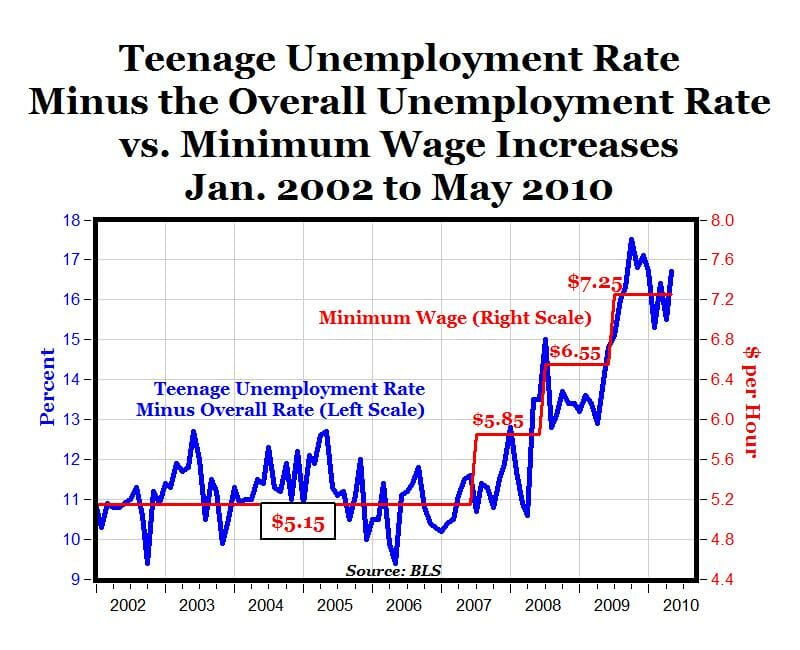
In the US, here's a plot of the correspondence between the teenage unemployment rate and recent large minimum wage rate hikes:
Quote: "Each 10% increase in the minimum wage [since 2007] was accompanied by a decrease in employment of 1.2% for Hispanic males, 2.5% for white males and 6.5% for black males. When looking at hours worked, we saw a similar effect: Each 10% increase in the minimum wage reduced hours worked by 1.7% for Hispanic males, 3% for white males and 6.6% for black males.
The data clearly show a disproportionate loss of hours and employment for black young adults. Let's put these lost opportunities into context. Between 2007 and 2010, employment for 16- to 24-year-old black males fell by approximately 34,300 as a result of the recession; over the same time period, approximately 26,400 lost their jobs as a result of increases in the minimum wage across the 50 states and at the federal level." (source: http://mjperry.blogspot.com/2011/07/second-recession-from-mi... )
It's more complicated than that: on the issues that are most controversial in the USA, it's true that other countries have what looks like a consensus by comparison. But other countries have their own issues that make Republicans look positively enlightened: see, for instance, many European countries' right-wing edge of opinion on immigration and diversity.
Sure, conservatives get bad in the States--see the attempt to block building a mosque in Tennessee by a bunch of drooling rednecks--but look at things comparatively. In Switzerland, they banned building mosques anywhere in the country. In France, they (successfully?) tried to regulate what clothing Muslim women can wear in public. And even those countries are relatively enlightened for Europe: try being an immigrant in Greece or gay in Russia.
The difference is that in Europe, the entire spectrum is much more visible because they come in separate parties.
And yes, you'll find lots of nutjobs, but overall, across Europe, for the most part those nutjobs are now marginalised one or two parties to the right of the mainstream right wing parties, whereas in the US the centre of gravity in terms of votes fall far closer to them.
(Btw. you bring up another interesting point: To most people in the Western parts of Europe, parts of Russia might be geographically Europe, but we don't tend to include it when talking about Europe; the same often goes for countries like Ukraine - I know I didn't even consider either of them when using the term Europe earlier)
Definitely, but a prevailing view amongst many HNers is that the world is the United States[1], so it was more about challenging that assumption than anything else.
>When The Economist opines on new ideas and policies, it does so on the basis of their merits, not of who supports or opposes them. Last October, for example, it outlined a programme of reforms to combat inequality.
Most people believe that they make judgments based on merits, but that does not make it so. Even avoiding ad hominem arguments provides no guarantee of objectivity. For example: this idea that inequality is a problem is completely normative, and the ability of policymakers to solve it from the top down is unproven, and still uncertain. In addition, making US presidential endorsements (democratic for the last 3 elections) does not help them look like an impartial spectator in the political game.
The proposals which "The Economist" proposes do not always align with any specific political or interest group, but they are almost universally (monetarily or fiscally) activist.
Who can guarantee objectivity? No one. That doesn't mean it is not possible to pursue it or even gain a good measure of it. Do you really believe it makes the Economist look partisan to support Democrats since 2004? What about before that?
From 1996 - 2012 it was Dole, Bush, Kerry, Obama, Obama.
Isn't it possible to support certain ideals no matter which party they come from? The fact that their proposals do not always align with specific interest groups supports a claim of impartiality.
I agree with you that it is difficult, and perhaps impossible to measure or achieve objectivity, but that is what they claim to have already done.
In addition, it is somewhat absurd to pretend that a magazine takes a position, when it is really the editorial board that makes all the decisions. If one wants to examine any potential biases, one should examine the record of each editor or columnist, not the entire 100+ year history of a collection of their works.
I also agree with you that they may not have any source-based bias, but their claims are much broader:
>The Economist has no permanent address on the left-right scale.
The Economist's endorsement of Obama in 2012 was pretty narrow. I think they switched twice over the course of the summer, and the final endorsement basically amounted to "we don't like Obama's policies, but we distrust Romney".
I rather liked their "True Progressivism" issue last year.
Although I don't always agree with the Economist's position, e.g. right to bear arms, it's always refreshing to read a media that is not pigeon holed into the traditional left / right that we today are accustomed to. Liberal in values, conservative in its economic views, while not being to the extreme of today's libertarians. Total win imo ;)
Definitely pro-gun control to the point they promote the total-ban of guns. On the other hand, and I think this illustrates a type of pragmatism, they were skeptical of proposed reforms post-Sandy Hook.
The Economist paints itself as classically liberal, but this is something of a farce. They criticized Mises, sometimes called the last knight of liberalism, for his liberalism. And they have been consistently pro-war for the last decade. What is classically liberal about that? Not to mention they favour all kinds of economic interventionism - boosting demand by "stimulus" for instance, is one of their go-to suggestions for an economy in depression. Classical liberals of the 19th century would recoil in horror at the Economist's current "classical liberalism"
Mises once got angry at a meeting of the Mont Pelerin Society and called Friedman, Hayek, et al. "a bunch of socialists". It is hard to imagine him describing the editorial board of "The Economist" as 'classically liberal'.
I got the anecdote from the documentary "Commanding Heights: the Battle for the World Economy", where Friedman himself relates the story. Below is a link to the video clip.[1] There is also a Reason interview transcript where the same story is retold by Friedman.[2] In addition, it is mentioned on Mises' Wikipedia page.[3]
I always admire The Economist's willingness to have political ideals, be explicit and unapologetic about them and to be pragmatic about them. It's an attitude that should be standard in the media.
Oh yeah. Not only is journalistic objectivity utterly nonexistent but the pretense thereof is angering and ultimately damaging to the quality and value of media.
I always wondered if that was because the British media are full of students of English, while the US is stuck with students of journalism (eg https://en.wikipedia.org/wiki/Journalistic_objectivity). The latter seems to correlate with a delusion of grandeur.
I disagree, whereas it is well-known that sections of the media has a bias which colours it's coverage, it is never explicitly declared and it also tends towards the dogmatic. I would be interested to see an example where this isn't the case.
I cancelled my Economist subscription recently due to finding myself frustrated with their political bias. It seems they often assert controversial opinions as accepted truth. I would much prefer that any statements of policy preference were backed up by references, data, or at least given with a nod to opposing viewpoints. Although, that would probably make publishing on a weekly schedule more difficult.
Echoing what they said in the linked article, it doesn't fit into a left/right paradigm, so "direction" might not be the right word. Instead I'd elaborate: editors there have opinions about political matters, and they frame their own political opinions as fact.
IMO, most people hold the described political view of being leftie in social and rightie in economic questions. To me the biggest challenge/question is how we can escape the current "local optimum" we are in in which you have to effectively choose between social and economic values (at least in the US).
It seems highly unlikely that we will see the emergence of a third party, so I wonder when either the Democrats or Republicans realize the potential of being a true centralist majority party. I tend to think that Democrats are better positioned, but thought that in the 2012 Elections, the Republicans had a great shot with Huntsman.
> IMO, most people hold the described political view of being leftie in social and rightie in economic questions.
I think that, to the extent the economic half of that is true, its only on the very high level, where almost everyone holds what is generally held out as the economically conservative view of "government should expend resources only on those things which are essential government functions".
What distinguishes people rather radically is what they see as essential functions of government.
> To me the biggest challenge/question is how we can escape the current "local optimum" we are in in which you have to effectively choose between social and economic values (at least in the US).
Its not really all that difficult: having an electoral system that produces more proportional representation results in more than two viable parties and more than one main axis of political variation. This is well demonstrated among developed democracies.
> so I wonder when either the Democrats or Republicans realize the potential of being a true centralist majority party.
There is no advantage to that if you have actual policy preferences that are not centralist.
And there's a big disadvantage to it if political views tend to be bimodally distributed rather than normally distributed.
That's not necessarily true. Proportional representation often has the undesirable side effect of dramatically increasing the power of small minority parties. The reason is that in order to gain majority control of the government larger parties often have to make significant concessions to a smaller minority party to get the votes. Also, you can end up with a lot of gridlock if no coalition can reach majority.
Two party systems have it's flaws, but what we are seeing now is more typical of a proportional system. Due to overly effective gerrymandering, the Republican hold on many congressional districts is so secure that the only real threat to those seats is from party extremists. Under our normal two party system with less polarized districts, extremist politicians couldn't win in general elections, but now that so many Republican districts are so secure, the party has essentially been captured by extremists (it's not a stretch to call the Tea Party a third party). In the past, the two party system worked by consensus, the more moderate members of each party would work together to carve out solutions to a problem, and keep in mind, the more moderate party members were typically from contested districts, so they needed to demonstrate leadership and good results to get re-elected. The end result was that the party that demonstrated the best leadership would get re-elected.
The Republican 'take no prisoners' strategy can probably be traced back to Gingrich. We are now seeing a culmination of that strategy, and I think most would agree that it has backfired. If I was in the business of making bold predictions, I think I would bet that the Republican party might get replaced by a new, more moderate party in the next 20 years. More realistically, they are going to shift back to the middle. Two party systems won't work otherwise, and our government isn't really designed to allow multiple parties.
> Proportional representation often has the undesirable side effect of dramatically increasing the power of small minority parties. The reason is that in order to gain majority control of the government larger parties often have to make significant concessions to a smaller minority party to get the votes.
To the extent that's an effect of PR, its mostly an effect of PR in a parliamentary system, where one needs a stable majority in the main house of the national legislature to establish a government administration.
If you keep the structure of the US government but change the electoral system for the Congress to one which produces more proportional responses, you don't have the same degree of incentive for disproportionate concessions to a minor party to form an administration.
> Two party systems have it's flaws, but what we are seeing now is more typical of a proportional system.
Er, no, dysfunction caused by extremism in the activist base which has disproportionate influence over one or both of the major parties is pretty typical of a two-party system, not a proportional system, as in a system which structurally can support more competitive parties, such extremism will more quickly drive moderates into other (existing or new) parties, and is thereby limited.
> Due to overly effective gerrymandering, the Republican hold on many congressional districts is so secure that the only real threat to those seats is from party extremists.
That's not due to "overly effective gerrymandering" (the fact that Republicans have substantially greater share of House seats than their vote share may be, but there is pretty much no way to divide up single-member, FPTP districts in the US that isn't going to result in lots of safe seats for both parties -- heck, a lot of Senate seats are similarly safe seats, and they can't be gerrymandered.)
And, in any case, gerrymandering itself is a high-stakes operation that can seriously effect representation only in single-member, FPTP districts, so insofar as the current problem is a result of gerrymandering, it is a direct result of the structure of the electoral system.
> Under our normal two party system with less polarized districts, extremist politicians couldn't win in general elections, but now that so many Republican districts are so secure, the party has essentially been captured by extremists (it's not a stretch to call the Tea Party a third party).
If you look at the history of the US, a national two-party system with extremely polarized districts and often a large number of states each effectively dominated by a single one of the two major parties is the norm, not an exceptional state. Your idea of "our normal two party system" is unconnected to reality.
And, yes, its a stretch to call the Tea Party a third party; since shortly after it became visible on the national stage its support has usually been about equal to that of the Republican Party (sometimes a bit more, and sometimes a bit less) and, more to the point, almost entirely overlapped with that of the Republican Party. The Tea Party is just a new branding for the activist base of the Republican Party.
> In the past, the two party system worked by consensus, the more moderate members of each party would work together to carve out solutions to a problem, and keep in mind, the more moderate party members were typically from contested districts, so they needed to demonstrate leadership and good results to get re-elected.
In the past, the two major parties largely represented different regional interests, but represent the same kind of elites, to the extent that their platforms differed it was more driven by difference in the interests of the capitalist class is different regions rather than ideological differences; this started to break down in the New Deal era in a major ideological realignment of the parties, which wasn't really complete until Clinton's first term. The main drivers for this were probably the labor movement and the reaction against it and the development of mass media which facilitated the development of national ideological communities.
> The Republican 'take no prisoners' strategy can probably be traced back to Gingrich.
Sure, the 1994 Contract with America was a watershed moment of the solidiying ideological alignment of America's two parties.
> We are now seeing a culmination of that strategy, and I think most would agree that it has backfired.
That's what people said after Gingrich did the same thing and "failed". The thing is, it hasn't really failed -- that is, done any worse than not doing it -- either for the interests it served, or for the people who executed it who, even if they lose elected office, will end up in well-paid sinecures in the network of corporate, media, and propaganda/think-tank operations that support the ideological Right. Which is why the "defeats" suffered by Gingrich isn't seen as a defeat -- its only a defeat from a perspective which keeps score by political offices held, not substantive influence exercised.
> If I was in the business of making bold predictions, I think I would bet that the Republican party might get replaced by a new, more moderate party in the next 20 years. More realistically, they are going to shift back to the middle.
Sure, what I'd say that's the most likely case: what we are seeing right now is an extended rear-guard action by a faction that maintains disproportionate influence on government despite its shrinking support; if it doesn't turn around support for its ideology, its either going to be replaced as the dominant faction of a major party, have the major party it is the dominant faction of replaced, or establish a non-democratic regime, and the latter seems like the least likely alternative by far.
But the kind of extended rear-guard action it is fighting is only possible because it this faction is both the activist and funding base of a major party in a two-party system. In a proportional system, it wouldn't be possible.
I was making some very large generalizations in my original comment for the sake of brevity and argument. Thank you for taking the time to pick them apart;)
> If you keep the structure of the US government but change the electoral system for the Congress to one which produces more proportional responses, you don't have the same degree of incentive for disproportionate concessions to a minor party to form an administration.
My original point was that the Tea Party has essentially shown that a more proportional system of government isn't any more functional or effective than a two party system. The Tea Party has essentially captured the Republican Party, not too dissimilar to how a minority party would make out-sized concessions of a coalition government in a parliamentary system. Both cases result in gridlock (or something that closely resembles it).
As I said, the question is how you escape the "local optimum" given that you are in it. Clearly neither parties have any interest in changing up the current electoral system.
Most election rules in the US are set by states, many states (including the largest) have a citizen initiative process. Support by incumbent politicians is not necessary for reform that provides proportional representation with candidate-centered elections (e.g., STV rather than something like party-list-proportional) at the state level, which can provide the basis for creating pressure for the necessary federal reforms (e.g., modifying the federal statutory prohibition on multimember congressional districts -- created to stop the practice of states using multimember winner-take-all districts to avoid minority representation -- to allow multimember districts using methods that produce proportional results like STV) to at least allow states the option of providing better methods of electing federal representatives.
You might think that most people hold that view and I would guess that a lot of the people I socialize with would agree but the majority of Americans don't. That's why people like Jon Huntsman didn't win the Republican primary in 2012, Chris Dodd got almost no votes in 2008, and plenty of other candidates have fallen into the same trap (Chris Kelly, for instance, lost badly in the 2010 California Democratic Primary for Attorney General). If Americans really didn't agree with either party, you'd see them winning but the only real insurgent challenge is coming from the Tea Party on the far right.
That's why people like Jon Huntsman didn't win the Republican primary in 2012,
Well part of that is that primaries are mostly voted on by the extremists within the parties. The majority of republicans may well have supported Huntsman, but since most of them don't vote in the primary we never got a chance to find out.
When you consider that roughly 40% of eligible voters didn't vote at all in the latest presidential election -- more than either major party were able to muster -- it seems reasonable to say that the electorate isn't pleased with the current situation but isn't empowered enough to do anything about it.
While I can't say I'm right, I don't neccessarily think that "John Huntsman did not win the 2012 primaries" -> "Most people hold that view"
I.e. primaries are very different from elections, you have to have a different support system/funding/incumbent endorsement etc. to succeed in these different situations
I life in Finland, and we have a well working multi-party system. But we have no notable parties in the "Libertarian" corner of the Nolan chart [1]. Every now and then someone tries, but they never manage to secure over 5% of votes, get maybe 1 or 3 representatives in the parliament, but soon disappear again.
I believe the scene is similar in a lot of European countries.
In the US, the opposite is true. The average American is somewhat to the right of the median Senator on social issues and somewhat to her left on economic issues. A lot of people like to identify as "fiscal conservatives", but that generally boils down to "the government should spend money on good things and not on bad things".
When you have two sides, there is a 'left' and a 'right'; one can capture the middle, but it will still occupy its side. Unless either party significantly expands (25%-75%), or a large third party captures one far end of the spectrum, neither Democratic or Republican can legitimately claim to occupy the center.
That isn't a historical certainty. Even leaving the social axis aside and sticking strictly to economics, the American party system only started to fit a left/right model during FDR's presidency. Progressive Republicans started to split from the party in the '20s and eventually found themselves a home in the New Deal coalition. The big change of the post-Carter epoch is that the socially conservative, economically liberal "Reagan Democrats" have almost entirely disappeared off the map, resulting in both parties becoming more separate on social issues.
I think it's safe to say that a modern representative democracy (assuming a capitalist, industrialized society) will generally have a right faction and a left faction in national politics. What makes things complicated is when you throw in regionalism, nationalism, militarism, ethnic issues, moral issues, and any other matter of controversy that doesn't always split the same way as left/right economic positions.
Almost a year ago to the day, The Economist ran a leader ([1], also cited at the bottom of the OP) that described itself as "radical centerist", blatantly "stealing" ideas from both right and left. The surprisingly poor article posted here not only fails to clarify or improve this position, but actually muddies the waters of discourse, because it fails to spell out what it means when it uses terms like "left-wing" and "conservative". These definitions are particular and subtle, and it is worth explaining what The Economist actually means in this article. This is especially true given the international audience of the paper (and HN), where these terms sometimes appear to mean contradictory things.
I won't pretend to be a master political theoretician, so corrections are welcome, but at a high level here is what is going on.
In most of political theory, the spectrum breaks down roughly into two huge types of political party (and yes this is a massive generalization):
* those on the right wing, which are typically fiscally liberal and socially conservative, that is, they believe that companies should behave as they like, but people need to be told how to behave even in their private lives, and
* those on the left wing, which are mainly socially liberal, that is, they believe that the government should tax and regulate more heavily, but that people should be able to do what they like privately.
Across the globe what it means to be "a liberal" is different. In the US, the "liberal" signifier refers to the fact that the person believes that the government should not regulate personal decisions like gay marriage. In France, it is the opposite: the "liberal" signifer refers to the fact that they like less regulation on the markets.
The Economist, simply put, is liberal in the sense that it tends to favor less regulation on both these fronts: it favors legalization of drugs and gay marriage, but also less regulation for markets.
There are of course exceptions (it favors gun regulation for example), but this is basically the position that it has come to call "radical centerism". The magazine is often called libertarian, but only conveniently so -- the gun control exception in particular casts this supposition into doubt, and rather than accept this branding, the editorial staff has evidently decided to pick this new title.
This is probably the right move. For all its flaws, this is something that the article did get right.
> In most of political theory, the spectrum breaks down roughly into two…
As a Ph.D. candidate in a top tier political science program, let me just stop you here and assure you that whatever follows is almost certainly categorically incorrect. Political theory is so wildly diverse that one strains to appreciate the relevance of large chunks of it, but it, without a doubt, does not generally/roughly/approximately break down into the positions of the U.S.'s two major parties.
> I won't pretend to be a master political theoretician, but…
This is kinda like when someone starts a sentence, "I don't want to be an asshole, but…" or "I'm not a racist, but…" or "I don't want to interrupt, but…".
Thanks for the spirited reply, Perceval, but I don't see a place where you justify a disagreement with the substance of my position. What I do see is you bragging about your acceptance to a nice school. Not to belabor the obvious, but lording your supposed superiority over opponents is not a good way to conduct a discussion.
Maybe the first part is going in the direction of a productive discussion -- are you complaining that the split between "right wing" and "left wing" is so general as to lose all salience to the discussion at hand? I assume that can't be your position, because that's pretty obviously wrong.
> lording your supposed superiority over opponents is not a good way to conduct a discussion.
It wasn't really an invitation to discussion.
> the split between "right wing" and "left wing" is so general as to lose all salience
No, the left–right split is just fine for talking about U.S. politics. It becomes more problematic when you begin to include other countries whose political divisions split along different issues.
But it becomes almost totally useless if you try to shoehorn "most of political theory" into two categories based on only two criteria (social, fiscal) that, gosh, just happen to match up with the two present day U.S. political parties.
I don't want to be an asshole, but…instead of prancing around like you actually know something why not correct what you think is "certainly categorically incorrect".
There's no quick fix for this level of misapprehension. You would just have to start at the beginning, Political Theory 101, bust out your copy of Plato's Republic and read your way back to the present.
You've added nothing to this discussion and look like a dick to boot.
Moreover - I usually find that people who know something well should be able to summarize/explain it to laymen. Those who resort to 'Oh, you are so wrong, it would take years of study for you to begin to appreciate how complicated an issue this is' do not.
No, it would take about one semester to begin to understand why two parties representing two branches of the liberal tradition within political theory cannot represent "most of political theory." Just like it would take about a semester of intro level computer science to understand that "most of programming" cannot be reduced to the differences between Obj-C and Java along two criteria (e.g. typing discipline and messages/methods). Anyone who claimed such a thing would be wildly, objectively, prima facie wrong about the history/diversity/breadth of programming—certainly not the top post.
> In most of political theory, the spectrum breaks down roughly into two huge types of political party
I've never, in the course of getting a degree in Political Science and studying it independently thereafter, run into this "theory" anywhere but on libertarian (and usually, specifically, Libertarian Party) propaganda leaflets and sites.
It certainly does not represent "most of political theory" when it comes to "types of political party".
Most traditional cultures have in place laws meant for social control but rarely have centralized mechanisms for economic control. As political opinions drift, it's common for part of the population to stick to what they perceive as traditional values and part to push for something they perceive as better. Movements that catch on tend to be egalitarian. I think this sufficiently encapsulates the monarchist vs revolutionary position that the Economist uses.
Any egalitarian revolutionary pushing for social change will have to address economic advantages that have built up over time, so they tend not to have a laissez-faire attitude toward business. The mechanisms they propose to adjust wealth and power inequalities vary. Even people pushing for less centralized control of the economy fall into this category. Government subsidized monopolies are not free market competition, no matter how much some multinational corporate advertising agencies might push the concept.
Hmm, this piqued my curiosity a bit. The confidence with which you said it made me wonder if I'd been misusing the term "fiscal conservative" all these years, but after some (extremely brief) research I think I was right all along: Fiscal conservatives seek to reduce taxes and regulation[0]. But that would reduce your entire comment to basically "right wing" == "conservative" && "left wing" == "liberal". Am I missing something? (Very honest question--I'd love to learn something here.)
EDIT: Err, it seems the Wikipedia article I cited is more focused around the idea of reducing government expenditures rather than necessarily reducing taxation or regulation, although it does seem to suggest that fiscal conservatives are more likely to reduce government in general (assuming a deficit isn't already present). Anyway, it doesn't seem to match up with the parent comment.
The short answer to whether that is a good phrase to be using is that it depends on where you are. Outside of the wind tunnel of American politics, "liberal" tends to mean that many liberties are afforded you, with the implication being that you have fewer regulations and rules. But in America, liberalism is not merely a factual description of how encumbered $SOME_ENTITY is, it's also seen as an ideology that stands in opposition to conservatism. So it's a bit overloaded. If you're living in America, you probably haven't been using it wrong, per se.
That said, I have no degree in political science. So, WTF do I know. Here is your grain of salt. You're probably right though that I should not use "fiscally conservative" as the opposite of "fiscally liberal", because they are not really opposites.
I'm not sure you're on the right (ha!) track here: saying the right wing want to tell people how to behave goes against pretty much everything I know about politics: right wing people want to ban abortion sure, but they also want to allow people to own guns, not have to pay for health care (in the US, a country I'm not from), not pay taxes etc,
There is only one simple explanation of "left" and "right" that I've ever really liked (even though it's only partial), which is this: the right want equal opportunity, the left want equal outcomes. That is to say, the right believe that everyone should be taxed the same (equal opportunity), whereas the left want rich people to be taxed more and poor people to be taxed less, since taxes affect the poor more / the rich can take more taxes before it hurts them (equal outcome).
Regardless, as Perceval says below, it's kind of hard / impossible to boil these concepts down to something simple or even sided, since we're talking about people, and people don't usually fit into into nice clean boxes.
To say that the right want equal opportunity is dead wrong. Anyone who wants to do away with estate tax clearly has no care for equal opportunity. As I have said before, I would be a libertarian 100% if we could have a 100% estate tax and devote 100% of the proceeds to education. A true meritocracy (or as close as I think we could get). IMHO Conservatives would be against this because it would allow their kids to fail, and liberals would be against it because it would allow accountability for the the people coming from nothing.
So I'm not American, and so have no idea what you're talking about. Estate tax seems to be something to do with taxing wills? Regardless, doing away with any kind of tax would be equal opportunity, because it's being gotten rid of for everyone. When I say equal opportunity I mean: "presume that everyone is exactly like me: how should I behave?". E.g., "Just because someone is poor doesn't mean they should be taxed less than me (or me more than them), we should be taxed the same".
hackula1 means this: If one child is born to the family of a billionaire, and another child is born to a poor unwed teen mother, then in what meaningful way can it be said that those two children have "equal opportunity"? Even if the billionare's child is a lazy fuckup, he/she still stands to inherit hundreds of millions of dollars and so will never have to want for anything. Even if the teenager's child works hard, without access to nurturing child care, education, books, etc., the odds are stacked against that child leading a happy and successful life, much less becoming a millionaire.
The only way to make it truly be the case that those two children succeed or fail in life due to their own qualities and choices -- "equal opportunity" -- would be to take the billionaire's money and spend it equally on nurturing and educating the two children. (In the US, the "estate tax" is a tax on inheritance, that is, it's our society deciding how good or bad it is if a child can inherit all or some of a parent's fortune.)
> The Economist, simply put, is liberal in the sense that it tends to favor less regulation on both these fronts: it favors legalization of drugs and gay marriage, but also less regulation for markets.
I think it's more of an aversion to fiat currency, than an obsession with the gold standard. The jury is still out on that one, we haven't even broken the century mark on that.
The Economist has held its editorial stance for over a century. Your language thus suggests that the print magazine was on its last stand even in the late 19th century.
Not to argue about its target audience, but the Economist is a multi platform publication at this point. Not only that but and audio version also comes default with the IOS app (i listen to it everyday on way to work).
Honestly, I'm a little confused about this article. It's probably one of a few fun little fluff pieces commemorating the anniversary.
I don't even read it much and I've always understood, and think most readers understand, that The Economist has a somewhat undogmatic mixed left/right stance endorsing both liberals and the occasional Neo Fascist, at once backing universal healthcare (which they acknowledge in this article) and destructive warfare (which they do not).
I think while it likes to present itself to be above the fray it actually has an editorial policy to favour and endorse candidates according to a proximity model:
1. sort politicians by perceived direction of views - PV, 0 being the most right, 100 the most left.
2. Their preferred PV* is something like 45.
3. Proximity to that number is favoured, not the actual positions.
This of course is pretty easy to do and that may be the reason why editors are anonymous. You can pay relatively little to make endorsements using an algorithm.
This is of course a horrible way to choose a candidate or a policy, but does it really matter? The readers seem to like it.
I really hate when people shove others into right or left categories - that's as dumb as it gets. Like it's impossible to have different opinions on different things, or what?
>We like free enterprise and tend to favour deregulation and privatisation. But we also like gay marriage, want to legalise drugs and disapprove of monarchy.
Most party-based political systems seem to stabilize in the form two parties. Which ideas these parties support is often pretty random and is often not self-consistent.
the best summation of the Economist's editorial viewpoint is that it's aimed at rich businessmen, & consequently combines tacit support for economic inequality w/ choice morsels of liberalism - viz. healthcare & gun control - in order to differentiate itself from "unsophisticated" paleoconservatives
I think it's a bit cynical to read it that way: there's good reason to be anti-inequality but also skeptical of naive wealth redistribution as the solution to it.
What we are left with is the European social-democratic welfare state, which seems to work well enough if you have a base of natural resources to work from. I notice the Economiat generally isn't too critical of most European tax rates (a typical cry of rich businessmen) but rather is critical of countries that have widespread and systematic structural barriers to economic freedom - the UK, pre-Thatcher, and modern France, for example.
France represents a fun eternal potshot game: they keep claiming doom yet France keeps chugging along with its massive civil service, huge employment regs, and longest vacations on Earth...
"naive wealth redistribution" seems to be a bit of a strawman to me. re: European tax rates, perhaps it would be more accurate to describe the Economist as supporting the current economic status quo. besides, while Europe does have a much stronger safety net, it's almost as unequal as the US - it's not like the well-off are any less hegemonic there.
So you have a point that the status quo isn't actually all that great except in the one country that The Economist always yells at.... France and Belgium. Though the Scandinavian countries also seem to do well (lots of natural resources help).
This is one of those cases where the inadequacy of trying to describe our politics on a simple, single left-vs-right axis shines through so starkly. If we used a two-axis system, where one axis is economic and the other social, The Economist would (mostly) fall in the socially-liberal, economically-conservative quadrant.
"We like free enterprise and tend to favour deregulation and privatisation. But we also like gay marriage, want to legalise drugs and disapprove of monarchy. So is the newspaper right-wing or left-wing?"
Eh what? All those stances are almost text book libertarian... so how could anyone be in doubt.