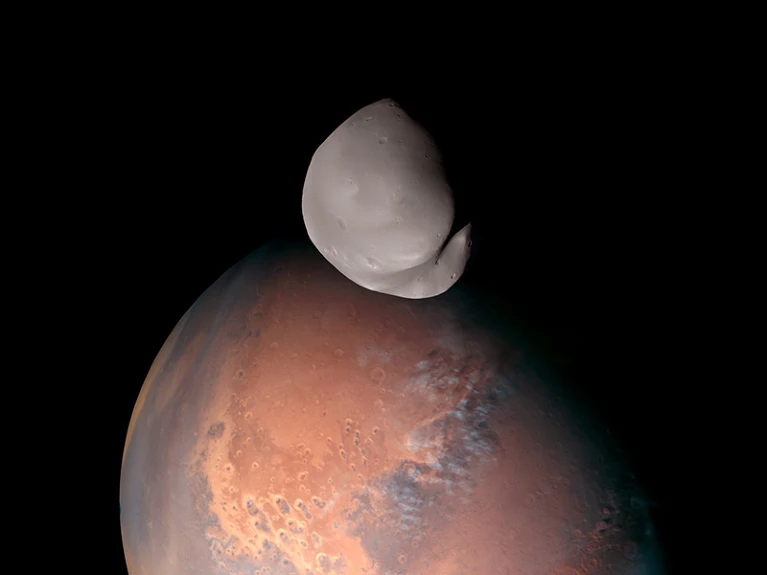
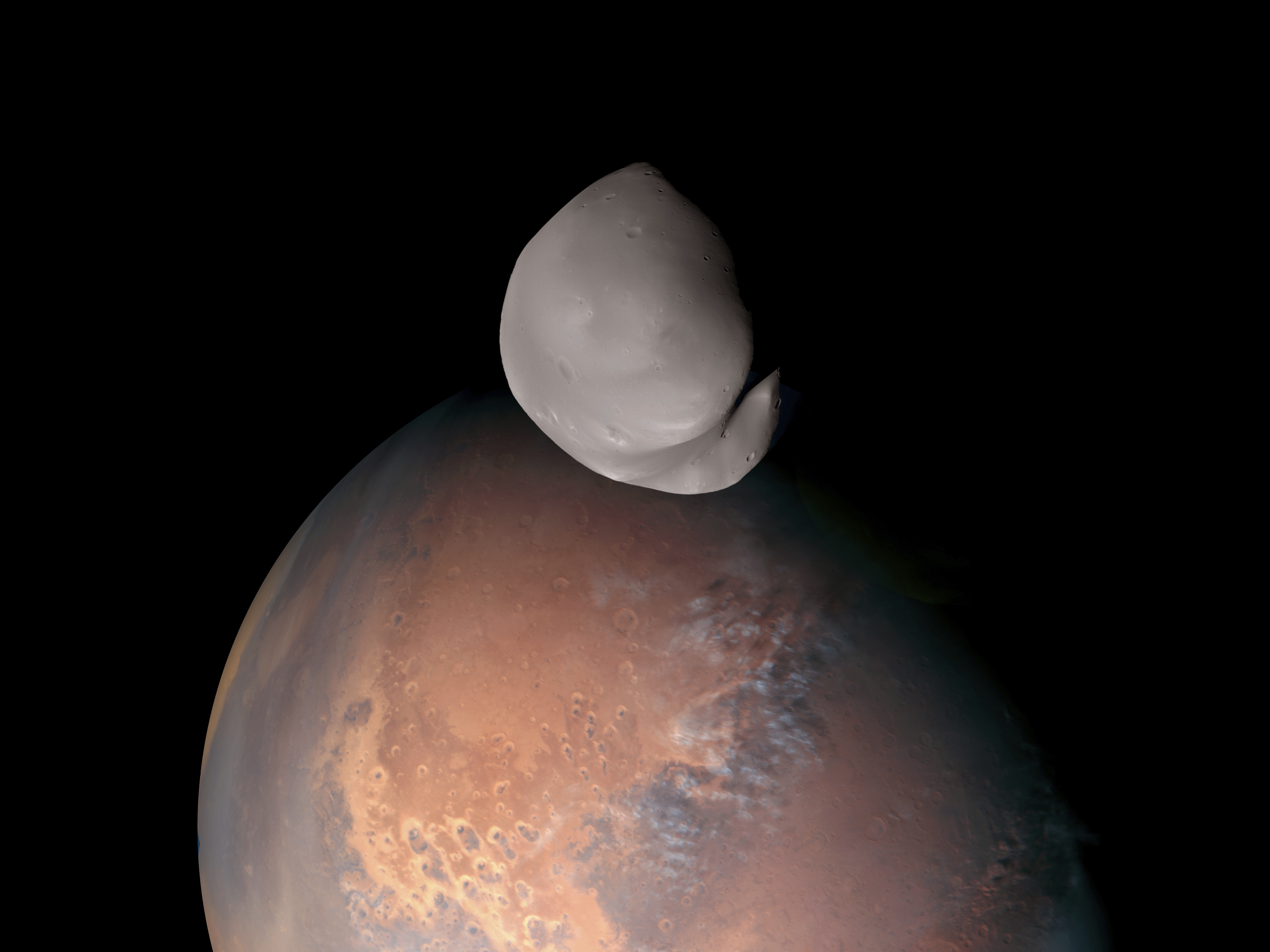
It's sort of amusing to see Deimos described as "little-known". I grew up playing Doom, so I learned about Mars's moons Phobos and Deimos way earlier than I did any of the other, better known moons in the solar system.
You got some strangely heated responses to this, but I just wanted to say I share your boat. Its nice to see real pics as an adult now of it all. Also, my trip to Phobos and Deimos was, you could say, hellish. 11/10, would rip and tear again.
I think the first I heard of it was in another game, Ambrosia Software's top-down scroller Deimos Rising, which came bundled with my Pixar lamp iMac back in the early 2000s.
The soundtrack to that game really stuck with me, as it was installed on the eMacs in our classroom so we played it during indoor recess. Since the addons page is long gone, I threw the soundtrack up on the internet archive.[1] Ben Spees, who did the Soundtrack went on to found the math rock band Mercury Tree.[2]
I mostly remember Ambrosia for the Escape Velocity series though, especially Nova.
According to the boardgame High Frontier, Deimos contains a lot of water, and yet the Deimos Down card in Terraforming Mars does not place an ocean tile. So which is it? Why are different boardgames so inconsistent about Deimos?
"little-known" as an adjective, in American English, is used exclusively when talking about people's awareness of the existence of a thing. With the title's phrasing, it literally does refer to people knowing the name or not.
A fun Deimos fact is that there exist stable prograde orbits around it, while there are no such orbits around its bigger brother Phobos. Because Phobos orbits closer to Mars, its gravitational sphere of influence is smaller than its physical size.
A nice paper on the different ways of orbiting the Martian moons and their trade-offs:
If we're sharing fun facts: apparently it takes the same amount of delta-V to travel to the surface of Deimos as it does to the surface of the Moon. Because of the Moon's much larger gravity.
There have been people playing with the possibility of using it as a refuelling station, because it's thought to contain a lot of water.
You can land on Phobos just fine, and unlike on Deimos there's no danger of accidentally jumping off into space (Phobos escape velocity is about 41 km/h). All the 'sphere of influence' stuff means is that orbits are too perturbed by unevenness in the Martian gravitational field and can't stay stable.
Deimos is much smaller, but because it's further from Mars there is a region right above the surface (below 700 meters or so) where you could have stable prograde orbits.
Since both have gravitational acceleration below one thousandth of a g, I guess that counts as microgravity? Visiting those would be very interesting as an experience of gravity. I wonder if it would even be properly perceived as gravity, you'd have trouble orienting yourself and standing "up".
It's a good question. There's been very little data on partial gravity, but what there is shows that a pronounced physical sense of "down" and "up" doesn't kick in until about 1/5g [1]. That said, a horizon and big rock underfoot are powerful visual cues, and it's anyone's guess what it would feel like to walk on a small celestial body like that. There's one good way to find out!
> "a gravitational field of about 0.15 g is necessary to provide effective orientation information"
That's slightly less than lunar gravity (0.165 g). But, it's about the minimum amount needed to be able to use gravity to detect orientation, and is not necessarily enough to detect it reliably. That's thought to be one reason astronauts fell so often on the moon, although there were certainly other factors as well.
The paper also observes:
> Benson [30] showed that 0.22 g was not adequate to provide a vertical reference during experiments in the International Microgravity Laboratory (IML-1) on board Spacelab and Clément et al. [31] showed that in microgravity, 0.5 g provided by a centrifuge was enough to produce a perceived tilt of 90°. These values suggest that indeed it is likely to be the case that even after adaptation to a microgravity environment, forces in excess of 0.15–0.3 g are required to provide a behaviourally useful gravitational reference.
To answer your question, since vision is an important part of our orientation mechanism (also analyzed in the linked paper), it's likely that astronauts on the moon would have more difficulty with their eyes closed. Not necessarily that they'd have no sense of up at all, but that it wouldn't necessarily be accurate, so if they tried to walk with their eyes closed, they'd be much more likely to fall.
It's possible. There seems to be a lot of individual variability around this threshold, although as usual the problem is a severe lack of data on the effects of partial gravity on anything.
Alan Shephard and Ed Mitchell reported that the 7 degree tilt of their lunar module interfered with their sleep, which suggests it was noticeable. But it would be hard to point to something in their cabin arrangements that didn't interfere with sleep.
One unfortunate downside of tech limitations in the show The Expanse is that there's no good way to do low-g. Part of the first season is set on belter dwarf planets where the gravity would've been under 5% G.
They do show the coriolis effects on Eros(https://expanse.fandom.com/wiki/Coriolis_Effect).
But yes, for the most part we should see more awkward movement at such low g. Both Eros and Ceres are at 0.3g
Oh I didn't even realize they spun the asteroids for gravity. I'd assumed they were relying on the natural gravity, which would have no Coriolis but would also mean only 0.03G on Ceres and even less on Eros.
In the books especially, they talk about going "up" into the cheaper, lower-gravity areas, or "down" to the docks, where outsiders and tourists were more likely to be. The books also have more to say about cladding around Ceres and Eros so that they wouldn't fly apart when spun, and Tycho Station's part in engineering that.
I just wanted to ask about that: if they spun them for gravity, wouldn't they fly apart? Because you'd have a meaningful amount of gravity pulling the rocky surface away from the asteroid.
But even cladding the surface to keep it together, you're talking about many tons and tons of rock you suddenly need to keep together. At that point, why not make a space habitat completely separate from the asteroid? It seems silly to put your base on the gravity of an asteroid and then try to undo the gravity of that asteroid.
As long as a chunk of rock is in one piece (rather than a pile of rubble) it's not going to get pulled apart by a modest amount of gravity. Look at any cliff overhang (or the underside of any boulder) for proof. So the trick is just to pick an asteroid that is not a rubble pile.
Look at cliff erosion. Look at moons and asteroids being pulled apart just by differences in gravity between its different sides. I strongly doubt any asteroid of meaningful size is going to be strong enough to withstand meaningful rotational gravity.
If it were close enough that Mars pulling you away from Phobos was strong than Phobos pulling you towards it, Phobos also couldn't hold itself together - it would crumble into a ring.
I remember sitting on my front deck with my telescope watching Mars for a couple hours. The local atmosphere settled and the planetary features and colors were amazing. After a while I kept noticing a speck appearing and disappearing off the edge of Mars. After an hour it had definitely moved substantially. I ran in and checked my observatory software and it was Deimos !! Imagine that, a 7.7 mile diameter object seen visually from 43 million miles away.
Somewhere I read (was it Clarke?, Asimov? ... who knows) that you could pitch a baseball on the surface of Deimos, wait some number of hours (minutes?) and it would have orbited and returned from the opposite direction, you could then hit the ball with a bat and some time later catch it on the re-orbit and declare yourself out.
Escape velocity is just around 5 m/2 so don't pitch it too fast or it won't come back! Even a Little League pitcher should be able to throw a ball at 20 m/s or so.
If you can jump around 128cm high on earth (measured at your center of mass), you can accelerate yourself to more than 5m/s upwards.
Most healthy adults should be able to do that, especially with a running start. It's about as much as you need to do to get a passing grade in PE at age 16 in most places. Also in this hypothetical you don't have to fight much gravity while accelerating - only inertia.
Probably difficult to do it as a high jump, but a person on a bike hitting a small ramp could do it no problem, assuming you could even find enough traction to get going fast enough in such light gravity.
EDIT: To summarize a big page, Demimos is relatively close to Low Earth Orbit in delta-v terms so it makes a convenient place to top up fuel tanks with volatiles extracted from the carbonaceous before heading further outwards. Maybe.
I figured it was called a moonlet because it didn’t have enough innate gravity to form a sphere shape. The pictures from the article have it looking quite bumpy.
This is interesting. From what I understand Russia has launched multiple probes to the Martian moons and they all have failed. Amazingly, they still are planning at some point in the near future to launch the same Soviet-era designed probe again.
This is a real credit to the UAE scientists and engineers. Getting to Mars and being able to do something useful has historically been a very tough problem.
It's escape velocity is about 5.5 m/s, you might be able to sprint fast enough to float away from it. I suspect walking on it would be an exercise in tedium as you took a step and waited while you floated back down to the surface.
Falling a distance of 1 metre would take 25 seconds, and for a step 10cm high it would take 8 seconds.
If you exerted the same force to lift your body upwards as you'd need on earth to rise by 5cm, as in going on tip-toe, you'd jump about 1.5 metres. It would take you well over a minute to land again.
I used to have this dream where I was not quite flying, but if I jumped horizontally and then picked my feet up, it took a very long time to fall back down. That would be, for me, literally "living the dream".
> I suspect walking on it would be an exercise in tedium as you took a step and waited while you floated back down to the surface.
With a surface gravity of 0.003 m/s, even slight twitches by an astronaut would be enough to launch off the surface.
The flip side of that is a sample-return mission (as with OSIRIS-REx) could work with a similar mechanism and manuvering. Though obviously more delta-V is required to get into and get out of Mars orbit.
Any mission visiting would be in danger of perturbing the moon's orbit by shooting off from it, to go home, maybe? I wonder how space agencies would think about that.
I don't think that's a concern. The DART mission was able to alter the orbit of Dimorphos, but that asteroid is only 160 meters in diameter, much smaller than Deimos at 12.4km (mean diameter, it is oblong).
Mass wise, we're talking about Deimos at 1.5x10^15 kg, vs Dimorphos at 5x10^9 kg.
I would expect astronauts landing on Deimos would wear some sort of jet pack that could push them back to the surface in case they accidentally float a bit too far away from it.
Phobos is already on a doomed orbit, at only 10,000km above the surface it is very low and slightly decaying all the time. Eventually Phobos will be ripped apart by tidal forces in Mars’ atmosphere and (at least partially) crash into the planet.
"eventually" the sun will expand and make the rest of mars valuable beachfront property again.
Time to start selling real estate there. Get in before the ground floor, imagine the profits! All the cool pipples are doing it, you wouldn't want to miss out.
In the boardgame Terraforming Mars, you can do that with Deimos. In the game, it would increase the temperature of Mars by a couple of degrees and destroy some of an opponent's plants.
I mean so's Mars. I'm not sure what the incentive to land on Deimos and deal with the microgravity is, vs just landing on the planet itself where you at least have some atmosphere.
One fun thing about Deimos is that apparently it takes the same amount of delta-V to travel to the surface of Deimos as it does to the surface of the Moon. Because of the Moon's much larger gravity.
There have been people playing with the idea of using it as a refuelling station, because it's thought to contain a lot of water.