I grew used to not pressing these during the pandemic, so for a while after this change I often stood there for ages before remembering I now have to push the button. Thankfully I've adjusted now.
The comment about the crossing times being too short is spot on, often they are too short for me as a healthy young person. Trying to cross when you can't move as quickly must be a total nightmare.
Sydney has a few crossings where instead of particular directions being open to pedestrians, the whole crossing goes green for pedestrians and red for cars. This seems more efficient to me, and safer since cars aren't moving at all when you cross - often you have to share the space with cars turning left when you cross. I wish we had more of these.
In regards to ped/car conflict, it would be nice to at least have red, yellow, green instead of red, flashing red, green. I often get irate cars gesturing as if I were crossing on a red when actually they glanced at the flashing red. That just means don't start walking, it is the yellow of ped lights and it lasts a while.
The flashing red usually starts pretty soon after the green, you usually can't cross entirely on a green. It doesn't mean the person was slow or jumped the light.
Some other nitpicks:
As a car, you have to wait until everyone is finished crossing. You can't just sneak through the middle, or cut just behind someone.
Unrelated to lights but tangential, you have to give way to all existing traffic when entering a road. That means if you take a turn, and someone is crossing the road ahead of you, you have to wait. They couldn't know you were about to barell around the corner, and they are under no obligation to hurry out of your way. No stress, you will be gone in seconds.
Here in Stockholm they got rid of the flashing green man on large intersections (in other words, where the change was most dangerous for pedestrians).
Because cars can always turn through a crossing, this causes near misses and mayhem all the time, but I find generally that a lot of people don’t notice or just accept the car-dominance as a natural thing.
When the kids were small we taught them about these dangerous intersections calling them “surprise-red-man” crossings (sounds better in Swedish).
I’ve never been able to work out the logic of why the flashing green man should disappear on exactly those roads where they’re most needed.
>Because cars can always turn through a crossing, this causes near misses and mayhem all the time, but I find generally that a lot of people don’t notice or just accept the car-dominance as a natural thing.
A big strong person weighs 100kg and is made of soft meat and can deliver close to 1hp at peak performance. A car is made of steel, weighs twenty times as much and has 200 of those horse powers constantly. That's why.
This is also why car drivers respect trucks on the road.
Don't mess with things that can trample you is basic human instinct.
If I had to guess, they probably don't want red/yellow/green for pedestrian walkways because it might confuse drivers into thinking that light is for them. I do think an alternative would probably be preferable, I'm just not sure what it would look like.
Some intersections in the US have a countdown timer letting pedestrians and drivers know how soon until the light changes. It seems to help but I'm sure someone who doesn't regularly walk around town has no idea how long it actually takes to cross any given road.
I always like those as a driver. With a green it lets me know how stale the green is. And with a red it lets me know how long I have before I need to be ready for the green (e.g., do I have enough time for a sip of water while waiting?)
Timers are very common in Asia. But the countdown timers for Green to Yellow could be dangerous as most people seeing the timer about to be zero from far and speeds up instead of slowing down. Recently many of the traffic signals in my city have removed countdown timers for Green to Yellow and has kept timer only for Red to Green change.
Long-duration timers are also incompatible with fully traffic-actuated signals and/or public transport priority, because both of those mean that the actual phase sequence that's going to happen can be determined only a few seconds (if even that) in advance. Those kinds of timers you mention in Asia on the other hand require that the phase sequence get fixed at least one signal cycle in advance (i.e. on the order of one or multiple minutes), which is much too long for full traffic actuation and/or public transport priority.
Heh, in California (er maybe just San Francisco, can't remember), as of a few years ago, the orange countdown (or just a flashing orange hand) means "go ahead if you think you can make it across safely before the light changes".
And two weeks from now (also in California), legally, you can do whatever the hell you want, even cross on a solid orange hand (or even cross where there is no crosswalk), as long as you do it safely.
I'm sure there's some sort of logic to how these are set up, but I've seen many that have long "countdown" phases even for a very short crossing. It's relatively rare to see a pedestrian light that will stay white for more than a couple seconds. Realistically pedestrians are making a judgment call on whether the seconds remaining seem like enough to let them cross, rather than obeying the flashing-red indication to not start crossing.
"I'm sure there's some sort of logic to how these are set up"
Yeah I think the logic is:
1. Maximize car throughput.
2. A pedestrian is entitled to cross only if they were waiting when the light changed to 'walk', and not if they arrived when other pedestrians were already walking.
No, they are correct, it means "don't start crossing." Not everyone can run, eg, people in wheelchairs or people who need walkers, or able bodied people carrying lots of groceries. Running as a pedestrian is very dangerous. It creates confusion for drivers, it makes you more difficult to see, and it makes it more difficult for you to see if you're running in front of a moving car.
That's not universally correct. A few years ago, in San Francisco (I don't think it was California-wide, but maybe I'm misremembering), the law was changed so that it's legal to even start crossing on a flashing orange, as long as you are safely able to get out of the intersection before the light changes.
(And as of Jan 1 of next year, jaywalking will no longer be an offense in California, so you can cross whenever and wherever you want, as long as it's not dangerous to do so.)
in europe generally jaywalking is only allowed if there is no marked crossing nearby. crossing at a red light is not jaywalking but a different offence that is still punished.
yep, it's like that in the UK as well. No such concept as jaywalking at all, you can cross right next to a marked crossing when its red if you must. Works on social trust and works well
You are right to feel that way, and I think it helps to picture what life was like when the term showed up. These days we take it as almost an immutable fact that cars are on roads, and people are wherever else they can fit. But back then (1910s) streets in city centers were still commonly unsealed dirt roads. While cars were starting to get popular, they still moved at walking pace, and people using roads were still a mix of adults and kids just walking about, bikes, horse drawn buggies or carts. Looking back at photographs from the time you notice that the roads are just full of foot traffic, they weren't crossing the road, the road was how they got around.
But cars were getting faster and more dangerous, and it was no longer compatible to have mixed traffic. Rather than ban cars from cities, we convinced people that actually, it was the car's road afterall and you shouldn't have been there!
During that time the term jay walking came about, and it was used to paint the pedestrians as the one's getting in the way of the automobile driver, rather than it being the automobile that was out of place. If we use a very cynical lens, and I think we should, it was a essentially a marketing campaign from automobile makers.
The term "jaywalking" itself is of US origin. Most of the rest of the English-speaking world doesn't have any offence by that name. While they do tend to have certain traffic regulations prohibiting pedestrians from crossing a road in an unsafe manner, those regulations are generally narrower in scope than many "jaywalking" laws in the US are.
Yeah as someone from the UK the idea of crossing the road being a crime is mind-blowing, getting around would be intolerable as a pedestrian sticking to crossings.
Indeed, as a pedestrian I have just as much right to be in the road (either crossing, or just walking along it) as I would have were I to hop on a bicycle, and more rights than if I was driving a car[1]. Motorways are the exception, where you're not allowed on or beside the road unless you're in a suitable powered vehicle or there's some kind of emergency.
There are various markings that suggest that you probably shouldn't cross, but they aren't enforceable. Cars also have priority in many cases, but priority isn't an excuse for crashing into someone.
[1]: My right to drive a car is limited: I need a license, insurance, and permission from the owner. If I'm driving or riding a bicycle, I need to obey signage -- no jumping red lights, no going the wrong way down one way roads. If I'm walking, I'm perfectly at liberty to walk through a red light if I want to.
On the other hand until very recently, the rules for turning vehicles were less in favour of pedestrians in the UK – drivers were only required to give way for pedestrians that had already started crossing (whereas in Germany the corresponding rule also includes pedestrians that are only *about to cross), and every time I was on holiday in the UK, I found the difference to be indeed noticeable, with drivers executing turns noticeable more "aggressive".
Relatively recently, that rule was changed in the UK, though how fast that affects actual driving behaviour remains to be seen. Meanwhile in Germany though crossing against as a pedestrian still remains illegal – the only mitigating circumstance is that unlike for vehicular infractions, the fine for pedestrians hasn't been increased and for now remains a nominal 5 € (10 € with endangerment).
Unless I am actually out for a run, I don't run to cross intersections but blinking hand means "cross with a sense of urgency" to me if I'm not yet crossing but I saw it start blinking and have an idea that it isn't a handful of seconds from changing.
"Sydney has a few crossings where instead of particular directions being open to pedestrians, the whole crossing goes green for pedestrians and red for cars. This seems more efficient to me, and safer since cars aren't moving at all when you cross - often you have to share the space with cars turning left when you cross. I wish we had more of these."
---
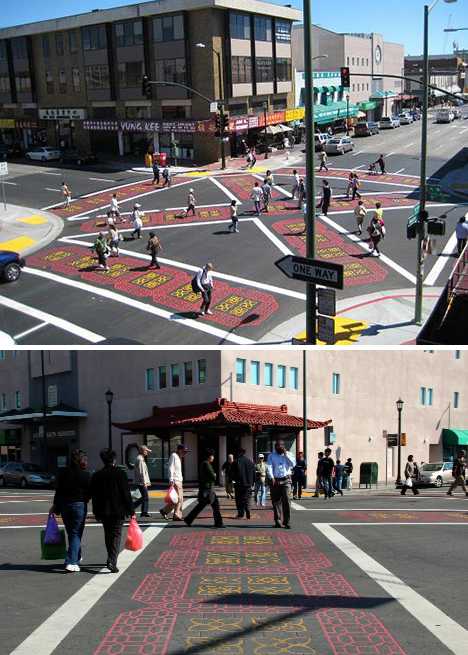
These are called "pedestrian scrambles", and I like them a lot more too. I do know there's a few in the Sydney CBD, but I don't recall them being marked particularly well that they are a scramble.
The ones in Oakland (picture below) are very well demarcated, and a study found them to reduce vehicle-pedestrian conflict though did increase the amount of people crossing parallel to traffic when the signals indicated "don't walk".
One of the side effect issues of scrambles is to obtain the same throughput of cars you have to may have to increase the delay in between pedestrian cycles. When only allowing pedestrians on some axis you can allow cars to run in parallel.
One argument I saw somewhere (I can't remember where) is that if there are enough people to make a scramble worthwhile (and you don't care about car throughput) - you probably shouldn't have any cars there at all!
If there are enough for a scramble, then there are probably enough to build a pedestrian layer _above_ the car layer entirely. Isolating large vehicles from fragile human beings is the best engineering solution.
> there are probably enough to build a pedestrian layer _above_ the car layer entirely. Isolating large vehicles from fragile human beings is the best engineering
As far as I can tell, the general consensus among urban planners is that building pedestrian overpasses/Skyways/skywalks is a _really bad idea_.
They suck pedestrian life away from the ground plane and surrender it to cars, which has all sorts of second order effects.
The ground level becomes darker, and more dangerous with less "eyes on the street". Car focused transport planners are more bold to increase traffic volume (with increases in pollution/crashes/noise). Businesses on the street struggle.
> Isolating large vehicles from fragile human beings is the best engineering solution.
It may be the best _engineering_ solution (don't get me wrong, I love some Brutalism and textured concrete), but it's usually a horrible outcome for street life. The best solution for a healthy, livable street is to build large spaces for pedestrians and cyclists, reduce car speeds to 30kph/20mph, or remove cars altogether.
Hongkong has a lot of raised pedestrian infra in the central business district. It is difficult for people with "reduced mobility" (disabled, old, baby cars, etc.) to navigate. As a second order effect, it has turned street level into somewhat of a Mad Max zone where cars drive as fast as possible knowing there are no pedestrians to worry about.
Related: Hongkong also uses (awful) metal gates to keep pedestrians caged into sidewalks. Again: It makes drivers more aggressive. When I visited Shanghai, a lot of sidewalks blended into the street which had an interesting effect: Drivers were much more cautious because people frequently flowed into streets.
Last comment about lower car speeds: I recently drove on Japan (100% grade separated) expressways in Tokyo, Kawasaki, and Yokohama. At first, it seemed so damn slow. Mostly 80 km/h, but many places slowed to 60 km/h. Really, 60 km/h feels like crawling on an expressway! Always two lanes each direction. Very few on/off ramps. However, after driving more than an hour, I could see the effect: Traffic flowed very smoothly, even in very busy areas. I can only guess this is intentional design.
England, especially London, has removed a lot of those railings in the last decade, for exactly this reason.
(I was amazed just how similar the street level design of Hong Kong was to London when I visited. Of course, it had a century of being constructed to the same standards and regulations.)
The Las Vegas Strip makes heavy use of pedestrian overpasses, but I don't find them to have the negatives you describe. Possibly because the area is so lit up (even at night), cars are kept deliberately very separate from from pedestrians (a lot of drunk people roaming around), and in many places the above-ground overpasses connect to the second levels of adjacent buildings, which makes them a more natural part of the cityscape.
I'm not sure that kind of design can work everywhere, but it can perhaps be an option in some places.
Literally raise the 'pedestrian ground level'. I've also realized that construction cranes and other things that need to poke up through that level should do so by rotating and shipping away the cap segments that the pedestrians walk on and blocking off a work site while in use. Though they'd do that anyway for safety.
Yeah, overpasses are definitely the right choice in some places, but I'd quickly grow tired of them if I had to cross a few in a row. The USYD overpass on City Rd is a good example - a lot of people opt to use the street crossing rather than the overpass, and it's pretty easy to access compared to some (e.g. nice long ramp instead of stairs)
> If there are enough for a scramble, then there are probably enough to build a pedestrian layer _above_ the car layer entirely.
What a lovely and fair idea. Make the ones who use muscle power to climb up and down, while not even sligtly inconveniencing those who can accelerate by just changing the angle of their feet.
I wonder if people who think this is okay walk sometimes or become one with their car already.
My town in Ireland (pop 30k) has scramble phasing on intersections. Ireland really doesn't go in for mixed phases anywhere (nor conflicting phases).
We'd generally be better off with most of the traffic lights in town being replaced by humped pedestrian crossings on the legs of roundabouts, except for the two major thru roads. But for some reason, the county council has been putting in signalized intersections (with ~12-16 light poles) for small, 30kph intersections (max one lane each direction).
I agree with your comment about pedestrian volume and removing cars. Two important points are frequently overlooked. (1) Businesses need to receive deliveries by truck. (2) Disabled or elderly people need a way to access the area, usually by car. Regardless, car volume can be dramatically reduced in many of these areas.
> often you have to share the space with cars turning left when you cross.
The UK doesn't allow left through a red, so a green man means no cars will (legally) come at you.
The UK roads have lots of things that are annoying (and lots of good), but that's a good call in my book, even if it means cars at a red can't turn left even if the side-road crossing is (apparently) empty of pedestrians.
Australia doesn’t either. But there will be a green straight-ahead signal that allows a turn through a crossing, or a red arrow that extinguishes. In pedestrian heavy areas these usually happen when the pedestrian light changes from green (cross) to flashing red (complete crossing). Therefore cars can travel through the crossing while pedestrians are still crossing, but the pedestrians get a head start.
On much of the European continent, drivers with a green light wishing to turn left or right must expect to give way to pedestrians who also have a green light.
Another benefit of these is that, as a pedestrian, if you need to go diagonally across the intersection, you can just do so, without having to make two crossings.
An intersection in Honolulu near where we usually stay when we visit just recently (in October) switched to "pedestrian scramble" mode, and it's amazing. This intersection was excessively annoying, because previously one of the four possible crossings inexplicably disallowed pedestrians entirely, so if you wanted to get from "our" corner to the opposite one (where there's an often-visited ABC Store), you'd have to wait for three pedestrian light changes to get there. Honolulu is annoyingly pedestrian unfriendly (traffic light cycles are very long and favor cars), so it could previously take 4-5 minutes to make that simple crossing.
> did increase the amount of people crossing parallel to traffic when the signals indicated "don't walk".
This is a feature, not a bug. With the setup of "two 1 way streets feed into a scramble", crossing safely on a "do not walk" is trivial, with only a single direction to look for many of the most common crossings.
Saw a couple of those in Perth (WA, not Scotland) way back in the eighties, and have been gabbing excitedly about them ever since. Never seen them anywhere else, though.
I walk, I cycle, I drive cars, I drive buses and the occasional truck. From every perspective I should welcome this setup in many, many places.
scrambles are great when drivers actually obey the lights. in my experience there's always a car who is watching the cross-direction lights, and drives through the intersection as soon as it goes red.
At least in that case they're starting from a stop, so they can't be going all that fast through the intersection. And yeah I can't say I've every seen that happen.
Probably in countries with intersections where the turns lack signals. In the Netherlands most of the time you can't even tell which colour the other signals have, because they point in the direction of the oncoming traffic they are for and have a cover that blocks light leaking out beyond that.
It does happen here in Belgium, at least in Antwerp. But I have to say this is the worst place I've seen in Europe regarding traffic rules violations, and people routinely drive on red at the slightest excuse.
In general, when I visit Singapore, I feel like a second class citizen in comparison to cars. A lot of long waits at crossings, or unnecessary private cars in crowded areas. From the design of the city (and society), it looks intentional.
The public transport is so good that I never felt that way, especially since car owners have to pay obscene fees for a license to drive. But definitely it's not a good walking city. The heat doesn't help.
St Petersburg has very few crossings that have traffic light buttons. When there is a button, it usually comes with a huge bright yellow sign with an arrow pointing at it. So for me, when I visit other countries, it's sometimes very non obvious that there is a button in the first place — I'm just not used to them being a thing. So I'd stand there clueless, waiting for the light to change, only to realize a minute later that there might be a button that I have to press.
> This seems more efficient to me, and safer since cars aren't moving at all when you cross - often you have to share the space with cars turning left when you cross.
one of the features i loved moving to London: there's no "cars turning AND pedestrians crossing the street". yes, it does add a bit to congestion, but makes things more safe when walking, as well as when driving (and yes, i do both in London).
and it's still weird travelling thru places that don't have this.
The SF Bay Area has the opposite problem with crossing times. I regularly watch a person with a 3 year old, or with a walker cross the street in half the allotted time. On top of that, in some areas, all left turns are always protected, leading to 4 cycle crossing schedules (assuming no pedestrians).
4-5 minute traffic light cycles (a given light switching from red to green takes 4 minutes) are pretty common now. I think the idea is that they want to intentionally cause traffic jams to encourage people not to commute (public transit is spotty, and not improving).
You could claim that the 60 seconds per green maximizes throughput, but if you look at intersection utilization during rush hour backups (what percentage of the time is at least one car moving through the crossing?), you'll see that it's often well under 50%.
Really, they should have a "I need extra time to cross the road" button, and just time the automatic walk cycle for a fit 50 year old.
Why are we giving advantage to the form of transport requiring external power again? So we can have even more wasteful urban design incentives? Maybe we should pay people to use gas lol.
The idea that the "SF Bay Area" has a single way to design light cycle times is ridiculous. Each intersection is governed by a local city department that has its own guidelines around light placement, times, signal priority, signal synchronization, speed tables, etc. There's also added nuance around whether a particular road at the intersection is deemed a collector or an arterial. It's a fascinatingly complex topic but gesturing at the "SF Bay Area" and making a conclusion is senseless. Moreover most Bay Area cities are playing along to some level (some areas more than others) to Vision Zero plans which very much prioritize pedestrians over drivers.
As implemented, Vision Zero is just extremist NIMBY-ism. They aren't improving transit (and the bike lane "upgrades" are clearly designed for traffic quiescence, not cyclist safety).
As you say, it only prioritizes pedestrians, which basically means that the 99% of the population that doesn't live less than 5 blocks from work is screwed.
> As you say, it only prioritizes pedestrians, which basically means that the 99% of the population that doesn't live less than 5 blocks from work is screwed.
I'm sorry that you don't walk or bike much but others do. Not everyone is a highly compensated, young knowledge worker. Some folks are students, who have more time than money. Some are active people who value active commutes. Some like to walk for recreation. Older folks may need to walk for their health.
Most of these improvements are created based on community surveys. Even Fremont which is a very auto-oriented suburb, and has even called out auto-orientation in its planning documents, has run surveys that shows that there's latent demand to bike and walk if infrastructure exists. The number one reason Fremont residents cites that they don't walk or ride bikes is that they feel the streets are unsafe to bike or walk in. That you prioritize your speed over the demands of others is of no matter since you aren't the only one paying for the infrastructure.
Pedestrian crossing isn’t an exceptional case for which we should make the minimum allowance. Pedestrians are just as deserving as drivers (if not more!) of sometimes getting to go through on a green they didn’t explicitly wait for or request.
OK, does that mean we should shut down the entire intersection for 30 seconds after a 1 percentile pedestrian would be done crossing?
Should we do that for every single cycle, even when no pedestrians are present?
Many cities in this area do exactly that. I once had a 35 minute "normal route" commute that only took 15 minutes once I figured out how to do it in a third more distance, but by only making right turns at traffic lights.
> OK, does that mean we should shut down the entire intersection for 30 seconds after a 1 percentile pedestrian would be done crossing?
The problem with treating pedestrians as "1 percentile" means that you'll never increase pedestrian modeshare. Design an infrastructure for 1 percentile pedestrian usage, then the moment someone who absolutely doesn't have to walk (read: anyone who isn't homeless/poor/otherwise optionless) goes there, they'll be dissuaded. The Netherlands solves this with automatic priority signals where pedestrians and cyclists (each have their own dedicated ROW btw) get priority if they're there, but cars get automatic green lights if there aren't pedestrians or cyclists. This requires a lot more money than most US cities can afford because US cities are so auto oriented that per capita they have much more traffic infrastructure than the Netherlands.
> Many cities in this area do exactly that. I once had a 35 minute "normal route" commute that only took 15 minutes once I figured out how to do it in a third more distance, but by only making right turns at traffic lights.
Think about how a pedestrian feels. The extra light cycle times save lives and make walking a more attractive option. How many times have you been talking with a friend or partner in the car? If a pedestrian light cycle is efficiency focused, pedestrians can't have that experience when crossing (even though drivers definitely can.) What happens if you're walking your kid or your dog, and they decide to bolt the other way? The pedestrian experience should be a lot more than a bare minimum timed interval and a painted strip. In many European and Asian countries, pedestrians have dedicated signaling and priority.
Instead of constantly seeing this as a battle between your time and the pedestrian, think of other factors. Every pedestrian crossing the intersection is a person not driving, not creating congestion in the auto system, not putting wear and tear on the street you're driving on (so lower paving-oriented taxes), not emitting greenhouse gases if they're not driving electric, not releasing brake dust in the air. The built infrastructure is a balance of many goals. You are but one of many users and your time is not the highest priority since you aren't the only one paying for the infrastructure.
I think they mean that you can't design crossings for the slowest 1% of pedestrians, rather than pedestrians being 1% of road users (obviously they're a lot more than that)
The light should not be designed to be open for exactly one pedestrian crossing (of any percentile), any more than it should be designed to be open for one car crossing.
> I once had a 35 minute "normal route" commute that only took 15 minutes once I figured out how to do it in a third more distance, but by only making right turns at traffic lights.
So then there's actually no problem? It seems like it's the best of both worlds: pedestrians have extreme ease at crossings, and drivers -- with a little route planning -- can still get places quickly.
The current crossing times affect significantly more that 1% of pedestrians. I don't know what the optimal times would be for each intersection, but expecting pedestrians to sprint across so the cars can move a bit faster isn't reasonable.
My city has the scrambles and the insanely long light cycles, they were installed about 4 years ago. It has really helped to scare drivers out of city centre. Cyclists and pedestrians have also learned to avoid downtown because waiting 4 minutes for the light to change is excruciating no matter what mode of transport you're using.
I don't drive, but now I skirt around the outside of downtown when cycling because avoiding those intersections saves me ~10 minutes.
In Vancouver the light cycles are super fast, and it keeps things moving for everyone. They have the right idea, and there isn't much room for slack, you gotta be quick.
Here in Sydney most cyclists just ride on the sidewalk, despite it being illegal. How does your city keep them on the road? I do think in pedestrian heavy areas (like the city centre) the cars may just have to wait a bit longer, these areas usually have pretty good public transport links anyway.
Segregated bike lanes. I am happy cycling on most roads but sometimes it’s hairy and dark and cars are as being particularly aggressive and fast so I’ll pop on the pavement until it’s a calmer road. With cycle lanes it’s much nicer, there’s a new one between Greenwich and Tower Bridge just opened and it’s so bloody nice!
These lights aren't in city centers. They are at freeway exits, boulevards between downtown areas, etc. Downtown areas in the cities I am referring to prefer stop signs.
Pedestrians might say the same back. You underestimate how much long light cycles delay someone walking to work. A person walking downtown might easily dwell 30% at lights when the blocks are short. We're all in each other's way.
I have no opinion on this phenomenon outside SF, but in the city proper, as a pedestrian, I love it. I know that when I'm walking, I'll rarely have to wait more than 45 seconds or so at nearly any intersection. It's also great when I'm out for a run, as stop-and-go would be crappy for my fitness regimen.
I frankly don't give a damn about car traffic; cities are for people, not cars. And I say this as someone who owns a car and drives it often enough. (Again, outside the city, sure, ok, things are different, and you really need a car to get around. That itself is another city-planning failure, but that's a separate issue.)
> This is to reduce overnight noise for local residents
Presumably this means the beeping of the signal for visually impaired people. Why not just keep the automated walk signals, but only enable the beeping when the button is pressed? This is how it's done in Toronto, and there are highly readable signs at each button stating this.
Not continuously but if the crossings were on a schedule during the night then you would hear it every couple of minutes.
Following the rest of the above comments might clear it up but I'll outline the thought process
1: People think it is dumb that they turn off the schedule during the night.
2: It's because the walk signal is going to annoy people if it's going off regularly, especially at an intersection.
3: Of course the locator pings will continue because vision impaired people have to be able to find them, nobody is going to complain about this. They ping whether on schedule or during times you need to press the button.
4: the grandparent comment of mine suggested that the crossing should only make a sound if the button has been pushed.
5: the reply below that says "They beep intermittently so you can find them to press them in the first place." thinking the comment was saying that the comment was talking about the pings and not the walk sound
6: I clarified what they must have been saying including a video for them and anyone who hasn't been to Sydney and might not know what the sounds are
7: you made a snarky comment presumably without understanding any of the context.
Blind people don't necessarily need to read the signs. If they're in a city like Toronto, they already know there are cross walk signals at all major intersections, and these always have buttons, and the buttons are almost always in the same spot (especially with newer signals, where the buttons are mounted on short posts immediately beside the tactile strips, rather than on the main post holding up the overhead signals). If I recall the signs do have Braille text, but even if they didn't it wouldn't really matter, would it? Either way they'll need to push the button.
Well its a bit better than Adelaide. We were like Sydney and then the stickers disappeared and with it the "auto introduction" of the pedestrian cycle. However the times that buttons need to be pressed is a closely guarded secret. The local Council owns the roads and subcontracts traffic operations to the state "Main Roads" department. If there is a problem you ring "Main Roads" and the response is can't change anything have to refer to Council as we are subcontractors. Won't disclose programming either (Melbourne has it as Open Data) So we get such niceties as:
* Lights adjacent a shopping centre needing to be pushed after 6pm (or is it 7pm?) even though the centre doesn't close or die down in activity till 9pm
* Having to press buttons at each side of an intersection unlike the cars (e.g. for a North South movement a car arriving from either the North or the South will get a cycle, but for walking people if you arrive at the North East Corner and see someone at the South West Corner you need to press two buttons to get both sides lit, even though it doesn't affect cycle timing
* Minor roads crossing major roads that cross major roads stay green all the time for drivers, but not for walkers (but did prior to the pandemic). You need to press the button and wait 20-30 seconds or in some bad cases wait press the button to cross the major road as well to force a new cycle and then get your green after 90 seconds.
Frankly Sydney is streets ahead as it least its not a secret. But still as other commentators might point out, I've seen in suburban Tokyo to cross a major road signs saying "Between 11pm and 5am press this button to cross the road. If you are blind between 11pm and 5am press this other button to cross the road with a beeping noise".
The only reason I can think to keep it secret is they want the data from button presses to inform the cycle times, although surely there are better ways.
The person who decided it's a good idea to have a button next to a label that says "do not push this button" should get a small electric shock every time the button is hit.
I have a 30-minute walking commute to work, and changing back to non-automated buttons has added about 5 minutes to that if I'm not super lucky with timing. The worst is seeing the lights turn and knowing it would have lit up green for pedestrians only to have to wait a full cycle for the next opportunity.
You always do. The damage you can get from a simple balance loss, or worse, when falling on a car or a curb is scary. Wear your plastic hats to protect your head people!
How often do you lose you balance and what direction if I may ask? Not sure how I'm supposed to hit my head on a bike unless a car hits me. If you lose balance that often leave it at home.
Helmet is good especially for the latter reason but a bicycle goes 20kmh and if you fall you don't die, just get your knees hurt or something.
Once in a bad situation is enough for permanent brain damage. Another bike or a car making a sudden move, someone hitting you, etc. Curbs and cars provide for dangerous landing spots if you fall.
I know of two separate people who were biking as a part of their daily commute without a helmet, and woke up in the hospital with zero recollection of what happened, but multiple issues (such as one of them being unable to concentrate or remember things).
So did the two seperate people fall, or get hit by a car?
I know zero people who hurt themselves badly on a bike, but I know two that got hit by a car as pedestrians, so going with my anecdata walking is much more dangerous than biking
You don't hit your head on the bike, you hit it on the concrete or a curb. Roads can be slippery, material failure is possible. The speed of the bike isn't that much of a factor, it's the object under you preventing you from effectively mitigating the fall, or making it worse.
I fell twice recently because of slippery roads just as you're saying. Both times my head was far far away fron the floor, I only hurt my palms and knees both times.
I still don't know how you're supposed to fall head first onto a curb unless you tie your arms behind your back.
agree with some caveats. helmets are a must when cycling on roads. but parks are a bit different. also, i remember a study that said drivers are more cautious when they see a cyclist without a helmet. not sure how relevant the study was, but as a driver i can confirm this.
all this being said, summer time + helmet = lots of sweat.
True, most people in cars choose brain damage. But my campaign for car helmets has not taken off, despite the fact that more people in cars will die or be irreparably damaged for want of a helmet than people in bikes.
I wouldn’t say it’s always comparable like that. I takes me twenty minutes to walk to work, but there is a 200 m elevation difference. I don’t walk back up home and take a bus instead, which does take a bit longer, but i think walking back up would still be easier than cycling.
Some of the pedestrian route isn’t really bike accessible too, as stairs are involved, there are alternative routes of course, but some can be considerably longer.
Sydney is probably less cycling-friendly than you expect.
I don't have the source but I remember reading that the trend over the years has been removing bike lanes instead of adding.
as a road bike cyclist and a driver, i tend to cycle wherever there's a road. so i do understand that i'm a bit biased, but usually it's quite safe riding a bike in a city (due to slow traffic), especially in a place like the CBD in Sydney.
Sydney CBD is a nightmare for both pedestrians and cars. A really forward looking government/traffic agency would simply block all cars between Macquarie St and Darling Harbour with the exception of the feeders to the harbour bridge. That would dramatically increase the attractiveness of the CBD.
There's like, one of those "3 only" in my entire neighborhood in San Francisco, and I want to have a talk with whoever at the department of public works who decided this was a good idea. I'm sure they're likely dead by now and no-one has changed this from the 1960s though.
I'm inordinately irritated that this quiz is impossible to ace. I got every question right but for #6, which has an answer format that makes it impossible to answer correctly. "Sorry, trick question," it says when you put in "0 hours" as the best approximation of the correct "you can't park here at all" answer. Like, I knew that … you just … made it impossible to answer correctly? What?
This is a silly thing to be upset about, but just … why would they have done that? It's so stupid.
People used to not using the buttons during the day may not remember to use them at night. They may not even be able to see the labels at night, since (unlike any actual road sign, at least in the US) they aren't even retroreflective. This is likely to cause confusion, leading people to cross without a walk signal.
So this will disproportionately endanger people walking at night--which is already the peak time for driver-inflicted fatalities.
If they can't see the labels at night so what? They use their daytime experience of expecting it to be automatic and wait awkwardly for nothing... or they push the button and the light changes eventually.
The issue is that people won't "wait awkwardly for nothing" forever. If someone can't see the label and is used to having it change automatically, they're likely to assume that the signal just "isn't working," causing them to cross without a walk signal.
IMHO the biggest problem here is that the label doesn't meet the usual standards for road/pedestrian signage. In particular, "real" road signs are retroreflective so that you can see them easily under streetlights (or in car headlights). This is particularly important for signs that are only relevant at night. (Semipermanent signs should be made of a sufficiently durable material, which this...is not.)
But if you don't see the label the default assumption will be 'I need to press this button to cross', so they'll just press it for nothing during the day, which is hardly that bad.
Most of the world doesn't have these ridiculous buttons. A large number of people wouldn't expect to even ever having to press a button to get a pedestrian light.
Most of Australia also doesn't have these buttons as far as I'm aware.
So that's not most likely to be the default assumption at all.
1. At intersections with "leading pedestrian intervals" or "exclusive pedestrian phasing," walk signals provide unique safety benefits that reduce the risks posed by oncoming traffic.
2. This can be important: due to road geometry or other obstructions, it can be hard to see oncoming traffic from a distance, especially for the visually impaired.
3. Blind pedestrians can hear audible walk signals, but cannot see oncoming traffic at all.
4. At sufficiently complex intersections, it can be impossible for you to tell whether stopped cars are about to come towards you when a light changes.
5. Most importantly: walk signs usually tell you how soon a light will change, so that you don't start walking just before a light change.
This is why walk signals reduce car-related fatalities, particularly at night, when people are most at risk.
Most people walking past 10pm in the Sydney cbd, have had a few drinks anyway so guaranteed to cause confusion and increase j walking. Also the ambient noise detection does not work at all, I live at ground floor and can hear a nearby one and another one over 200 meters away clearly during summer night when I keep the windows open. the council turned it off completely after much complaining
I agree with this commenter and disagree with those calling it 'pearl-clutching.' If I have learned one thing in my life with regard to user interaction, it is to expect people to make mistakes and to do counter to what you would expect. This is especially important when life is on the line.
Yeah, I really don’t get it either. Extra context for anybody not from Australia - somebody basically always needed to press the beg button to cross at any intersection with signals for about as long as anybody has been alive. They temporarily changed it during COVID so you didn’t need to touch it. Now it’s going back to how it always was.
This already happened months ago in my city, I hardly even noticed.
At every hour of the day people have to wait for a walk signal. Nobody is just randomly walking into the road and trusting "the system" to stop cars for them.
So the fact that people are waiting for a signal at all times of the day isn't the issue. The issue is that, at certain times of day, after waiting, the signal is not forthcoming.
I guess it's possible you could take that first step if you are watching the orthogonal street light and attempting to preempt the pedestrian green, which never comes and instead you could be jaywalking into the path of a car that is turning.
I think if you thought through this a little further you would realise it doesn't follow.
No one is just walking into an intersection as if the 60 second timing cycle is their circadian rhythm. There are also hard to miss sounds queues that go with the pedestrian signals.
There are no shortage of city intersections worldwide where the buttons are placebo and people b manage just fine.
I wrote a blog post about Transport for NSW removing full automatic operation of the pedestrian buttons (aka "beg buttons") in the Sydney CBD, evaluating each of their stated reasons why.
You may recognise Australia's parking button sound from a sample in Billie Eilish's hit Bad Guy, I've linked a video at the end of the blog post!
In the first sentence (currently “Transport for NSW (TfNSW) has recently installed these around the Sydney CBD – a sticker on top of a pedestrian “beg button” explaining the button is redundant before 6am and after 10pm”) I think you mean it’s redundant between 6am and 10pm
Sometimes when waiting, I tap out morse code on the beg button. I hope there's a log of button presses so that a traffic engineer will one day be impressed with the length of messages I've been able to .- .-. - .. -.-. ..- .-.. .- - .
From my observation, this is how they always worked in Australia (or used to work pre-pandemic). Automatic during the day, and manual at night.
This allows less stops for cars at night. At night on high traffic roads the lights stay green until someone presses the walk button, or a car arrives at an intersection.
Your best bet is to get into the habbit of always hitting the button. If you're worried about virus transmission, then use your elbow.
Which is better for the environment, and for the sleep of residents adjacent to the road. From that perspective, it seems like madness to suggest that cars should be forced to stop and idle repeatedly during the night on the offchance that a pedestrian might be waiting to cross. A pedestrian idling for a few minutes (assuming they require the guidance of the "green man" and are unable to assess the safety of crossing themselves) has much lower impact.
I would love if self-driving car pedestrian-, and intent- detection algorithms were deployed at traffic lights to understand when there's a person wanting to cross and automatically change the lights for them.
I don't know how we can align economic incentives to make this happen though. Maybe we just need to wait for a self-driving car startup to go bust and release all their code to the public domain.
My hometown - as usual - combines the worst of both worlds and installs placebo buttons. They don't do anything, but if you think it makes you feel better while waiting for the green light you can press them.
In my city some of these buttons have no function other than blinking after you have pushed them. But it depends on the time. Early in the morning you have to push it, otherwise it will stay red forever.
So for me the sticker reads: "we are too incompetent at programming" :).
My other thought: "these don't look official, someone private has made them for a joke".
I'm not sure of the point of those stickers. We have a very similar setup on many of our CBD intersections where I live (including the exact same buttons): push to request crossing on all intersections, with Barnes Dance/Pedestrian Scramble [0] crossings having automatic crossing during the day, and we don't have any such labels. If a crossing has been requested or is automated, the crossing indicator lights (and beeper) is active, otherwise it isn't lit, so you know to press the button.
It's only enabled between certain hours, so it's already creating confusion, but those hours also happen to be the hours people are likely to be drunk, it's likely to be dark so they're more likely to be hit by a car, pedestrians are more likely to not notice the beg button, etc.
If you are gonna have the beg buttons, have them all the time, so it doesn't just end up creating more confusion.
The only reasons the buttons were removed was because of paranoia over COVID spread through surfaces. This was done hastily so they made the simplest change possible, adding the walk to every cycle.
Now they've had time to program it properly they can let trucks and heavy vehicles through more efficiently at 10pm-6am. How many pedestrians are around at these times?
More than you'd think. We're talking about the CBD and inner suburbs, there are a lot of late night venues and people often use public transport around here which involves a bit of walking. And 10pm isn't that late, particularly on a weekend.
Trucks and heavy vehicle really don't have any business in the CBD and for the few times they actually have to come in to the CBD for e.g. some construction work, I'd argue it's completely ok for them to wait longer.
In Hamburg we have these, but even worse they are touch activated with a light if you successfully activated it and some of them don’t work. No one understands the gesture needed to make it function and every time I see people randomly rubbing and smacking it to try and activate it. Worst part is that there are some major junctions that won’t go green for the pedestrian unless you press it. Easily the worst UX I’ve ever seen for a public infrastructure. You can’t even activate it unless you are at the right part of the cycle. If you try and do it when the lights have just changed back to red for the pedestrians it won’t work.
Absolutely maddening. They should never use whatever company they contracted to design those again
A solution that solves the noise problem without returning to beg buttons, is to make the intersection a flashing red at night. It becomes a 4 way stop where pedestrians have the right of way. Everyone wins.
I have worked with TfNSW SCATS ("Sydney Coordinated Adaptive Traffic System") in another city. No need for the sticker: this behavior for ped requests is typical.
I've always been confused about these. If you push the button, and it's an intersection with walk signs going both north/south and east/west, which one of those lights does the button apply to?
(I don't live in Australia, but you do occasionally see them in America.)
As well as the arrows, the buttons are just positioned intuitively most of the time. We usually get two perpendicular kerb ramps rather than a diagonal one pointing at the centre of the intersection. The button for the crossing you want is the one closest to you or facing you when you're waiting at the intended ramp.
The button gets mounted on its own post if there's not a traffic light pole in the right place to piggyback off.
In the Australian design there’s generally an arrow indicating which direction it goes. It’s embossed to for vision impaired people to be able to feel it too (it also is designed to resonate so if you touch it, you can feel the audio signals so if there are two directions, a vision impaired person knows which direction the sound is saying is safe to cross without needing to see the light signals).
I got booked for jay walking in Sydney. It was a $75 or $85 fine. And yes, I'm still feeling salty about it because it seems completely out of proportion for the severity of the offence. But then that's pretty much in line with how all the other offences are handled.
Would it really be that hard to have something to detect the presence of pedestrians near the crossing and insert pedestrian cross cycles while they're there?
On every crossing? It might not be hard but it surely would be expensive. I'd guess that there are tens of thousands of these buttons around Greater Sydney, possibly even in to the hundreds of.
Also Sydney's crossing buttons are notably reliable. They last for decades and have been adopted across many other Australian cities and, IIRC, overseas somewhere.
I thought they changed this during the pandemic to save lives by preventing the spread of Covid (because everybody touches the same button, thus causing Covid to spread).
Isn't forcing people to press this button a huge risk to catching Covid? I wonder how many people will die because of this change


The comment about the crossing times being too short is spot on, often they are too short for me as a healthy young person. Trying to cross when you can't move as quickly must be a total nightmare.
Sydney has a few crossings where instead of particular directions being open to pedestrians, the whole crossing goes green for pedestrians and red for cars. This seems more efficient to me, and safer since cars aren't moving at all when you cross - often you have to share the space with cars turning left when you cross. I wish we had more of these.