Note that the city did nothing of the kind. They adopted a resolution stating their intent to reform the zoning code by the end of next year, a non-binding and thoroughly unambitious bit of foot-dragging.
This resolution "could start a process", great. It seems like only a small part of a political battle around whether and how to add more housing in Berkeley. Particularly interesting to me is that CA Senate Bill 828 passed somewhat quietly but is going to force many cities across California to increase housing density.
eh, this isn't a good read of what happened. Zoning reform needs to go through a lot of reviews like CEQA, and there are places where people can sue to slow it down. It is happening, this is just the legal process by which it happens.
zoning reforms are subject to ceqa, at a legislative level? zoning variances on a per project basis certainly are, but reforms?
in any case, one thing to keep in mind in any housing discussion is that uncertainty in its many forms is what principally drives up development costs. ceqa is one tool deployed as a weapon to increase project uncertainty, and ultimately drive up development costs. complex permitting/regualtory regimes and overly prescriptive (vs. descriptive) building codes (and their review processes) are more sources of uncertainty, risk, and untimately cost.
yes, zoning reform and area plans are both subject to CEQA, there is a bill at the state level to allow rezoning for <10units/parcel to skip CEQA review
This is all about trying to short circuit attempts at the state level in reforming housing like SB10 and SB478. The first allows skipping of some environmental checks but the second goes after cities by limiting how floor area ratio (FAR)regulations are applied; the common tactic is to upzone a property to look like it permits denser housing but set a FAR requirement that completely blocks it.
Sadly for libertarians like me it is going to take state intervention over cities and counties to fix it. Why is that a problem, well I would prefer the cities and counties to fix it themselves as local governance should be able to do that.
However the real culprit is the entire process has been hijacked by special interest groups along all lines who want their piece of the pie or simply don't want anyone else to have a share of the pie. So through the elected officials by whom they control through contributions and media to the courts when all else fails it is very difficult to get anything actually done.
The reason why state control works better in this scenario is because of the law of numbers. It takes a lot more effort to exert control over a state than a city, town, or county. Add in the fact that voter interest and participation drops at each lower level of government, and you have a recipe for capture. School boards are probably the best example of this.
This is a big problem in NYS, where there are too many little overlapping fiefdoms with different boundaries, election schedules, etc. that your average citizen cannot be expected to keep track of and hold accountable; basically government by obfuscation. Robert Moses did a lot of bad things, but he did towards the end of his career call for things to be consolidated at a level no lower than county level.
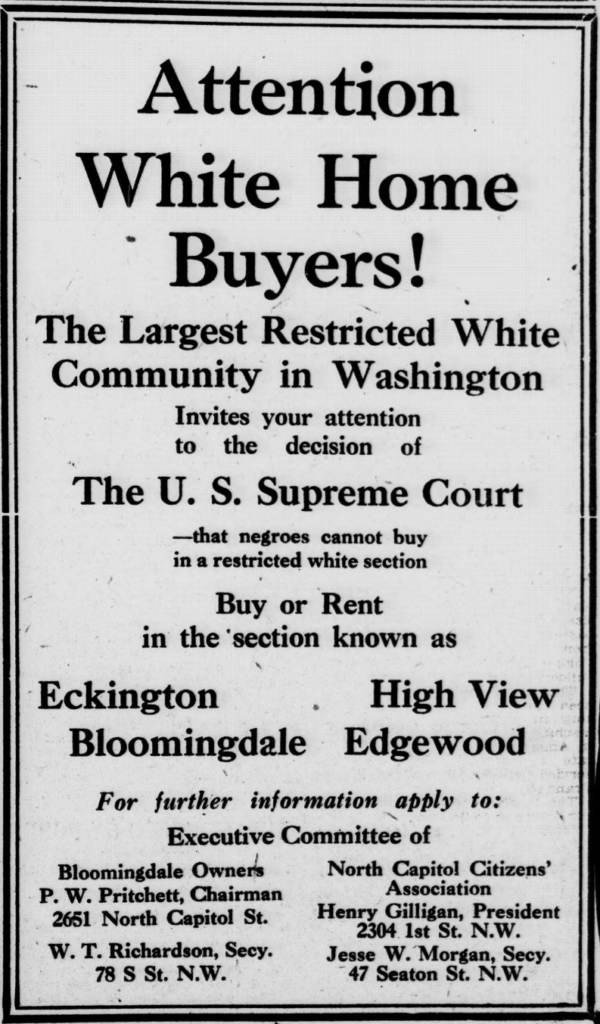
What the article didn't originally mention is that Berkeley was the first city in the country to adopt single family zoning 100 years ago, in response to the large migration of African Americans to the West Coast.
Other cities of the country, seeing the opportunity to enforce segregation through zoning, followed suit, and today we live in the consequences.
Density advocates can only hope that 100 years later the counter trend also spreads as successfully.
EDIT: updated comment to reflect updated article content.
Berkley must have been pattern-matching on Atlanta, and wanted to keep black people out of white neighborhoods. That's the explicit goal of "R-1" zoning.
The original title of the zoning districts are often conveniently left out of modern discussions. In 1922, it was:
- R1 white residence district
- R2 colored residence district
- R3 undetermined race district
There's this "1922 Atlanta Zone Plan" (authored in part by the mayor of Atlanta) that outlined the R1/R2/R3 zoning paradigm that we all live with today.
Quoting from the piece[0]:
> The residence districts are further subdivided into three race districts:
> R1 or white residence district.
> R2 or colored residence district.
> R3 or undetermined race district.
> [...]
> The above race zoning is essential in the in interest of the public peace, order and security and will promote the welfare and prosperity of both the white and colored race. Care has been taken to prevent discrimination and to provide adequate space for the expansion of the housing areas of cach race without encroaching on the areas now occupied by the other.
I wrote about the entire document (and copied it in its entirety) here[1].
I hope to someday see the entire zoning paradigm (residential, commercial, industrial) struck down, for the same reasons that redlining is illegal and widely understood to be immoral.
I have done a lot of architecture... mostly technical archtectuere (data centers, dense corp HQs (goog, FB, Salesforce, Brocade, etc...) and a shit ton of medical (SF General, El Camino, Sequoia, Nome, and many others)
And I have worked in a few foreign cities (Singapore, Hong Kong, etc)
To me; Singapore is the most amazing city. But here is my takeaway from all of that WRT zoning:
There should be no commercial property or residential high-rise that does not have the following:
Every building should incorporate underground parking, and no residential building should have tenants on the ground floor and at ground level, there should be commercial space (bakeries, shops, etc.) But every building project should include parking and commercial space.
Zoning should be much more both maleable and specific at the same time.
It doesnt make sense off the cuff, but the thing is that zoning should be PER PROPERTY + ENVIRONMENT + NEED + COMMUNITY - REGULATION - NIMBYism
> There should be no commercial property or residential high-rise that does not have the following:
> Every building should incorporate underground parking, and no residential building should have tenants on the ground floor and at ground level, there should be commercial space (bakeries, shops, etc.)
I agree with that, but this ...
> But every building project should include parking.
Mandatory parking minimums are a big problem - especially in dense areas with good transit access. They drive up the cost of building significantly [1].
In mixed single/multi family neighborhoods, parking minimums make it difficult for homeowners to add ADUs and other structures that can help achieve higher density via incremental up-zoning.
We should be solving our transit problems by building better transit systems, not by building more housing for cars.
Yes, but this is still only one of about 10 other factors that prevent the region or city from having enough housing, or affordable housing (and I don't mean in the public government-run housing sense).
Maybe Berkeley should also try to address the other unending issues that they keep up to prevent any meaningful change, if they really mean it:
-- Endless and convoluted environmental + city approvals processes that corrupt any transparent application for development and favor those who have money to navigate it
-- Picking and choosing special interest / special case neighborhoods or people to try to protect, to the detriment of everyone else wanting to live there
-- Rent control
-- The extremely backwards property tax policies that favor existing landowners over anyone new, young, poor (though this admittedly is California's problem, not just one city or county) and make everything else attempted bandaids -- and misguided bandaids, at that -- to fix the system.
What is most unfair about prop 13 is that the lower tax rate can be transferred to your descendants. It's one thing to pay 10x the taxes of your neighbors, it's another thing altogether to have a class of people benefiting from lower taxes over generations!
Also, I know there are probably better ways to finance a city, but that's how we currently do it. It should be done fairly, ideally we should meet in the middle. It's fundamentally unfair that some folks pay up to 10x or more than others. I'm speaking personally, but it really bothers me that my neighbors are actually OK with this.
Also, there are lots of ways to ensure elderly/retired folks can stay in their homes. Taxes can be deferred.
> What is most unfair about prop 13 is that the lower tax rate can be transferred to your descendants
That’s mostly gone now with Prop 19. It used to be that children could inherit apartment buildings, multiple houses, commercial buildings, with no new tax assessment. Now, children can only inherit a parent’s primary residence without a new tax assessment. Even then, they can only avoid a tax increase up to the first $1m in value and only if the children live in the property. If they keep it as a rental, they lose the benefit.
The change should result in more properties being sold after inheritance, which will increase market supply and lower prices.
The very wealthy will avoid the tax increase by holding property in corporate entities and passing the stock to their children. Moderately wealthy people (e.g., working professionals who also own small properties) will be affected the most because they often don't do the same kind of estate planning that the very wealthy do.
Prop 13 needs to be reformed because taxes need to be fair. Taxes can be deferred for those who cannot afford to pay the full tax so they don't have to move. The benefit should be restricted to a primary residence, no vacation, investment, or commercial properties. Deferred taxes can be paid when the owner sells the house if there is enough equity. At some points victims of prop 13 will out number those that benefit from it. One can only hope people will wake up and do the right thing.
Taxes are fair under Prop 13. What's fair about making people pay more tax just because the market value of their house has increased? They will pay taxes on those gains (over a certain limit) when they sell.
> What's fair about making people pay more tax just because the market value of their house has increased?
If you believe that, then why ratchet them up just because the property is sold? If you're going to detach property taxes from the value of the property, then do it for new homeowners too.
If we are scaling property taxes with the property's value, we might as well do it for everyone and not treat people special just because they were living there longer. Other costs people deal with scale at least by local cost of living. Groceries, electricity, water service, etc. all increase year after year. Do we let people pay 1960s costs for everything else just because they happened to move to the area in 1960?
Prop 13 as it currently stands, is a wealth transfer from young, new homeowners to elderly, established homeowners.
> If you believe that, then why ratchet them up just because the property is sold?
An argument here is that it's about budgeting and predictability.
If I choose to buy a $1M property today, I need to consider and budget for the $10K+/yr in taxes on it because I know full well that's what I'll have to pay. If that doesn't work for me, I don't have to buy it.
But someone who bought a $50K property and responsibly budgeted for the $500 in taxes on it will be severely punished through no fault of their own if that $500 becomes $10K.
They did not "make a leveraged bet". They bought a home to live in and watch their child grow in it.
Not everyone looks at real estate as a investment vehicle to maximize profits. It's just a home. It's not healthy for society to view homes merely as if they were shares of stock to be traded for maximum value. If you want to make leveraged bets, better to play the options market.
Find a city and neighborhood you like and are interested in setting roots there for the long haul. Find a house that you love that can be a forever home for your preferences.
Don't think of it as an investment to flip. Think of it as home. After the purchase, no need to ever look at the property value estimates again. Just live it.
Somehow you left out the whole part about actually buying the house.
Maybe your feel good spiel would make sense if price-to-rent ratios weren't the highest but that's not the case. Most of what you pay for here is a bet that values will go up. If it weren't for stupid laws like Prop 13 that only help land speculation this wouldn't be the case.
It doesn't even need to be someone who moved to the area who's grandfathered in to the cheap taxes: Families can share ownership of a property and retain it forever.
Property values go up over time. I initially paid $8k a year and now its $14K, which is actually about right for the market. I am protected from wild increases so that I don't have to move my kids out of a neighborhood and school they've grown up in.
I agree that scaling property taxes with their values is bad. Not sure why government expenses magically double when housing value do.
Look into land value tax. The goal of property tax is not just to fund collective expenses, but also to encourage the most valuable use of the land for the collective benefit (eg. let's not waste valuable inner Bay Area land on single family homes, but instead with more dense uses like four plexes).
Yes but there are places in the world where the house you buy when you're 30 isn't the one with your deathbed.
Ideally living people will move out and make room for the next generation when they no longer have use for 4 bedrooms in a good school district close to jobs.
Great. So to get that rolling, split roll obviously was a great first step, that unfortunately failed. But we should try again.
Beyond split roll, do you have ideas to 1) protect people that would be harmed by an immediate rollback of 13 and 2) build the political coalition to get it done?
1) these people hit a huge jackpot I don't care to "protect" them at all. We already have the CA tax postponment program for low income seniors anyway.
2) no. As long as California is a direct democracy the law will stay. Even Prop 15 failed so any chance of reform through the existing process is doomed. Justice Stevens echos this point here: https://www.law.cornell.edu/supct/html/90-1912.ZD.html I suppose that maybe with billions of lobbying and ad spend we could Prop 22 a repeal through but even then I doubt it.
The only way I see it happening is if the courts strike it down as unconstitutional. Equal protection is applied stronger on issues of race and Nordlinger v Hahn didn't address that. We now can see real data that Prop 13 systemically hurts minorities and I believe another challenge is warranted.
Edit: actually should have talked about "disparate impact" instead in that last part.
How is it fair that two houses built side by side in the same year with the same floorplan might have one pay literally 10x the property tax than the other, merely because it changed hands? What's worse, the 10x house actually realized those capital gains, so the state also got that cash.
Theoretically the house that changed hands, the new owners knew what they were signing up for and could verify their budget could handle the higher taxes. Whereas the original owners, whose home value has shot up significantly since purchase way back when, may not be able to pay for the new higher taxes if they were applied in full.
Simple, the people in the houses moved in at a different time. A house isn't just a thing you buy and sell. You live in the house, raise a family, become part of a community. My neighbor across the street bought her house 30 years ago. She's an artist and doesn't make much money. She is well known in the community. Should she be forced out of her house so that some rich tech worker can move in?
If want to cry unfair, then it would be better to aim at commercial real estate. That's a pure money business. Why should they get protection under prop 13? Make no sense at all.
So you feel the right solution is to give millionaires massive tax breaks and have middle class folks who can barely afford a house pick up the slack?
It is absurd and an anomaly. Let them stay, but when the reap a $1M+ profit on the house when they sell or die, they can pony up the tax, just like everyone else.
> So you feel the right solution is to give millionaires massive tax breaks and have middle class folks who can barely afford a house pick up the slack?
I did not say that so I don't mean that.
If a low/middle class person buy the house they can afford to pay and live in it, they don't become millionaires just because other people around them bought houses more expensively later. They're most likely still in the same career earning that same low/middle class income. They don't have any additional money to pay much higher property taxes, they are certainly not millionaires.
Tax them after sale, sure, if the property value is still high when they sell (it might not be).
Which is why you let people defer them, rather than just getting rid of them.
If they budgeted for a 200k house, that turned into a 2M house, they should be ecstatic when they sell it, the government takes the property taxes and they still get to keep more than 200k.
Don't you dare touch the holy commercial real estate that is luring in all those stupid techies who are driving up the value of my house. Oh god I hate techies, I made this neighborhood good for them, they are taking advantage of my hard work and now they dare to come here and settle down? Preposterous. Look at all the landlords kissing their asses by building expensive luxury apartments so they have a place to live in and driving up the price of housing. I bought this neighborhood without the techies and they should stay outside.
A tax on the market value of a house should go up when the market value increases.
This is double true when the value went up without any change to the structure. Structures depreciate, and become less valuable over time. When property values go up in California, it's almost entire land value that goes up. The value increase isn't from the labor of the land owner, it's just simple rentierism.
Land gets more valuable because of what one can access close to it: jobs, relationships, people, universities. All this value is socially created. This sort of wealth hoarding is hugely damaging to the economy, and all sorts of thinkers revered by people in the US have nothing but the worst possible words for it, from Adam Smith to Thomas Paine.
It is quite strange for the wealthiest members of a community to depend upon the less wealthy to fund a community, but that's what Prop 13 is all about. This situation, where the wealthy could buy their way out of taxation, is a lot of what led to the French Revolution.
You're right. Early adopters bought their way out of taxation, house appreciation made them wealthy. It's not that you start out wealthy, you get wealthy in the process and once you are wealthy you don't get taxed more. That's the effect he was describing.
I wouldn't phrase it that way because it's not what they did, even if decades down the road it turned out that way (it could well have gone the other way like it did for homeowners in Detroit years ago).
What they did was buy a home they could afford, based on monthly mortgage + taxes payments, which is the entirely reasonable and responsible thing to do.
Having the property tax balloon out of control and out of any conceivable affordable range due to actions of other people in the area, is hardly fair.
> It's one thing to pay 10x the taxes of your neighbors, it's another thing altogether to have a class of people benefiting from lower taxes over generations!
And, surprise surprise, that class is white people.
Makes sense given that minorities were at large disadvantages to buy property in the past so mostly whites have been able to take advantage on the low tax rates. I'm surprised this isn't getting challenged in court. Nordlinger v Hahn didn't consider race.
> The extremely backwards property tax policies that favor existing landowners over anyone new, young, poor (though this admittedly is California's problem, not just one city or county) and make everything else attempted bandaids -- and misguided bandaids, at that -- to fix the system.
It's bizarre how much Prop 13 appeals to folks, even those who don't benefit from it. When you explain it to people, their initial reaction is to express worry about the millionaires who own the houses that have quintupled in value, as though they are in need of protection.
I hope someone eventually finds the right sales pitch to get rid of it: the policy distorts not only price but liquidity.
> It's bizarre how much Prop 13 appeals to folks, even those who don't benefit from it.
It should appeals to anyone who buys a house at any age.
Without Prop 13, home owners tax rates rise just because nearby businesses are successful, which is absurdly regressive.
Prop 13 appeals to and benefits people who don’t own real-estate yet, because it means that when they can do so, they know that their costs will be predictable, and they won’t be forced out of their homes by the next wave of IPOs or whatever else beyond their control (such as government money printing) pushes prices up.
I feel that the solution to the issue you raise is to reform property tax in CA, not to stick with Prop 13.
Prop 13 definitely doesn't benefit people who don't own real estate because property owners have an incentive not to sell: they can keep their lower tax rate and their expensive home! This restricts supply and raises property prices.
There are a lot of reasons that property taxes have risen in California. Giving people free money that expires when they sell their home is one. Making building more housing mostly illegal is another. Economic prosperity among some people in the urban regions of California is certainly one too.
Property tax - especially on the land value rather than the improvements - is good. It can provide a feedback of the cost of what someone is using.
Funding schools based on tiny districts is of course a poor policy, and local taxes -- be it property taxes, income taxes, corporate taxes, sales tax, fees, whatever -- shouldn't be what dictates the funding of local schools. That's really a separate question.
> What you are calling ‘value’ in this case is just a measure of how much other people want the property. It has nothing whatsoever to do with cost. This just makes it easier for even richer people to take existing property rather than invest in developing other places.
Allocating resources to the people who want it most (and presumably make the most of it) seems like a good goal to have. Wouldn't that be the most effective use of resources?
That's not what single family zoning does. It keeps the value of the land a bit lower than it would be otherwise by preventing denser development. In most areas, a developer can get a lot more money out of a medium-density condo building or a tower than out of a house.
If that wasn't the case, developers wouldn't want to build denser buildings.
Consider how much would it cost to get a standalone house with a sizable yard on Manhattan?
I thought they meant homeowners by property owners rather than developers. While selling to a developer for density would benefit the initial sellers it would cannibalize the value of other houses by fulfilling demand.
It doesn't get close because of the size of the problem. If 85% of real estate is single family housing then how is a 1% increase in density supposed to solve the problem?
> but it does make the existing real estate more valuable.
No it doesn't. Existing real estate is valuable because there is a mismatch between commercial and residential real estate. By building more residential real estate you are reducing the mismatch.
That’s not typically how the relationship between building and home values works over time. Places where density increases also see increases in prices for existing homeowners.
But sure - Prop 13 and new building are separate issues.
Home owners definitely believe that proximity to multitenant housing lowers property values, and vote accordingly (whether that is actually the case is up for debate, but also less relevant to voting behavior than perception).
I don't think that having gotten lucky and bought a home somewhere when it was cheap should entitle you to enjoy living there forever when others are willing to pay more for the same home. Imagine you spent your life eating a certain kind of shellfish, which used to be cheap, but then a foreign country started importing this shellfish in huge quantities and drove the price very high. I don't think you should feel entitled to be able to buy the product for the rest of your life at the cheaper price you were used to.
People who bought may feel more entitled to a stake than renters, but in either case it's necessary to have some kind of incentive (high property tax) to drive out people who don't want to pay the market rate for living somewhere, so that available housing slots end up being given to those people who are willing to pay the most for them.
Is there any other space where taxes are so inequitable as with property in California?
Why don't they move to a more equitable tax scheme based on, say, what the district requires rather than what the home was bought for? I already know the answer, because nobody would vote for it.
It is the same in Berlin, where I live. People voted for the Mietendeckel but the only group of people that benefitted from it are the long-term renters who already have all the house they need. Among the screwed: small-time landlords, new renters and new families who need bigger apartments.
>How about people who saw the potential in a place before other people did, and contributed to its success?
Contributed to its success by following a tax policy that encourages commercial real estate at the expense of residential real estate? Are you sure those people aren't just taking the jobs that the commercial real estate is providing hostage and are now extorting people for the privilege of living near the job?
>The market signal is that people should go and invest in those places.
No, the market literally screams into your face that you should build more housing and fix the commercial vs residential mismatch.
> I don’t see why people with money should have the right to force people out of their homes.
Agreed. Opposition to prop13 essentially is a statement saying that whoever has more money because they hit it rich on an IPO deserves the right to kick out established residents just because they have more money.
> I don't think that having gotten lucky and bought a home somewhere when it was cheap should entitle you to enjoy living there forever when others are willing to pay more for the same home.
What should buying a home mean if not that? Sure, if someone else is willing to pay a lot more, they're welcome to bid on it, but it's still up to you if you want to give that up and stay put where you have roots, friends, family, kids in school, etc.
Exactly. A home is a home. It's not a share of stock to be sold to the highest bidder. The whole point of buying a home is to establish roots in one place and become part of the community and see your child grow up there.
Agreed. There is some cognitive dissonance going on between the idea of the home you bought being your property—meaning you shouldn't be affected by changes in market value unless you choose to sell it—and the requirement to pay annual property taxes merely to retain what you already own. People buy homes rather than rent precisely to avoid this sort of situation, but to the tax collector everyone looks like a renter.
> I don't think that having gotten lucky and bought a home somewhere when it was cheap should entitle you to enjoy living there forever when others are willing to pay more for the same home.
If others are willing to pay more for the same home, then they should make the current owner of the home an offer.
There is a thing of value -- a tax subsidy -- which makes the house more valuable to the current owner than the next. That's the distorting power of Prop 13, the old owner has to give up not only the house but the tax rate.
(This is somewhat ameliorated by the fact we let people take the tax subsidy with them under many circumstances now, so people can move to a different part of the state and already pay less tax.)
> Property prices in CA have risen because salaries and IPOs have enabled people to compete for property.
They have risen because nobody resists commercial development, only residential development. The reason? Commercial real estate still brings in taxes and it increases home values which also increases property taxes on homes. The insistence to only reap the benefits of commercial development without further residential development is what is causing problems in the first place.
One way would be to tie property rates for everyone to inflation. Not sure why just because housing prices double, that the government needs twice as much money.
With prop 13, the burden of paying for infrastructure and services provided to you and your neighbors falls to new generation of owners who pay 5 times in property taxes than their neighbors. This is unfair and is absurdly regressive.
Most other states regularly reassess the property of your home for taxation purposes and many have mechanisms to reduce tax liability of people living in their homes(vs renting them out) or seniors.
In california however due to prop 13, both the state and the city are forced to find different ways to pay for their costs, such as raising sales tax(which went up significantly since passing of prop 13 in 1978) or passing local bond measures to pay for schools, sewage etc.
The only people who win are those who won a lottery of being able to afford a home in CA 10/20/30 years ago.
> With prop 13, the burden of paying for infrastructure and services provided to you and your neighbors falls to new generation of owners who pay 5 times in property taxes than their neighbors.
Not as much as you seem to think. California’s nominal property tax rates are low (also due to Prop 13), so property taxes start low when you buy and get lower over time. The things that most people pay property taxes for in other places are paid for out of other local taxes, or redistribution of state taxes (e.g., sales tax) revenue to local governments.
> Most other states regularly reassess the property of your home for taxation purposes
So does California, annually; it just limits the annual increase of the assessed value.
> With prop 13, the burden of paying for infrastructure and services provided to you and your neighbors falls to new generation of owners who pay 5 times in property taxes than their neighbors.
At first yes, but over time you become one of the people who pays relatively less compared to new buyers.
Nobody won a lottery 10 , 20 or 30 years ago.
If you buy a home today, then in 10, 20, 30 years time people will be saying you won the lottery.
You're turning "fuck you, got mine" into a virtue.
No one is saying that if someone makes a bunch of money, they don't get the money. Your assets go up, that's yours. We're just saying that they shouldn't also have the government reducing their taxes so other people can pay them.
> You're turning "fuck you, got mine" into a virtue.
Can you explain how?
I’m not turning anything into a virtue.
I’m just stating the fact that the deal has been the same for everyone.
You seem to be trying to change the deal to make it even more onerous to own property.
> government reducing their taxes so other people can pay them
That just isn’t what you are saying. Prop 13 doesn’t reduce people’s taxes.
It only limits the rate at which they can be increased.
You want taxes on existing property owners to be increased so they can no longer afford to live there, and can be replaced by people who have more money.
>You want taxes on existing property owners to be increased so they can no longer afford to live there, and can be replaced by people who have more money.
Yes, people who want to build more housing and lower prices in the long term.
>At first yes, but over time you become one of the people who pays relatively less compared to new buyers.
Wow, if this is intended then this is a literal ponzi scheme. I always assumed that it was an unintended side effect but people are actually banking on this? That's crazy.
I literally pay 10x as much tax as my next door neighbor in a house with the same value. The schools need to be funded and the cost should be shared far more equally.
Taxing wealth -- albeit in this limited form -- is fairly attractive, and especially the taxation of land (rather than improvements) is. (We should be incentivizing folks to make efficient use of land.)
> We should be incentivizing folks to make efficient use of land.
Yes - why don’t we invest in places where house prices are lower?
Stockton keeps being mentioned.
The incentives are for people to live there and for businesses to set up offices there, and amenities to be created for the people who live and work there.
Why would you be against developing areas that are not as nice right now?
> Yes - why don’t we invest in places where house prices are lower?
There is an old quote. "Why do people rob banks? Because that is where the money is." Whatever benefits of the area are why people were willing to pay higher prices. It is good for not as nice areas to develop but trying to bootstrapping a less developed area is also expensive with fewer guarantees of demand in the area. It is like trying to go max density zoning from the start in Sim City and having massive bills and no demand. "Retirement communities" are the main demand for those cheaper niches and even then they have other demands to fulfill like medical care.
Nobody is talking about bootstrapping demand in less developed areas.
Elsewhere people were talking about how people were being forced to buy houses in places like Stockton because they couldn’t afford to buy them in Cupertino.
So the demand is already there.
One complaint was that those people have to travel a long way to get to work.
One dystopian solution to this is to use taxes to confiscate property from people who live near employees, so that workers can live there temporarily.
Another way is for companies to open offices in places where their workers can afford to live, contributing to the creation of more attractive communities as they do so.
>The incentives are for people to live there and for businesses to set up offices there
Clearly not, otherwise people would move there. As it turns out, network effects exist, causing jobs to be near each other and for some reason people like to be close to their jobs rather than commuting 90 minutes from Stockton.
>Why would you be against developing areas that are not as nice right now?
These aren't mutually exclusive and you know that.
Comments elsewhere claim people are moving there since housing is cheaper there.
> As it turns out, network effects exist, causing jobs to be near each other and for some reason people like to be close to their jobs rather than commuting 90 minutes from Stockton.
That can be solved by building offices in Stockton.
Businesses expanding out of areas that are too expensive is a good thing.
Forcing people out of their homes so that businesses have access to a bigger pool of workers without needing to open more offices just seems like corporate welfare, forcing yet another externality onto both employees and the nearby community.
>Why would you be against developing areas that are not as nice right now?
> These aren't mutually exclusive and you know that.
The choice to live on one place versus another is mutually exclusive.
The argument seems to be that older people should be taxed out of homes near successful businesses so that current workers can live nearer to workplaces. (And they in turn should be taxed more so that they too move out as soon as they can).
That seems to be very much about businesses not needing to expand to areas in need of development.
Property taxes under Prop 13 are actually a pretty good way to fund local government.
The revenue is very stable and dependable. Even in the depths of the 2009 dowturn, almost all California counties still had slightly increasing tax rolls. Assuming most municipal business is pretty stable, this would seem to be a good match.
Other states solve this in other ways. In Washington state, the overall assessment for a municipality can only go up slightly each year, but individual property assessments are not limited, so you can still have your share of the tax go up a lot if your neighborhood is assessed higher and other neighborhoods in the municipality are assessed lower.
> Property taxes under Prop 13 are actually a pretty good way to fund local government.
No, it's not.
Which is why California local government relies on special districts funded by Mello-Roos charges (essentially property taxes
that are flat per unit rather than value based, and are outside of the Prop 13 limits) and large transfers of state revenue for funding ever since Prop 13 restricted the top nominal property tax rate in California to much lower than effective property tax rates in the US as a whole rolled back valuations on existing property so that people weren't then paying full rate, and restricted the rate of increase of assessed value.
> The revenue is very stable and dependable
And very low, forcing reliance on taxes that are less stable and reliable than property taxes would be without the Prop 13 assessment increase limit, which is a net loss of stability.
Stability might be a decent argument for something like the assessment increase limit (if you ignore the distributional inequities) without the ultralow nominal rate limit, but to avoid reliance on other means you'd have to raise the nominal rate to target the desired effective rate given age and value distribution observed.
Taxing property has a massive advantage of stability and predictability for local governments. If you have a local sales tax, a neighboring jurisdiction might compete for lower tax rates; you might have a high-volume retailer close or move to the neighboring town; you might have a large business close (or get enticed to move).
I'd like my city to have a stable source of funding, so we don't have problems issuing bonds and don't have to cut school funding during a recession.
Property tax rates rise WHEN YOU HAVE MADE MONEY ON THE HOUSE. It's as simple as that. If you don't want to pay them, sell the house for a huge profit and leave. If you do want to pay your fair share and continue to live there, take out a second mortgage.
We're talking about millionaires, not vulnerable victims.
Millions of Californians are millionaires on paper because they bought their house 30 years ago and held onto it.
Millions of them are also retired or on SS and if they had to pay market value property taxes they would be not be able to. Take a huge profit and leave, for where? You've lived somewhere most of your life and should be kicked to Stockton?
For some reason I hear Tom Selleck's voice talking about reverse mortgages. There's a winner for public policy.
In the case of HCOL places like the Bay Area, yes, perhaps they should move somewhere cheaper. The money they would make from selling their house gives them a lot of options.
As it is today, young families are the ones buying in far out places like Tracy, Stockton, etc., and they still might pay higher property taxes than a retiree in the heart of the Bay Area. It seems backwards to me to have an incentive structure that keeps the labor force farther from work than retirees.
> It seems backwards to me to have an incentive structure that keeps the labor force farther from work than retirees.
That is a problem that we don’t have to solve by destroying communities through eviction.
We can build workplaces where property is affordable, and those communities can develop into attractive places to live, and their property prices will rise too.
It seems like a weird non-goal to try to create a society where there are only a few places where there is work and amenities.
The natural response to one place becoming too expensive is to invest in making more places where people can live and work.
Cupertino school district is planning to close some schools[1] because there aren't enough kids - fewer and fewer young parents can afford to live in this area.
There are multiple ways to destroy a community. Apparently, one way is to artificially cap tax on long-time residents until only old people are left.
I am convinced that California is hell on earth. It's designed to maximize human suffering and when you tell Californians how to get rid of the heat they tell you that they like it this way and actually would like it even more if it was hotter.
I wouldn't call it "destroying communities through eviction", but I do agree that cramming everyone into the same small set of places is its own harmful issue and should be reconsidered as well.
My "millionaire" grandma in the middle of San Francisco would literally die from those options. She is fragile due to age. Her house is familiar to her. Familiarity reduces stress, confusion, and accidents. She is close to family.
She will die soon enough. You can wait.
Better yet, you can do what she did many decades ago. Get a house built on undesirable land, then be part of a community that makes the value go up. The home you now covet is only valuable because of people like her. Nothing stops you from doing likewise. Pick some crummy land out in Mississippi or West Virginia and create a community.
I didn't say force. I said incentivize. Society benefits from incentivizing her to move, so that more humans can occupy the space she is currently occupying, which will improve regional productivity, reduce highway and transit overcrowding, reduce greenhouse gas emissions, all sorts of good stuff.
If her property taxes aren't artificially constrained by prop 13, she'll see her taxes go up over time, and decide how much she values staying in the house and paying the increasing taxes, versus retiring sooner or investing her resources in other areas of her life. The market at work.
Also, ideally we wouldn't simply remove prop 13, but replace it with a better, progressive-not-regressive tax code, eg. allowing homeowners of limited means to defer portions of their property taxes until the sale of their property. This would make it easy for grandma to stay put, and be vastly more fair and healthy for society than the status quo.
> Why don’t you go somewhere where prices are cheaper and make a nice community there?
Incentivize usually means offering something to someone to make something attractive.
That is not what you are proposing. You are proposing to take away her money by force until she can’t afford to live there.
> If her property taxes aren't artificially constrained by prop 13
Taxes that rise based on a tax inspector estimating the value of an unsold property are at least as artificial as taxing based on transactions. There is nothing ‘natural’ about property taxes. It’s a system constructed and imposed by the local government.
> she'll see her taxes go up over time
Yes, through no fault of her own, if and only if other people continue to drive up prices.
> and decide how much she values staying in the house and paying the increasing taxes
Agreed. If other people drive up the price, they’ll be able to force her out of her home.
> Society benefits from incentivizing her to move, so that more humans can occupy the space she is currently occupying, which will improve regional productivity, reduce highway and transit overcrowding, reduce greenhouse gas emissions, all sorts of good stuff.
A kinder way would be - why force grandma to move, when not doing so would bring all of these benefits to areas which need them more, and frankly, have better incentives in the form of currently lower costs?
Why don't you stop building more commercial real estate if you don't like it that people move to your community? For people with poor means money is everything. Lots of people come to your community and become what you call "rich" in the process because the jobs are in your community.
> My "millionaire" grandma in the middle of San Francisco would literally die from those options.
I don't see why (2) or (4) would affect her lifestyle much.
> Better yet, you can do what she did many decades ago. Get a house built on undesirable land, then be part of a community that makes the value go up. The home you now covet is only valuable because of people like her. Nothing stops you from doing likewise. Pick some crummy land out in Mississippi or West Virginia and create a community.
I don't follow any of this. I don't understand why this viewpoint would mean it makes sense that people who have made tons of money should contribute less of it to their societies.
Winning by taking from others ain't the goal. When new people arrive, they should be getting the same deal from the government you are, not getting hosed because they're less established.
(Obviously your prescience is rewarded: you made tons of money on your house.)
> Winning by taking from others ain't the goal. When new people arrive, they should be getting the same deal from the government you are, not getting hosed because they're less established.
But that’s just it - they do get the same deal.
Everyone pays the same percentage of what their house cost when they buy it.
Grandma got the same deal you do.
If you buy a house now, it too will be worth more if you wait 30 years.
You just have to wait as long as grandma did. That is literally the same deal.
You literally described giving established people a better deal than ones who are less established.
> If you buy a house now, it too will be worth more if you wait 30 years.
It might be. Or I might have bought it in Redding or Vicksburg and pay tax on the market value, same as my neighbors who buy today. Prop 13 only kicks in meaningfully for people who basically won the lottery, in proportion to their gains.
To do that, it distorts the market, adding friction to what is already a market with unhealthily-high friction.
The median valuation in Stockton would be $350K. Your poorer 1/3rd millionaires will be screwed also. Which is pretty much everyone in CA who has owned for 10 years.
I guess they can all move to trailer parks in the Mojave and make way for the real millionaires.
#4 is essentially my favorite solution to Prop 13 (although I would accept just about anything that would get rid of it).
Basically, for residential properties, keep the existing Prop 13 tax increase logic, but apply the difference in taxes between the Prop 13 rate and the real rate as a lien against the property, to be paid when it changes hands.
That preserves the (utterly unfounded) objection of "throwing out grandma on the street", while still recouping unpaid tax. There are some complexities with the lien happening for a very long time, like that happens when the lien matches the property value, but as long the lien is strictly called in, they should be minor.
This is a solved issue in other states. Not sure why CA struggles so much.
Just allow a homeowner to defer taxes until sale or death. When the house is eventually sold the city can get back their $800,000 in back taxes, with interest.
Do you think it is fair for a person who owns $2M worth house to still receive benefits paid from taxpayers money? Because my take on this is: you're millionaire so you can take care of yourself, no public money for you.
Also, no, they wouldn't have to move to Stockton, they wouldn't have to leave their home town. Sell your house for $2M, buy two condos, for $1M million each, move into one of them, rent out the other, and you're set for life, and you will still have your original $2M to pass to your grandchildren after you die. Or you can invest your $2M in ETF, and live in the rented condo, cashing $100k of capital gains profits every year.
For someone with $2M (or 1.5M, or even 1M) net worth possibilities are endless and living off of taxpayers money shouldn't be one of them.
Is supposed to be some joke? You know, if people knew they were going to get knocked out by property taxes they would have a strong incentive to prevent that from happening by simply building enough housing for themselves.
At a tax rate of 1.3% the jump in monthly taxes for a house valued at 400k to 1.2M is about $433 to $1300. It's not nothing but it's also backed by a house that's now worth $800,000 more - allowing them to take a second mortgage or a HELOC. In no way am I dismissing the concerns here. It probably affects some people more than others and we can talk about specific targeted exclusions. Right now, even the proposal to eliminate this for commercial buildings was rejected.
Like rent control, this is indiscriminate welfare. Qualified welfare reaches the people who need it the most.
Only in the sense that food stamps benefit everyone with kids and medicaid benefits everyone with a body. Is that what you mean, you're valuing prop 13 as a potentially-out-of-the-money option / a safetynet?
The people who are actually receiving the value of the benefit for prop 13 are those who have made lots of money on their house -- the more money they've made, the more benefit they get.
> Property tax rates rise WHEN YOU HAVE MADE MONEY ON THE HOUSE. It's as simple as that.
That’s not how property taxes work. You pay them whether you make money on the house or not.
You only make money on a house when you sell it.
> We're talking about millionaires, not vulnerable victims.
This makes no sense.
Buying or owning a house doesn’t make you a millionaire. Most people take out large loans to do so, and generally their net worth goes down at the point when they do so because of the costs.
Purchase prices may go up, but they also go down when the economy weakens.
> > Property tax rates rise WHEN YOU HAVE MADE MONEY ON THE HOUSE. It's as simple as that.
> That’s not how property taxes work. You pay them whether you make money on the house or not.
> You only make money on a house when you sell it.
You are correct in that you do not (yet) have cash in hand from the value increase of the property. So if one defines "make money" as "have cash in hand", no money is made until one sells the property.
But, what one does have in this situation is an unrealized capital gain. And if one defines "make money" to include unrealized capital gains, then the homeowner has "made money" -- they just do not yet have cash in hand.
In a discussion about paying property taxes, which must be done with cash, what purpose would it serve to define unrealized capital gains as “make money”?
I don't know why you think value doesn't exist until a transaction. Nonetheless, people are welcome to contest the price if it's wrong and they're welcome to sell the house and leave if they don't want to pay the tax.
They're actually welcome to stay and have a lien on their house: if you're living there you aren't going to have it taken away for a property tax lien. (If they will where you are, they can fix that in the same bill that repeals property tax distortions.)
> Buying or owning a house doesn’t make you a millionaire.
I'm focusing on the millions of houses in California that have went up in value by huge amounts since the last market snapshot for the tax basis whose owners are millionaires.
> I don't know why you think value doesn't exist until a transaction.
Value is determined by what the market actually pays, not by someone’s model of what it would pay. That isn’t the value - that is an estimate of what someone would receive if and only if they sell at that moment. Contesting an estimate doesn’t change that.
Whenever prices fall, do you propose paying cash to homeowners to reimburse them for all of the overpaid taxes?
Forcing someone to take a loan on a volatile asset that they can’t sell without losing their home is a brutal policy.
> I'm focusing on the millions of houses in California that have went up in value by huge amounts since the last market snapshot for the tax basis whose owners are millionaires.
Ok - so you just don’t care how many other people get hurt or displaced as long as you get to take money from some millionaires?
> if you're living there you aren't going to have it taken away for a property tax lien.
I don't know if that is true for CA, but in some localities, you most certainly will, eventually, be evicted from your own property for a property tax lien. It will take quite some time for the court case to wind its way to completion, but eventually the Sheriff will show up one day with an eviction notice and forcibly remove you from the property.
> Property tax rates rise WHEN YOU HAVE MADE MONEY ON THE HOUSE.
That's not true. You have only made money on the house when you sell it. Should we force people to sell their own houses because other people have more money than them?
I don't think "if you have enough money you can push others out" is great policy.
Property taxes aren't like income taxes -- the tax rate is incredibly variable and set at at the local level when cities make their budgets. So if the city doesn't need more revenue, the tax rate can just be adjusted down to keep property tax payments the same. But if the city does need more revenue, hopefully it's because more public services are being provided, in which case, it's entirely fair that the people who live there and benefit from the increased services pay for them.
This doesn’t actually address anything in my comment.
It sounds like you are saying tax rates should have nothing to do with home values and should just be arbitrarily adjusted to make property owners pay for whatever the local government wants.
That's the entire discussion. This is entirely your opinion. The previous poster was cherrypicking a comparison to stocks which is what I was trying to clarify.
> Without Prop 13, home owners tax rates rise just because nearby businesses are successful, which is absurdly regressive.
No, they don't.
The tax bill rises, the tax rate does not.
> Prop 13 appeals to and benefits people who don’t own real-estate yet, because it means that when they can do so, they know that their costs will be predictable
It doesn't, though. First of all, because it makes it less likely that they will be able to (not just because of what it does to buy v. rent pricing, but also because it pushes needs that would be paid out of real estate taxes into other taxes, which means people who don't own property are less likely to be able to say to buy property, since they are paying extra other taxes to subsidized ultralow property taxes for property owners (Prop. 13, in addition to it's restrictions on assessed value increases, also limits California’s nominal maximum property tax rate to well below the national average property tax rate.)
But even if they manage to get to own real estate, it doesn't do anything to guarantee greater predictability overall, just greater predictability of the taxes associated with ownership. The financing gap it creates is closed through factors which change over time and to which homeowners are exposed.
IMO it is best to view conflicts like this in terms of trying to provide a benefit to some people, and how to pay for it.
Prop 13 is promoted as helping people of modest means (lower income, or retired) who see the value of their property go way up, thus imposing an unaffordable tax burden and forcing them to sell and move.
The cost of this benefit is currently (AIUI), higher income taxes generally, and particularly on high earners, as well as higher sales tax. If you look at state and local revenue over time you will see a shift away from property tax and towards these other taxes.
The thing to focus on is that the total amount of state revenue is going to end up about the same, laws like this just shift who pays it.
Equity is not the only concern, though Prop 13 is certainly a transfer of wealth too established, richer people from poorer, less-established ones.
Prop 13 also incentivizes people _not to move_. This adds friction to an already high-friction market: people are disincentivized to upsize/downsize, move closer to work, etc., which harms the market beyond just the fact that it's an inequitable wealth transfer.
> express worry about the millionaires who own the houses
You don't become a millionaire just because the paper value estimate of your house becomes larger.
A low-income person who scraped by to buy a modest home in a cheap area doesn't become any less low-income just because suddenly the demographics change and rich people move in. Forcing them out of their home where they have built their life just so one more rich newcomer can get in, is not fair. For example, East Palo Alto.
Did you read the origins of their zoning code? "Protecting" the city by attempting to limit Black people to certain areas. Not a great look.
A lot of zoning code is based on similar ideas, even if most people are not dumb enough to say the quiet part out loud these days.
You do still hear it on occasion: Bend, Oregon, where I live, passed a similar change a few years back, which was then superseded by Oregon's HB 2001, which effectively eliminates exclusionary zoning in our cities. At the local hearing for the Bend rule, there was a woman who was really upset that "renters" might be able to live in her neighborhood. They're dirty, messy, and "don't care about where they live", according to her testimony.
> A lot of zoning code is based on similar ideas, even if most people are not dumb enough to say the quiet part out loud these days.
That's the way it's always been. Here's an '80s example I ran across just the other day, and I'm actually grimly impressed by the clever video editing that puts up a WW2-era photo of mostly-white schoolkids to anchor a viewer's thinking away from "is this racist?" just as he says the worst part about "them" lol https://www.youtube.com/watch?t=973&v=jCMvOiupDLo
I can’t say what was in that woman’s head, but neighborhoods that have a lot of rentals tend to have a different character independent of race. Homeowners have stable enough lives to have saved up a down payment, they tend to be older and have families. They also have a reason to not annoy their neighbors, because they will have to live with them for many years.
Now, younger less settled people also need places to live, and the Bay Area’s solution is to send them to Stockton or something, but not everything is about race.
"Homeowners have stable enough lives to have saved up a down payment, they tend to be older and have families. They also have a reason to not annoy their neighbors, because they will have to live with them for many years."
This can be generalized - beyond the housing debate - as "having skin in the game".
As someone who has been (at various times) a short and long term renter, a landlord, and a homeowner ... it rings true to me that, generally speaking, renters invest less in their homes and their neighborhoods and have less at stake in the outcomes of those neighborhoods/communities.
That was certainly the case with me as a renter.
I don't think it's morally negative to segregate neighborhoods on the basis of renting vs. owning. The attempts to link this kind of segregation to past periods of literal racial segregation is, in my opinion, going to find less and less traction - especially as non-white stakeholders (homeowners) aspire to the same kind of skin-in-the-game cooperation with their neighbors.
> non-white stakeholders (homeowners) aspire to the same kind of skin-in-the-game cooperation with their neighbors.
What about the rampant housing discrimination in home-buying (without any enforcement) [0]? What about massive racial wealth disparates?
I think it is pretty naïve to suggest that the current backlash against having "renters" has nothing to do with race. Not more naïve than suggesting it only has to do with race, but close.
Or, we could take a shortcut and ask those very people what they think and what they would like.
Which is to say, let's find some non-white stakeholders (homeowners) with skin in the game in their neighborhoods and communities and ask them what they think.
I drive through some very nice, very well ordered, single family zoned nieghborhoods in Fremont - the owners of which are predominantly non-white. The same exists in many other bay area communities.
Are those people vehemently advocating for upzoning and loss of local control ? Do those people have a strong preference for owners over renters ?
Thanks for sharing that article. I agree that those who are setting different financial requirements for different races or asking for different information (like identification) before showing homes are discriminating based on race, and should be investigated. Leaving those instances aside, there are also times when directing clients to certain neighborhoods based on race may not be a bad thing. For example many minorities want to seek out a community they are comfortable with (in terms of language, access to religious services, ethnic grocery stores, or even just neighbors with similar lifestyles). This is especially true for first-generation immigrants or the elderly, for whom living in a less ethnically-accommodating neighborhood may be a difficult adjustment because they may not have shared experiences with those around them.
In San Francisco proper, prices fell, because supply and demand are real, but those people spread out and prices are getting worse in a ton of other places, like where I live.
> it rings true to me that, generally speaking, renters invest less in their homes and their neighborhoods and have less at stake in the outcomes of those neighborhoods/communities.
Note that this isn't true in locations with actual renter's rights, like Switzerland.
"Economic segregation" is what I wrote, so not just race, but keeping those with less money away from "nice" neighborhoods and their good schools.
Plenty of people who rent might buy if there were more opportunities to do so, which there would be if housing weren't such an artificially scarce good in the US.
And when you describe 'those neighborhoods', keep in mind that that's probably a policy. If all neighborhoods had a mix of people, you wouldn't have quite so much of a concentration of people who aren't as wealthy.
> If all neighborhoods had a mix of people, you wouldn't have quite so much of a concentration of people who aren't as wealthy.
I don't think this is possible, or even desirable.
A huge part of a home's value is the neighborhood. How much crime is there? How good are the schools? How are the neighbors?
A "fancy" house and an "affordable" house in the same neighborhood are not going to have a large price difference. If you revert every neighborhood to the mean, then you more or less revert all property prices to the mean. Which means you have erased all the "affordable" housing options, and also reduced the QOL of the top 50% of people.
You're missing the simple factor of square footage. A 1000 sq ft unit is going to be about a quarter of the price of a 4000 sq ft one for the simple reason that otherwise the larger unit would be subdivided or vice versa. So people with less money get less space, but that doesn't mean they can't live on the same street.
Also, even to the extent that values are dominated by other factors, the intention is to increase housing availability through higher supply and lower prices. All housing becoming as expensive as upper middle class housing would be a problem, but all housing becoming as affordable as existing low income housing would be great.
Your expectation is that a 1000 sq ft "house" on a quarter acre of land would cost on the order of the same amount as a 4000 sq ft "house" on a full acre of land?
I'm saying that houses and plots of land with houses on them are not trivially subdivided like apartment complexes are. It is rare to see a house directly across the street from a house that is 4x larger and on 4x as much land. But if you did, the price difference between those houses would be much less than 4x, because so much of the value of a home comes from the neighborhood.
Its the same exact reason why houses cost more in Boston than in Wyoming, but on a different scale. The value of a home is heavily influenced by its location.
I think its reasonable to expect this to be more true of houses than apartments. Someone who is buying a house and putting down roots is going to care more about "the neighborhood" than someone who plans to move on in a year or two.
> It is rare to see a house directly across the street from a house that is 4x larger and on 4x as much land.
This is unambiguously as a result of zoning. It's rare to divide a one acre plot into four quarter acre plots because it's prohibited.
> Its the same exact reason why houses cost more in Boston than in Wyoming, but on a different scale. The value of a home is heavily influenced by its location.
Nobody is disputing that. But all that means is that a quarter acre plot in Boston costs the same as a full acre plot in Wyoming. It still costs a lot less than a full acre plot in Boston, which is often the only option the existing zoning makes possible.
You could at the very least, leave it to the market, rather than using government policy mostly shaped by older, wealthier people to heap more crap on people who are in less fortunate circumstances.
Where I lived in Italy, you actually had very different homes very close by - big expensive single family units right next to 10 plexes that are far more affordable.
Frankly, I think it was healthier for my kids to go to school there with both some kids from wealthy families as well as Nigerian immigrants. Their schools here are much more homogeneous.
> Plenty of people who rent might buy if there were more opportunities to do so, which there would be if housing weren't such an artificially scarce good in the US.
America has the cheapest housing in the Developed world. SF is not cheap, but its still cheaper than big cities in Europe.
Oh, I know something about that! I own a home in Padova, Italy.
Land is mostly cheaper in the US, but Italy and most of Europe provide far more housing options, in large part because they do not impose things like single family zoning.
Padova has twice the population of the town where I live here in the US, in about the same area, and housing is cheaper.
The economy isn't great there, but that's a separate story from housing. If it were hotter, it's a place where you can simply build homes in many shapes and sizes, from small apartments to nice villas.
some neighbourhoods are nice in and of themselves, due to their geography, proximity, etc.
most however are good only because of the people that reside in it.
When people of different classes ( not races ) have different opinions on what 'good' means, there is only going to be confusion.
even a good neighborhood, once it is deemed as undesirable, will lose its values, its taxes, and soon, its schools.
There are dual problems with renters, my personal experience leads me to believe it is not the renters that are the problem in neighborhoods with high amounts of renters.
While it is true the renter does not have "skin in the game" it is also true that many landlord put in only the absolute bare minimum of resources to maintain the rental property.
For example my grandmother before she passed lived in a aging neighborhood, as the original residents passed the homes where sold off as investment properties. She generally had a good relationship with most of the renters however the owners of homes routinely refused to repair things, refused to have proper tree maintenance done, and other such problems that would not be the responsibility of the renter.
If the property is adjacent to a gentrified neighborhood but not yet pricey, the landlord can degrade service until the low income tenants leave, renovate the property, and charge new gentrified prices as well. I know of a couple buildings in the DMV area that were doing this within the last 10 years
Well in my families case it was what ever the reverse of gentrification is. As the original owners died off in that neighborhood the neighborhood got worse and worse, more crime, less value, etc etc etc
The owners of the properties were not waiting out the poor people hoping to strike it rich like you seem to be implying
Just because the original intent may have bad doesn't mean that single family zoning in and of itself is bad. There are lots of municipalities with single family zoning. Mine does. Mine also doesn't allow any commercial property. And lots must be one acre or more. The residents want it this way. What's wrong with that?
Government enforced 1 acre lots is a good proxy for "keep the poor people out".
Also contributes massively to sprawl and thus carbon emissions because you can't have a more traditional sort of neighborhood where people might walk to the park and corner store.
Nothing against people owning a 1 acre lot if they want - that's fine! Imposing it on everyone is economic segregation.
>>> Government enforced 1 acre lots is a good proxy for "keep the poor people out".
Uhhh not in the very least. Many of us want to live in areas that have 3-acre minimum lots because of a little thing called nature. Those who want to live crammed into micro-apartments with 1 tree for every 30 people can, but those of us who want a whole town that is more grass that pavement should NOT be accused of classism or racism.
If you really want to help poor people, figure out a system that doesn't box them into ever-decreasing concrete apartments further and further from clean air.
Cities are actually 'greener' if you look at things on a global scale, rather than just having few trees outside that a few species (deer, say) have somewhat adapted to living in the urban/wildland interface.
If everyone lived on 3 acres, you know how much truly wild land would be paved over?
Now, I strongly agree that people ought to have the right to purchase and live on a large lot if they want. Great, you earned it, have fun!
Requiring that? That's using the government to perpetuate a sprawly, carbon-intensive lifestyle that very much does exclude those who are not wealthy enough to purchase that much land. That's part of the point in many places with that kind of regulation.
The majority of residents of an area using the government to control that area is the pinnacle of democracy.
>> If everyone lived on 3 acres, you know how much truly wild land would be paved over?
Actually, no there's plenty of land in America. Nothing would be paved, it would just be moved to yards (hint yards aren't paved). And if the population doesn't grow, then there's no reason America can't live like that forever.
When excluding illegal immigration, the US population is actually shrinking. There's no need to artificially box ourselves in.
Every human could have about 2 acres. At this level of distribution humans would essentially live in wilderness and integrate with nature. Oftentimes humans live in family groups so the actual point distribution would be uneven.
Unfortunately arable land needed to feed the humans varies by locale but tops at about .6 hectacres [0] or 1.48 acres[1]. This means that effective wilderness could be slightly less than .5 acres per human after some nominal usage for housing and utility right of ways.
That's false though. There are a lot of animals that do not want to be anywhere near humans, roads, houses or anything else. The presence of people wrecks it for them. Not to mention the jacked up carbon emissions if everyone had to drive around for everything because everyone is spread out.
Yes, there is some spatial optimization needed insofar as one would likely not want to be two acres in linear distance away from one’s infant. The habitable surface allocation could be thought of as virtual and fractional which would also account for point differences in relative value such as a natural spring, naturally occurring commodities like a gold mine or the human interest in subjective value like Hawaiian beachfront, all of which may change over time. Along the line of subjective preference is overall inter-human proximity in which some might choose higher or lower depending on intended lifestyle.
Human-avoiding life already has a hard time. The habitable surface estimate did not include many areas where the remaining ones exist, such as tundra, ice pack, mountains and deserts. Additionally inter-human proximity preference distribution will allow for additional area outside the aforementioned surface classifications.
>>Nothing against people owning a 1 acre lot if they want
Sounds like you do, you more or less accused anyone that desires a 1 acre plot of classism or wanting to "keep the poor people out", and of wanting to destroy the environment.
In reality most people that want that simply desire privacy, I for example desire that because i do not want to "walk to the corner store" or have a park at all in my neighborhood. I do not want to have "neighborhood" events, or be able to talk to my neighbor from my porch.
I want privacy, I want to be able to enjoy my hobbies which are solitary pursuits not group activities.
My town is fully built out, so it's not being imposed upon anyone except perhaps developers. Nobody can purchase a house and tear it down and build four in it's place. The lot is only zoned for one house.
Central planning is not something we should be encouraging, except for cases where the market fails. It's not clear to me there's a market failure that's being corrected with single family zoning.
Central planning leads to a situation where market signals are ignored, and entrenches the status quo, rather than allowing cities (and economies in general) to change as needed. It seems highly unlikely that we've stumbled upon the "perfect" land use pattern. Why make it impossible to change from it then?
I'm referring to zoning as the central planning. It's central planning at a local scale, but still central planning.
Instead of letting each town set its own course, why not just let each property owner set their own course (within reasonable limits for market failures, like safety)?
My entire point is that restrictive zoning is the bureaucrats in the city governments deciding what the best use is for each plot of land, rather than letting the market decide based on demand.
Also, if we look at the Berkley case (which is what the OP is about!), there was no external force, the town made the change on its own.
We're discovering that zoning is a tragedy of the commons style issue where it may sound good for any individual city, but is detrimental if everyone does it. It makes no sense to put on blinders with respect to the problems cities create just because of some notion that cities can operate in a vacuum, narrowly focused inward at the expense of good citizenship.
> Did you read the origins of their zoning code? "Protecting" the city by attempting to limit Black people to certain areas. Not a great look.
I've seen this claim in this discussion but without hard evidence that this was the sole or even primary motivation at the time (who would you even measure/prove that?). Regardless, it isn't the motivation today behind zoning so I am not sure why it matters what the motivation was 100 years ago. I feel like that's a weak attempt by urban activists to associate a negative label (like "racist") with zoning to trivialize the legitimate reasons people like zoning restrictions.
People want zoning so that they can retain the kind of city or neighborhood character they want to live in. There's nothing wrong with incumbents resisting change that accommodates others at their own expense. The point of local government is to serve the incumbent residents first and foremost and I don't see why the desires of newcomers to live wherever they want at whatever price point they want supersedes the quality of life that existing residents have sought out and cultivated for themselves previously. Those newcomers are certainly free to move to a part of the country with less demand than the Bay Area and make a life there.
> It's economic segregation, plain and simple.
Not really. It's segregation by people who are invested in their community versus people who may move on because they haven't put down deep roots. And even if it was economic segregation in effect or directly, so what? I, and certainly most other parents, want a safe neighborhood for our families, and higher income neighborhoods typically experience less crime. I also want better educated and more successful people in my neighborhood, because their children form the environment and society my children are exposed to and influenced by. Leaving all that aside, an influx of renters changes a city's politics, culture, and other characteristics. I've seen this first-hand in Seattle where the dramatic changes of the last 10 years have really hurt the quality of life in this city and crowded out 'old Seattle' culturally. So I see many understandable and legitimate reasons for people to want to avoid renters.
So, if you end single family zoning, you'll likely be displacing lower-economic-status minorities once again. Perpetuating the cycle. Areas with cheaper land and higher rates of renter-occupied homes will be easier for developers to target and buy up the land.
I don't think you can make an argument that you're going to repair any past harms by doing this. I think the argument that you're going to continue them if you do this is much stronger.
> "Protecting" the city by attempting to limit Black people to certain areas.
Why do you put protecting in quotes? The residents of areas typically like to be protected from demographic disruption, especially if the disrupting demographic is known to bring problems.
> Not a great look.
People are more worried about the place that they have to live, work, and raise their children than they are about your patronizing condescension.
Call it racism, if you want. Homeowners conspiring to protect their neighborhood from people who aren't up to their standard isn't different than a country setting up an army to protect its borders from low quality foreigners.
Cities have many stakeholders. Residents, sure. But also businesses, workers, the homeless, the environment.
And there are tons of tradeoffs. Maybe by rezoning and not mandating single family homes, the increased population density will improve access to transit and services. It's not necessarily as cut and dried as "Rezoning is negatively perceived by current residents, therefore don't do it".
"Wait, you have a problem with a city government trying to serve the people who actually live in a neighborhood rather than potential new residents?"
I am not sure if you are asking this as a rhetorical question, but if not ...
This aspect of the housing (and democracy) debate in the bay area is now framed in terms which reject local decision making ("local control") if those local decisions reinforce existing, exclusionary housing policies.
Which is to say, we like local control when it delivers results we agree with - like non-federal legalization of marijuana or so-called "sanctuary cities" but we don't like local control when it delivers results we disagree with.
Becoming myopic with the only stakeholders that matter are the current residents has similar problems with corporations that place profits above all else.
I feel the issue is that the governments are primarily protecting property owners, which are not all of the city's residents. Property owners may prefer the status quo, but there's still an effect on the citizens who rent, which shouldn't be disregarded.
It's hard to argue against rent control because one is effectively forced to advocate for kicking the most vulnerable people out of their homes, but you can count me as deeply suspicious of anything that incentivizes people to stay in one (poor) place instead of having the economic mobility to live in any area they desire.
>>*-- The extremely backwards property tax policies that favor existing landowners over anyone new, young, poor (though this admittedly is California's problem, not just one city or county) and make everything else attempted bandaids -- and misguided bandaids, at that -- to fix the system*
Can you please educate me on this? What specifically is this issue? How can I educate myself on it?
Rent control does allow renters to vote against new housing development (in the name of "preserving" a neighborhood) without having to bear the cost of increased rent.
It's never made any sense that any county in the USA has mandatory single-family zoning. If a community wants to keep things sparsely populated they should have to purchase land and houses at market rate to do so. As surrounding areas become more and more popular it would become more and more expensive to do so. That's how it should be.
If voting was mandatory in the USA this would've been fixed centuries ago.
Voting is how we got here. A city or any entity can adopt exclusionary policies based on the votes of the people who already live there, which obviously excludes the people to be excluded. What we need is the next higher level of government to set basic ground rules. There should be a state right-to-build law that automatically permits a moderate level of density. There shouldn't be any place within incorporated cities of California you can't build a four-family dwelling on a 4000-square-foot lot.
"What we need is the next higher level of government to set basic ground rules."
(to the parallel discussion, further upthread ...)
Here is a very good example of the state of the current debate that I was referring to. Democratic processes that produce undesirable outcomes are rejected.
Fortunately in the US, it's democracy all the way down (up?). The issue is that while municipal zoning boards are great at producing good outcomes for homeowners they are terrible at producing good outcomes for the region's residents. Unless we're going to start arguing for the abolition of state / federal governments then it's perfectly reasonable to discuss which democratic body best encompasses all the stakeholders. We don't let towns vote to secede from the US either.
Cities in California are creatures of the state. The state can usurp any of their powers, your thoughts about ideal, spherical, frictionless democracy notwithstanding. It's the same principle under which the state of Georgia is unable to simply vote that black people aren't humans, because the federal government forbids it.
Did you support non-federal legalization of Marijuana in California ?
I did.
I hope you'll continue to forgive me if it seems, to me, that many people are very excited about local control when it produces results they agree with.
The difference is that the legalization only affects the people in that region, whereas exclusionary housing policies affect other people who would like to move to the region, but cannot (because they did not get into the region fast enough, for example, because they are young) and therefore cannot vote on this issue.
That is literally "Democracy for me but not for thee." - people who made it there early ("me") can vote, and do (effectively) vote to keep newcomers ("thee") out and therefore not voting on those "local" policies. Yet somehow you turn it on its head.
I think policies should be decided at the level at which they affect people. As an example that I think we can both agree on: Foreign policy -> federal. Noise ordinances -> county. Would you consider this "Democracy for me not thee" as well?
I don't care whether I convince you, but I would really like to understand how your viewpoint interacts with my argument. If I understand it right, the core of our disagreement seems to be that I consider everyone who wants to move somewhere a stakeholder who should be able to vote, and you only consider people who already are somewhere. The rest follows from that.
"If I understand it right, the core of our disagreement seems to be that I consider everyone who wants to move somewhere a stakeholder who should be able to vote, and you only consider people who already are somewhere."
I don't know if that's the core of our disagreement but I certainly do disagree with that.
I think that I need a new term - I continue to use the word "stakeholder" but I am open-minded to the idea that someone who works in a place or consumes services in a place ... or even vacations in a place could be considered a stakeholder, of sorts.
I, on the other hand, am trying to distinguish people who have skin in the game - who have dedicated their life energies and life savings to a particular community.
We need to draw that line somehow and I think the purchase of real property is a decent candidate.
Well, their wish to move into a desireable area has no power over those who already live there.
The bay area problem is easy to solve, though: tie the number of office space permits to the number of single family houses. With such a law, a big corp won't be able to build another tower and bring 5k more employees there. What prevents such a law from happening is greed: the SF city council understands that there's no room there for another 50k office workers, but it can't resist the payroll taxes those will bring.
> the same principle under which the state of Georgia is unable to simply vote that black people aren't humans, because the federal government forbids it.
I think in this context, it's fair to note that this situation is itself something that can be changed by a minority of voters nationwide + another minority in Georgia.
If Thomas Jefferson hadn't replaced "property" with "pursuit of happiness" when he quoted Locke in the Declaration of Independence, we probably wouldn't be in this situation. People who own land should be free to use it as they wish as long as they aren't violating the rights of somebody else. Building an apartment building or a store anywhere you want should be fine but building a factory or power plant that pollutes or an open air stadium to hold concerts and sports events next to somebody's house without their permission wouldn't be. Free use of your own property should be a constitutional right just like free speech, freedom of religion and owning guns are.
You are right, however if voting were mandatory nationwide the situation you're describing wouldn't happen.
If 1000 people live in California and 100 of those people live in Berkeley, even if all 100 people in Berkeley agree with something, if the majority of Californians disagree it would and should override what the Berkeleyians want.
If voting is mandatory there's no situation in which a majority decision is actually suboptimal, unless you believe that a minority should somehow be able to override a majority.
The way democracy is implemented in this country is effectively rule of the minority over the majority - the catch is the minority just has to draw arbitrary boundaries surrounding their decisions. You can already see this if you just look at the Bay Area - how can it be so difficult to build if polls show the majority of people support it? Turns out the minority (homeowners) have more power than the majority (renters) in the Bay Area.
> If 1000 people live in California and 100 of those people live in Berkeley, even if all 100 people in Berkeley agree with something, if the majority of Californians disagree it would and should override what the Berkeleyians want.
This comment is facile. Your stance is much more broad and encompassing than "mandatory voting" if you're saying that higher levels of government have unilateral authority to override local authority.
> If voting is mandatory there's no situation in which a majority decision is actually suboptimal, unless you believe that a minority should somehow be able to override a majority.
What if the majority make a law saying "anyone gay or black is to be executed"?
Or "anyone with more than $1 million in assets should pay a 90% tax rate"?
Or "wildfire prevention, nuclear power plant inspection, SEC regulation, should all be defunded in favor of a federal football team with free bread at the stadium"? Maybe it takes 10-20 years for huge-impact consequences to be felt, and in the meantime you get free bread.
> What if the majority make a law saying "anyone gay or black is to be executed"?
What you're saying has already happened. The majority realized that was a terrible idea and undid that law.
> Or "anyone with more than $1 million in assets should pay a 90% tax rate"?
What's wrong with that? If it ends up being a bad idea the majority will undo the decision.
> Or "wildfire prevention, nuclear power plant inspection, SEC regulation, should all be defunded in favor of a federal football team with free bread at the stadium"? Maybe it takes 10-20 years for huge-impact consequences to be felt, and in the meantime you get free bread.
Yes, and once the realize the consequences the majority will undo their decision.
There are no problems with any of your examples. What's the alternative? The minority of the population makes all of the decisions?
> What's the alternative? The minority of the population makes all of the decisions?
That some decisions are based on evidence and expert-knowledge. Of course, this can be gamed, but it's not clear at all that this risk is greater than the risk of damage by the short-term thinking or false reasoning of an uninformed majority.
I disagree - in your post you're assuming an "uninformed" and "false reasoning" with respect to the majority but not this so-called "expert" minority. Knowledge spreads - the majority will take it into account, and if they're wrong the majority will undo it as the majority will feel the effects.
> and if they're wrong the majority will undo it as the majority will feel the effects.
This assumes the majority will correctly identify the root cause. Whereas, in fact, they cannot do this even in simple cases, let alone a case where the root cause was an innocuous-seeming policy enacted 10+ years ago. Especially while the current politicians du jour are providing dramatic, simple, alternative narratives of the cause to suit their own goals.
> This assumes the majority will correctly identify the root cause. Whereas, in fact, they cannot do this even in simple cases, let alone a case where the root cause was an innocuous-seeming policy enacted 10+ years ago. Especially while the current politicians du jour are providing dramatic, simple, alternative narratives of the cause to suit their own goals.
I agree, but it's still no worse (and in practice much better) than trying to let the minority figure it out, whom are no more likely to figure out the root cause either.
We can probably agree that governance is complicated though.
> We can probably agree that governance is complicated though.
Yes. I don't think there is an obviously correct solution either way. I'm really only arguing that "trust the majority" is not something I trust. Not that "trust experts" is without its own (possibly equally fraught) set of problems.
No, if the entire population of the United States, except the members of the Supreme Court agreed on something they can and would override all Supreme Court decisions. The Supreme Court does not function the way you think it does.
The main reason the Supreme Court appears to have so much power is because our Legislative Branch has been slow to actually pass new laws, meaning the interpretation of existing laws to new scenarios is becoming more and more important.
If an overwhelming percentage of the population disagrees with the Supreme Court on something, they can of course pass a constitutional amendment. For example, if enough people didn't like the Obergefell v. Hodges decision (gay marriage), a constitutional amendment could presumably (IANAL) have been passed that said states can only recognize marriage between a man and a woman.(This may get into state sovereignty issues but not important for this discussion).
Now, as a practical matter, the Supreme Court is a political creature and tends not to stray too far from popular opinion. Thus, the decision above was possible in 2015. It's likely not a right they'd have "discovered" in 1980.
However, the Supreme Court has certainly made decisions such as Brown v. Board of Education that were almost certainly not majority opinion even in many relatively liberal locations.
I think we have a slight misunderstanding. I'm not saying that the Supreme Court doesn't make decisions that are not popular. I'm simply responding to the original claim that the Supreme Court exists so the majority doesn't have absolute power, as you originally stated. This we now apparently agree on.
Now, as for the rest of your post - I completely agree.
You're splitting hairs. The Supreme Court is absolutely a check on majority rule--even if it's also the case that it can effectively be over-ridden by a supermajority that goes through a typically lengthy constitutional amendment process. That it's a check doesn't mean that it has absolute final say for all time.
>> the Supreme Court is a political creature and tends not to stray too far from popular opinion.
Supreme Court's role is to be a stabilizing factor, because majority can switch from Democrats to Republicans every four years. Supreme Court's partisan composition is basically a moving average of the last 5-6 presidential election's results, thus smoothing out temporary whims of the society.
> If voting is mandatory there's no situation in which a majority decision is actually suboptimal
If majoritarianism defines optimality this is tautologically true, otherwise it is distinctly non-obvious.
> unless you believe that a minority should somehow be able to override a majority.
The belief in inalienable rights is exactly the belief that on some issues a hypermajority of all but one is suboptimal.
So, yes, it's true that majoritarianism is optimal unless one believes that sometimes it's not, but not believing that majoritarianism is sometimes suboptimal is equivalent to not believing in human, civil, or political rights beyond the right to an equal vote.
I understand what you're saying, but in terms of coming up with a decision in which the majority is happy, a majority decision is inherently always the most optimal. The parent post example is effectively an example of that.
I do concede that for general governance what I'm talking about obviously requires more nuance.
> I understand what you're saying, but in terms of coming up with a decision in which the majority is happy, a majority decision is inherently always the most optimal
Sure, but why would that be the goal unless one believes that utility is a simple binary of “happy” vs. “not happy” and policy choices are also simple binaries?
If the amount of (un)happiness is more complex than 0/1 and you have a complex multidimensional policy space, majoritarianism may be the most tractable general approach, but it is delusional to think it is necessarily inherently optimal.
A lot of rules diverging from majoritarianism in otherwise majoritarian systems are designed in recognition of this and in the belief that the concentration of impacts of decisions in a particular domain make it particularly prone to the kind of things where majoritarianism is distinctly nonoptimal.
What about a 60% majority voting to commit kill the other 40% of the population because they felt mildly irritated by that 40%? How does killing 40% weigh against relieving the irritation of 60% and how is that optimal?
Again, this has already happened in the American Civil War. In your example the issue would be resolved or the country should fracture.
Also, would the reverse scenario (40% deciding to kill the 60% majority) be more optimal? No, it wouldn't. Assuming people have to die, it would be more optimal for the 40% to die than the 60%. Obviously if this was actually happening a moderate stance would emerge and they (being the majority likely) would decide there shouldn't be any death at all and that would win out.
Your examples are ridiculous and make having a meaningful discussion difficult. A good example, if you can think of one, is one where the minority is right and the majority is wrong without stating the majority is somehow worse than the minority.
Folks moved into a single family home region/city for a reason - to live in not a mass developed community. Now outsiders would force them that they can't do so.
2. Even if it were true, that would imply SFH are superior. There would be no need to make SFH-zoning mandatory then. The free market would show that SFH is the most cost-effective.
3. If there were folks living in an area that was previously SFH-only that's now becoming more and more filled with multi-families that would imply their SFH are now worth more and more. If they actually prefer SFH living they would cash-out and move to an unpopular area where SFHs are the norm. In practice what a lot of these people want is to live in a popular area, but not have any neighbors. In effect this is at odds with a democracy - the will of the minority must not override the majority.
That clearly isn’t true of Berkeley. The current zoning and design rules of Berkeley outlaw Berkeley as it stands. The current question is whether we should return to the rules under which 85% of the city was built.
What do you think that no planning authority achieves? The majority of actual high density cities that got that way in the last 100 years have been pretty highly planned. The best low planning examples of recent years have generally been suburban.
I disagree with that position, but I concur that the residents of the state could vote to give that power unilaterally to the state [in a way that the federal government could not seize that power from the states, at least in theory if we followed the Constitution].
I think that decisions should be as locally as is feasible, whether that's individual, family, neighborhood, town/city, county, state, or federally only as a last resort.
The state constitution already favors the state wherever there is conflict. If the state passed a law that anyone could build such-and-such thing, that would preempt any and all city laws.
It's not about California specifically - in general the majority should always have to ability to reject the decision of a smaller body by pure simple majority. To believe otherwise is basically to not believe in democracy.
To some extent this is already possible, but with gerrymandering and non-mandatory voting the obvious solution to this problem for the minority is just to suppress votes - hence mandatory voting.
A majority with no standing in the matter should have zero influence over the rights of a minority whose interests are directly affected. You're advocating the two wolves vs. one sheep model of unchecked direct democracy, which is pretty much the worst of all possible choices short of a malevolent oligopoly or dictatorship. When people speak fondly of "democracy" what most of them have in mind is a representative, republican form of government with at least some legal protection for the rights of minorities, even when the majority disagree.
This is orthogonal to the issue of whether voting should be mandatory or (pseudo-)voluntary[1]. Mandatory voting ensures higher participation at the expense of encouraging less informed voting on average. It also masks the absence of consent which would be implied by abstaining. (You can turn in a blank/voided ballot in protest under most mandatory systems but there is no record of who did that, whereas there must be a record of who did or did not vote.) "Voter suppression" is frankly not a very plausible explanation for why a majority of outsiders with no particular interest in the matter have thus failed to vote to set aside local planning rules (which for the most part don't affect them) and force cities to allow more high-density construction. Even if you made voting mandatory it's unlikely that this would change. And are you going to require everyone in the state (or country, or world) to take the time to vote yes or no on every trivial local ordinance? Besides being impractical, that would certainly generate a great deal of resentment regarding both the mandatory voting and the outside interference in local affairs.
[1] "Pseudo-voluntary" because to be actually voluntary the majority would need to respect the preexisting rights of those who didn't participate in the vote and the absence of their consent, and refrain from infringing on those rights as they attempt to carry out the majority's will. Since in practice you'll be made to conform to the result whether or not you participate, and others will insist that you accept the majority's will because "you had your chance to be represented" regardless of the degree of influence you did or (more likely) did not have on the outcome of the vote, it can't really be considered voluntary.
> A majority with no standing in the matter should have zero influence over the rights of a minority whose interests are directly affected. You're advocating the two wolves vs. one sheep model of unchecked direct democracy, which is pretty much the worst of all possible choices short of a malevolent oligopoly or dictatorship. When people speak fondly of "democracy" what most of them have in mind is a representative, republican form of government with at least some legal protection for the rights of minorities, even when the majority disagree.
Sure, but this never happens in the real world - all people are connected.
> "Voter suppression" is frankly not a very plausible explanation for why a majority of outsiders with no particular interest in the matter have thus failed to vote to set aside local planning rules (which for the most part don't affect them) and force cities to allow more high-density construction.
I'm not sure you're from the USA but this is just not true at all. Blacks and women, for example being able to vote could and would have made a difference - which is exactly why they were not allowed to vote to begin with, e.g. suppression.
The United States is not intended to be a pure democracy. You're basically arguing against the existence of the federal judiciary. The Supreme Court has absolutely disallowed laws around things like segregation which were supported by a majority of people--whether nationally or at a relevant local level.
While I agree with the general sentiment, increasing city density takes careful planning. If a neighborhood doesn't invest in the necessary public services such as transportation and education, more density can be a problem. So the entire community who pays for these services should have some say in what happens.
That said, I'm still pro growth as long as we plan accordingly.
Berkeley's population has been static for more than 70 years. In the meantime we've built a freeway and a subway with three underground stations. Also the number of _jobs_ in Berkeley has more than doubled. It is high time the city grew its population in order to benefit from these infrastructure investments.
Your argument seems to be against all zoning of intensity, possibly against all zoning period, and doesn't address the fact that living in a rowhouse across the street from a high-rise building or factory can suck.
Certainly, R1 zoning is a scourge: low-intensity should never mean "large lot, huge setback, short house, one door". Certainly, also, a land value tax that is allowed to grow with actual value should charge folks based on what they're taking from society by living somewhere (or whatever other use), to make single-family homes and parking lots and the like pay their fair share if they are going to exist. But I still think you might be making too sweeping of a statement in this post.
Zoning period only exists to stop people of particular races from moving into neighborhoods.
All the other things we see as benefits of zoning came later, in order to justify that original reason.
And most of the things we assume zoning is protecting us from are misunderstandings. "A rowhouse across the street from a high rise building or factory" is not something government has any constitutional basis to regulate on its own; all that comes from a court case that was pretty explicitly to keep black people away from white people.
> Zoning period only exists to stop people of particular races from moving into neighborhoods.
This is NOT true.
The initial zoning was to separate incompatible industrial uses from urban uses. A long time ago, people built nasty factories across from housing, a quality of life and public health disaster.
US zoning is a disaster again, of course: we have very little mixing for compatible uses (for example low-intensity commercial use near residential) and huge swaths of inefficient low-intensity zoning.
-----
That being said, the story of American suburbanization is CERTAINLY a story about race, and I didn't mean to imply otherwise. R1 was invented mostly to discriminate against Black people.
> "A rowhouse across the street from a high rise building or factory" is not something government has any constitutional basis to regulate on its own
Where in the California constitution are the relevant limits/enumerations on Berkeley's powers?
You are deeply mistaken in your first statement; though I appreciate you at least acknowledge race, that’s entirely what created zoning. I highly recommend any of the books on the subject. “The Color of Law” is the best IMO.
Factories have always been built across from housing, and we’ve never stopped that with zoning. We only stopped it from happening to white people.
My argument is not about zoning at all - it's about democracy and the will of a population. In your example, if the majority of the people don't want the factory or high-rise building to be there, it won't be there. And if they do, who are you, or I to say otherwise?
You either believe majority rules, or not. I happen to believe the former, but I do see many comments or believe the latter.
Coming up with a procedure to translate the opinions of people into actions by the state is not a yes/no question. There's the nuance of direct vs. representative, appointees, how things are structured.
You can't boil down political philosophy to an "either/or" on democracy.
Before we moved to our current house, a house a couple of blocks away was a meth lab, there was an accidental fire, and the fire department let it burn to the ground.
My next door neighbor bought the property and had to go before the local neighborhood association to get their approval for building 4 houses on the acre of property. They were not happy with the idea of trading 1 for 4 until he showed them that one alternative was putting 28 townhomes on there instead. Then they got on board with his plan.
As I understand it, the city would not have allowed a single home to have been built on the property. 4 was the absolute minimum.
This is Portland, Oregon and things are pretty different here compared to a lot of other places.
It makes a lot of sense if you like living in a neighborhood with single family housing.
I live in an apartment, but if I had a house I'd hate for an apartment building to be built next door overlooking my yard.
In most of the country private gated communities with HOAs are getting a big percentage of new housing. Keeping neighborhoods consistent is one of the reasons. I can't find a good link easily but wikipedia says 40% of all new housing in California is gated communities. https://en.wikipedia.org/wiki/Gated_community#United_States
You literally just need a thin majority of people in a community to force through zoning changes. Maybe people actually prefer to both live in and live around SFH-style development?
It never made any sense to me either until I learned that there was effectively no black population to speak of in the Bay Area until World War Ⅱ and the Second Great Migration, but now I just see it as a form of easily-deniable economic segregation: https://i.imgur.com/Ke7GP1Q.png
OOH, interest groups exist and restrictive zoning can cause illogical cityscapes with way too little housing. OOH, no planning, no zoning and laissez faire dynamics don't really get you to a logical metropolis either. Both tend to fail at density.
High density cities need as much investment in difficult infrastructure as they do in real estate. A lot of successful examples in the world at large are pretty highly planned. I'd also note that most are guided to some extent by national-level agendas. A purely local agenda isn't generally going to select fast change. All sorts of vested interest to the contrary. Property scarcity, but also other things. More people usually want their towns to stay the same.
IMO, there really is no way around the need for competent, well intentioned decision making... on average. There's also now way around a need for intention. What's the actual goal for Berkeley? Where do they want to be in 30 years.
Your post assume the density is a positive goal. I disagree, I think it's a miserable way to live.
Let people live how they want, and keep voting very local. Each city can have different density levels and housing styles. You want density? Move somewhere dense, and vote that way, I have no issue with it.
I'll move to low density areas and vote that way, and I expect you not to have an issue with that either.
If your goals are different, you have different options.
I don't think totally planned or totally laissez faire are optimal for most settings, but if there's plenty of land and the goal is suburbanized clusters then you'll probably lean more laissez faire.
If the goal is to keep things as they are, you have lots of options... most western cities are good at this.
This conversation (I'm contending) is context dependent. I think the/a current issue and the topic of this article (besides Berkely) is extremely high demand cities and their problems growing. It's a similar set of issues in Munich, London, NY, SF, etc. Housing availability is terrible. There are overcrowding & transport related problems. Looking at them, it seems like they're mice grown to elephant sized. The body plan doesn't suite the scale.
It gets philosophical, and you can definitely lean too far into creative destruction as well... I tend to favour evolution. Things will change. They need to.
Besides that, I think there is plenty of choice. Especially in the US, different locals are different. If you can and want to move, choice exists. I don't think that's the friction. The friction is from people who stay put and aren't comfortable with change. Those two things also go together. We all have a more conservative disposition about the things we've known the longest.
I disagree - if you want low density and the area is popular you should have to pay for the privilege. People can live however they want in this world, just not for free.
The US in general is a low density country and is a popular destination. Does it mean it should pay to whoever expressed the desire to immigrate to the US?
You can suffer from your misery. It's your choice. Homeless problems are your choice. Drug problems are your choice. High housing costs are your choice.
Mandatory single-family home zoning means that you are required to rent or own a sizable amount of land in order to live in a neighborhood. This has the obvious impact of creating invisibly gated communities where the less affluent are unable to live there, even if they were willing to live in smaller accommodations, which also means their children may not go to the same schools.
It's literally economic segregation, because it's the government forcibly segregating where people live through their finances.
Others have pointed out the historical nature of this policy, so I won't dwell there.
But instead I do want to highlight that a key aspect of our legal segregation regime was enacting policies that did not appear to be explicitly racist, so that they could achieve buy-in from moderates who might not share the racist aims. (The secondary benefit is that they were more resilient to legal challenges.)
So your response makes absolute sense: there are reasons for wanting to live in a less-developed SFH community. But there are also valid-sounding reasons that we might want voters to have to put a few dollars up as skin in the game before casting votes. Or why we might want to make sure voters meet some literacy requirements before voting. Et cetera.
This is about a 100-year-old policy. It's not crazy to raise aspects from the history of US housing policy in this discussion.
Folks may prefer that, but the original policy in Berkeley was put in place 100 years ago specifically in response to the perceived threat of the African American influx.
In highly developed urban/suburban areas today all over the country (not bucolic hamlets that people imagine), this zoning policy (along with others like large minimum lot sizes) effectively function as a demographic and economic sieve.
To add to this, some things can be tinted with racism while also being motivated by other -- sometimes even legitimate -- things.
It's easy to throw out the baby with the bathwater. It takes effort to throw away the bad and keep the good.
As stated in another thread: it's not a bad idea to prevent apartments from being built such that they overlook a single-family dwelling's back-yard.
EDIT: in all fairness, I should point out that others seem to know something about the historical origins of zoning policy that I do not. It's possible that I'm underestimating the degree to which racism played a role in shaping the legal landscape. Nevertheless, I can imagine a handful of legitimate reasons for single-family zoning...
> it's not a bad idea to prevent apartments from being built such that they overlook a single-family dwelling's back-yard
It's totally a bad idea to say that once someone has built a dwelling on a plot of land, they have forever banned increased density near them.
This is more severe when we're in our current situation, where we punish high-value uses of land and subsidize low-value uses of land, like single-family homes and parking lots.
Obviously the core observation -- that there are harmful ways to mix intensity -- is certainly true. The thing Berkeley, Sacramento, Oregon, etc. are doing are not to allow apartment complexes built in R1 zone, but ADUs, duplexes, and other low-intensity suburban housing.
-----
The history of American suburbanism is a story of race. There are other players (cars, telephones, pollution), but race was a major pillar, and is why you didn't see US-style suburbs pop up in other countries without similar race relations.
>It's totally a bad idea to say that once someone has built a dwelling on a plot of land, they have forever banned increased density near them.
That needs to be argued, not stated (ideally without the 'forever' part, which is very much a strawman).
>The history of American suburbanism is a story of race. There are other players (cars, telephones, pollution), but race was a major pillar
I think the question for most people is (1) how much of an influence is race today and (2) does racist motivation yesterday make the policy bad today.
In all the discussions I see on HN and elsewhere, discussion of these questions is conspicuously absent. What we have instead is a doxa such that anything contaminated by racism -- in any quantity or at any stage of history -- is to be rooted out. Such arguments are not terribly convincing, even though we both agree that racism is a bad thing.
Single family zoning is about what you are forced to build, not about what people choose to live in. In fact, if the demand for detached SFHs was as real as you suggest, there would be no downside to zoning for multi-family; nobody would prefer to build it!
Also, ultimately, the history of single family zoning is definitely all about race.
Urban development in the United States is already about race; it is inescapable and cannot be ignored. The demographics of about every American city bears a striking resemblance to the "redlining" maps used to deny affordable mortgages to non-whites. Redlining still happens, but now it takes the form of predatory lending.
Only on HN will someone look at housing & geographic distribution in urban America and somehow think "well I don't see how race had anything to do with this!"
Beyond that, so much evidence points to continued rampant housing discrimination today and we don't even try to enforce anti-discrimination law anymore like we did in the 70s and 80s. Compare [0] with [1].
Is the argument that, as a developer, I should be able to construct a large building with 1-person apartments the size of prison cells, say, if there is a market for that? Should the only limit be restrictions imposed by fire safety policy or similar?
No, building codes are a separate issue from land-use restrictions. Apartments must still meet whatever standards exist which can include minimum facilities, size and number of floors.
Although at the limit such standards can be effectively the same as simply banning apartments outright, so there is crossover.
Yeah whatever, I'll believe it when I see it. UC Berkeley announced plans for student housing 3 years ago, I still see scare mongering signs warning about "transient residents." Doesn't matter what the zoning says, these people will find a way to block anything:
“They thought they were going to get away with doing their soil samples,” Bates said, referring to UC Berkeley. “We’re saying, ‘No, you cannot get away with it. This is going to be more costly than you know.’” [1]
>Opponents of single-family zoning say it was used to exclude people of color from moving into certain neighborhoods.
I really wish they would include a similar line about proponents of the policy. If you're going to change something, you should at least understand why it was put into place to begin with, and what purpose it serves today.
Chances are I'm going to agree with this change, but this is still biased reporting of the worst kind.
Proponents of single family zoning in berekely in 1916 were explicitly racist. It was a way for them to exclude black people from town, and at the time housing segregation by race was both legal and common. This is quite well known.
Probably not directly, but it has that effect by proxy and the initial segregationist motivation is still in force. It's 2021 but the divides in wealth, living standards, outcomes, etc... still echo the racial divisions of the past. Hundreds of years of societal conditioning will take hundreds of years to fully revert.
The zoning laws also have a similar effect on those who are priced out by wealth & income, regardless of race, leading to rich enclaves & poor ghettos. These are harmful to society as a whole, which benefits from heterogeneity.
No, it's probably classism instead. Mandating that people rent or own a minimum amount of land means that you can keep poorer sorts out of the neighborhood, which also means their kids don't go to your schools.
It's gated communities, enforced by the government. And proponents want to act like it's morally acceptable because...democracy, or something? As if the fact that people democratically voted on something always means they're right.
If segregation was legal and common, why would racists even need to resort to single family zoning to accomplish their goals of excluding people of color?
Did they anticipate the end of segregation and require multiple fallback methods of exclusion?
Any analysis of current housing policy & trends, alongside public education policy & trends would lead to the conclusion that the motives haven't changed much.
That's great, but how can we undo the 100 years of segregation that this policy contributed to? Prop 13 makes it even worse by incentivizing the people who can afford homes to pass them down to their children, both enshrining the existing segregation and locking the disenfranchised out of that method of building generational wealth: http://www.radicalcartography.net/index.html?bayarea
Luckily prop 19 will help solve this. As of I want to say last week, you can no longer keep the tax basis on an inherited property unless it becomes your primary residence upon inheritance.
But I agree, Prop 13 definitely helps maintain generational wealth, but luckily much less so now.
My understanding is Prop 19 is can be evaded by trusts. Even without hiding ownership, an inheritor could live in the property for a year after inheriting (or claim to — enforcement seems difficult), lock in the old tax basis, and then move out. In particular, the lower tax basis is fixed as long as you live in the property for a year; it’s not permanently contingent on living in the property.
> My understanding is Prop 19 is easily evaded by trusts
No, trusts do not evade Proposition 19 (although some people scrambled to transfer to children with a trust before Feb 15 to avoid Proposition 19’s new terms). Under Proposition 13/RTC 60, the assessor always looks through the trust to see the beneficial owner at any time. LLCs may be useful though to preserve up to 49% of the discount on transfer as described in this article: https://www.pe.com/2021/01/15/prop-19-whats-next-for-homeown....
> Even without hiding ownership, an inheritor could easily live in the property for a year after inheriting (or claim to —— enforcement seems difficult), lock in the old tax basis, and then move out
No, the Board of Equalization’s guidance is to remove the parent-child exclusion as soon as the child stops qualifying for the homeowner’s exemption. According to the Board of Equalization letter to assessors from 2021-01-08, “at the time the family home is no longer the primary residence of a transferee, the change in ownership exclusion that applied at the initial transfer of the family home is lost.” https://www.boe.ca.gov/meetings/pdf/2021/011421-M1a1-Legal-A...
When I lived in Alameda, I was trying to develop a tiny home commnunity, working with some manufacturers of high quality tiny homes...
I hit roadblocks when I spoke to the city of alameda regarding their zoning laws, which required a certain square footage for any given home. IIRC it was >2,000SF per lot for a single home.
Further, if one was to build a shared infrastructure system (power, sewer, water, internet) upon which multiple building could be erected - It needed to have a single uniform entrance. So you couldnt build multiple building with their own discreet entrance as that would count as "multi building" and violates the zoning law.
There were some on the city council at the time (2013) that were trying to get this changed but it never happened - the Alameda City Council is rather corrupt for various reasons...
But the zoning law precluded anyone from doing anything progressive.
I mean, this is good progress, but very little of Berkeley was zoned single family anymore anyway. Basically just up in the hills. Everything near campus was already multi-family, and if it wasn't the city council would approve a zoning change for anyone who asked.
The supposed reforms should also loosen regulations in R-1A and R-2 zones, which are much larger. The press coverage of this is garbage. Read the actual resolution.
But yeah I think in practice the bigger question is whether Berkeley will streamline the process for replacing single-family houses with apartment buildings. AFAICT that is technically permitted but the approval process rejects the vast majority of applications.
Right, but you wouldn't build apartments in most of the pink area anyway, because it's all up in the hills. The part of the city that anyone would want to build multi-family on is, for the most part, already zoned for it.
In practice, reforms like this are more impactful when combined with density bonuses and ministerial approvals for housing proposals if the city is behind targets. Both of those are already in play in California.
OK but historically the policies were rooted in racism if you continue reading:
> The city was the first in the nation to enact single-family zoning, in 1916, which had the effect of pushing nonwhite people to more crowded, impoverished neighborhoods in the south and west. Berkeley also used racist covenants to restrict who could live where – Claremont’s inclusion of “pure Caucasian blood”-residents, for instance – and with redlining maps that praised exclusive neighborhoods like the Elmwood for their lack of “Negros” and “foreign-born” inhabitants. (These maps, which banks used to deny loans for residents of nonwhite neighborhoods, have to this day been linked to premature births and low-weight babies.)
It'll be interesting to see how much of an effect this has. Construction in Berkeley is still extremely difficult. Neighbors have many ways to oppose new construction, and something as simple as adding an extra room to a house can end up requiring multiple city council votes.
Still, I'm excited to see things moving in the right direction. Berkeley is fundamentally a university town with one of the best public universities in the world, so making it affordable to live in Berkeley is providing a great opportunity to many people.
It remains very good to remove SFH mandates, but it probably won't result in significant change for a good long while.
Purely from the underlying economics, you'd be surprised but in many cases the "highest and best" use of land will still be to maintain an existing detached house.
This policy however could make it that in cases where existing property is a tear down, and we're talking about what to build on bare land, it makes more sense to build with intenser uses.
Gut renovating old single family homes is a lot more difficult than demolishing them to build small, newer multi family (think a 2 story quadplex). There was plenty of the former happening throughout the Bay Area, and the latter was largely illegal.
I always liked the idea of budget-based taxation, similar to the way that condos do special assessments:
1. Decide how much money the state needs in taxes to fund the various pieces of infrastructure (roads, schools, etc).
2. Value everyone's property. Divide up the tax proportionally based on property value. If your house is worth twice as much as your neighbor, you should pay twice as much tax.
The interesting thing about this approach is that it creates a stable tax income rate for the state and mostly eliminates market fluctuations. Did the economy boom? Ok great, your house is now worth 50% more but so is your neighbor's house, so the ratio is the same and you pay the same tax as the prior year. Same mechanism works in reverse during a crash.
With this method, the tax paid directly relates to the budget. Spending too much? It's not the economy's fault, it's yours: maybe try voting for different initiatives (or representatives) next time.
This also aligns the incentives for older residents. If an area is economically static you should expect city budgets (and taxes) to increase roughly in line with inflation. If the area grows and develops and becomes a much more interesting place to live, it's no longer the same city. You have the option to pay for those increased services or you can move... similar to the way that you'll pay more rent if the landlord remodels your apartment building. But in fact, the effect is moderated: a house built in 1930 will probably be less valuable than new 2021 construction so the hold-out retiree should see taxes that increase at a rate less than the average.
Does the fact that this was unanimous imply that this was more about signaling than about achieving some real-world impact?
Presumably if they can get unanimous agreement today then there was some point in the past when they could have passed the same resolution but with a mere majority, right? And if you really think it's important to remove these constraints in a region and state with a really serious housing problem, you'd want to pass it as soon as was feasible?
Yes, this resolution is just symbolic. However, more concrete legislation to allow quadplexes in the vast majority of the city is coming soon. Our councilmember, Lori Droste, has been the champion for both initiatives. Following her on Twitter is a good way to stay up to date on these issues: https://twitter.com/loridroste
This change will have zero practical effect. The economics of fourplexes and smaller multifamily units do not work. After purchasing the lot and tearing down or modifying an existing building, the costs are upwards of $750K per unit, well above the market value of the units. The only hope is that some of the new factory fabricated housing can reduce the costs to make these sorts of buildings feasible. Construction is the one industry where we've seen literally zero productive gains in the last 50 years, and that has become the limiting factor on affordability.
So why is construction so expensive in bay area? 5000 sq ft McMansions can be built for under 300k elsewhere. Do we have too much regulation? Local labor is too expensive? Too much permitting? A difficult environment to build in (inc. earthquakes)?
I also disagree that the economics of fourplexes don't work. If they didn't work at all no one would build them. In addition, just opening up the option for them to be built should not cause any issues, even if it wasn't wildly successful in bring more units to the market.
This is spot on, as we’ve seen in SF the high cost of construction, due to high labor costs (driven by the high cost of living - catch 22) means that the only way to build without losing money is to build commercial, high-density or luxury property.
When I moved stateside I lived in Berkeley for a year, it's overpriced (rent and daycare are ridiculously expensive!!), overrated, overrun with homeless people (anything below 6th street) and the coup de grace has to be the incessant virtue signaling with houses competing for who has the most "social justice" billboards and signs..Glad I moved away..
Removal of single family zoning and the enforcement of urban growth boundaries are usually characterized as being complementary techniques, rather than counterproductive.
One interpretation is that it's not actually doing anything at all, which I agree is stupid/frustrating/nonsensical/favorite adjective.
The other interpretation is that it is a blanket zoning change of all existing single family lots. Which creates a whole set of emotions for a different group of people but is no longer, and least to me, nonsensical.
Or there's a subtler middle play, where one can no longer subdivide a lot into two single family lots. You can build single family houses on multi-use plots (I live in one, elsewhere), but you can't stop someone from knocking it right down again and putting up a denser structure.
Is zoning purely the domain of local governments? I don't see how we can realistically tackle climate change without a serious push to build extremely energy efficient high density housing. But sadly it seems that would have a snowball chance in hell in many areas with NIMBYism.
Would the Federal gov be able to do something about that?
no, again, the state is the canonical unit of government in the united states of america. states can delegate zoning to localities, termed "local control", but it can also revoke it and madate zoning (or not) at a state level. the federal government is not an umbrella organization, but rather an interstitial one with limited, delegated powers from the collective states.
the feds can regulate pollution generally because it's an interstate (and global) concern, but can't reach into states to coerce zoning directly.
It can certainly do so if Congress passes laws to give it that power, as long as it isn't unconstitutional. And that constitutionality can also be changed through amendments. Similarly within states, the power given to the state can be modified over time. I'm not sure that the states are the "canonical" model as much as the principle that America tries to provide locality of decision making as much as possible, so that people can live how they want based on their own local values, culture, etc.
no, it can’t. congress could try but it would be quickly challenged and ultimately found unconstitutional. states are the canonical units of government by design. an amendment might work in limited ways, but that’s also a much harder road (e.g., equal rights act).
Fat chance of this changing anything. Berkeley is liberalism run amok. Unless you already own property in one of the shrinking "nice" parts it's not that nice of a place to live, and loosely committing to allowing multifamily zoning is not going to change that.
I'll bet money that even if the commitment turns into law in 2022, it will still cost north of $1,000,000 to actually construct or convert a multifamily property due to ridiculous permitting costs that you can't see up front.
Single family zoning is par for the course in most of the US, and it's not a particularly partisan issue. California just got bad before a lot of other places:
Some places, like Houston, do a bit better through a combination of no official zoning and massive sprawl, but by and large, California isn't too far off the rest of the country.