According to anandtech the memory throughput is off the charts at 68.25GB/s [1]. That's twice as fast as high speed ddr4 memory (DDR4-4000 at 32GB/s).
In other words: they totally trounced and took it to the next level with regards to memory, because they can. If anything, memory control is their biggest advantage. Scaling the amount of ram won't be an issue. Increasing the bandwidth perhaps, but it'll still be way quicker than what Intel or AMD offer. This seems like something their next gen M2 version could tackle as a somewhat low hanging fruit.
It's twice the speed of one module of high-speed DDR4 memory. Mainstream consumer PC platforms all support dual-channel memory. Dual-channel DDR4-4266 would provide the same theoretical bandwidth as the M1's 128-bit wide collection of LPDDR4X-4266.
Intel's LPDDR support has been lagging far behind what mobile SoCs support (largely because of Intel's 10nm troubles), but their recently-launched Tiger Lake mobile processors do support LPDDR4X-4266 (and LPDDR5-5400, supposedly).
Just to be pedantic DDR4-4266 is non-standard and so won't be found in any mainstream OEM's laptops. LPDDR4X-4266, soldered to the board instead of socketed and with a lower voltage, is indeed an official thing though.
Right, JEDEC standards for DDR4 only go up to 3200. But 4266 is within the range of overclocking on desktop systems and only a few percent faster than the fastest SODIMMs on the market, so it's at least somewhat useful as a point of comparison.
LPDDR memories are developed with more of a focus on per-pin bandwidth than standard DDR because mobile devices are more constrained on pin count and power. But Apple's now shipping an LPDDR interface that's just as wide as the standard for desktops, and reaping the benefits of the extra bandwidth.
FWIW the latest-gen consoles supposedly have memory bandwidth in the hundreds of GB/s. The PS5 supposedly reaches 448GB/s, and the XBX 336 to 560 depending on the memory segment.
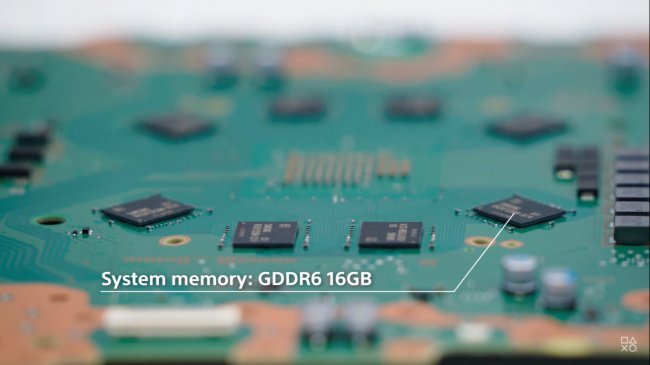
None of these systems seem to have on-die memory. Not sure about the XBS, but from the official teardown the PS5 doesn't even use on-package memory: https://www.gamereactor.eu/media/87/_3278703.png
And Apple certainly didn't wait for SoC to use soldered memory.
Yes, but as other threads commented, this is not particularly new. It's similar to how games consoles have been designed.
It's a natural evolution, especially when MacBook Airs and the ilk are not really user upgradeable in the Intel form anyway. It's much harder for regular PCs to make this leap because one party doesn't have as much control.


In other words: they totally trounced and took it to the next level with regards to memory, because they can. If anything, memory control is their biggest advantage. Scaling the amount of ram won't be an issue. Increasing the bandwidth perhaps, but it'll still be way quicker than what Intel or AMD offer. This seems like something their next gen M2 version could tackle as a somewhat low hanging fruit.
[1] https://www.anandtech.com/show/16252/mac-mini-apple-m1-teste...