>Foremost among these tools is enforcement action against companies that fail to honor their privacy promises
This is the crux of the issue. The problem is that when Facebook asks for "location information", the consequences of this are not being conveyed to the user. The user might think, "ah they want my location for the weather recommendations and event suggestions in my neighbourhood". They do not realise how something so "innocuous" as location information could be weaponised against them.
I used location data as an example because you could infer almost everything about a person just from that. You could know their social circle, their approximate tax bracket, which banks they use, who is their lawyer, their accountant and their wealth manager, their familiar situation, how healthy they eat, how healthy they are, whether they are chronically ill, and what type of chronic diseases they might have, what activities they engage in, what are their political leanings, I could go on, I do not think this is anywhere near an exhaustive list...
The user does not know that Facebook it going to tip off the insurance provider about the user's unhealthy eating habits or his chronic medical condition. Or maybe tip off his bank that he has substantial wealth elsewhere.
If I had a nickel for every time someone called me paranoid or a conspiracy theorist for mentioning this before last week, I'd have a ton of nickels.
I should feel better now that people of aware of the nefariousness of this type of data collection, but I feel worse. The general public is being fed this as "Russia" and "Trump", and not getting the real, horrifying, surveillance state truth of what's going on.
I'm less worried that the Trump campaign used CA (and that the Clinton campaign used CTR), than I am by Obama saying "it's just metadata".
The standard nickel is 5 grams but they typically weigh between 4.9 and 5.1 grams. However for such a large number of nickels, due to wear, I'd say it's a safer bet to lean towards the lower bound, and also add some uncertainty so a more accurate answer is probably 204±5 thousand nickels.
"For in every country of the world, I believe, the avarice and injustice of princes and sovereign states, abusing the confidence of their subjects, have by degrees diminished the real quantity of metal, which had been originally contained in their coins."
Obama...that was the president who authorized the FBI to infiltrate the Occupy Wallstreet movement and paint the protesters as rapists and weirdos, right? Democrats who think highly of him are no better than Republicans who think highly of Reagan.
> If I had a nickel for every time someone called me paranoid or a conspiracy theorist for mentioning this before last week, I'd have a ton of nickels.
I just had an existential age-related hiccup realizing that I had a school paper on the subject back in 2002.
I wish the USA would stop calling people conspiracy theorists for critical thinking, especially as we see more what used to be 'conspiracy theories' actually come to fruition. It actually hinders critical thinking and is a bad path to go down.
* Logically consistent in niche fields that could be verified if more information was public (Room 641A); these should really just be called "theories"
* Harmless garbage ideas perpetuated by dumb people (flat earthers); these theories deserve open ridicule
* Propaganda created by intelligent people with the intent of causing harm (Uranium One); these should simply be illegal as libel
Those are important distinctions. Some conspiracy theories are straight up garbage, they do not deserve any modicum of respect... legitimate theories are in the minority.
True.... though I bucket that under my last grouping, because I think there's a conspiracy attacking the legitimacy and experience of scientists. If the public mistrusts doctors and vaccines, they're more likely to distrust climate change and anti-refined-sugar research.
The problem is that a lot of people that complain about actual issues, like Facebook stalking, also try telling people about a lot of things that are totally conspiracy theories.
On top of that, as someone with experience in database marketing, people act as if they are being personally spied on. If you are tracking 800k people and you have 20 employees, the issue isn't really having another person looking at your data, the issue is the unethical ways organizations are using that data to manipulate you and the rest of society.
It's the difference between "The government conducts unethical surveillance" and "The government is spying on me."
The issue is that the difference between the "The government conducts unethical surveillance." and "The government is spying on me." has essentially disappeared.
When everything is remembered forever anything you've done can be retroactively traced backed to you when you become a person of interest.
That's a good point on how you phrase what they are doing. You want to avoid implying that you or the person you are talking to is being targeted (because they're not really and it makes you look like a conspiracy theorist).
"I'm less worried that the Trump campaign used CA"
But, and maybe someone can clarify, every single intelligence agency has come out and said that there was some interaction between Russia and Trump and, more specifically, between Facebook and Russia. And it's been proven Facebook is directly implicated in both the Trump campaign and Russian election meddling.
We hold the ability to vote in free elections as pretty a basic fundamental right in a democracy, so why wouldn't this be the thing we should all be worried about?
> But, and maybe someone can clarify, every single intelligence agency has come out and said that there was some interaction between Russia and Trump
No, they say (in the public assessment) that Russia intervened to favor Trump, not that there was interaction between Russia and the Trump campaign.
Now, there's been at least one guilty plea from the Mueller investigation specifically referencing interaction, but that's a separate thing from the public intelligence assessment.
> It's worth noting they ALSO say Russia intervened against Trump
No, they don't.
> There's at least two anti-Trump rallies alleged to have been organized by Russia.
Be that as it may, the public assessment does not state as the ICs assessment that any part of the intervention had an anti-Trump purpose (a rally can be organized whose overt message supports a cause without the purpose being advancing that cause.)
Whatever the FBI or people in it believe, the public assessment put forth by the US Intelligence Community does not address interaction; it is inaccurate to attribute that as a public unanimous conclusion of the Intelligence Community.
Note that I'm not making the “no collusion” argument, hence the reference to the Papadopoulos plea. The Trump-Russia interaction just is outside the scope of the public Intelligence Community assessment, and shouldn't be described as the public conclusion of the US intelligence community.
Could you provide a citation? OP's comment mirrors my understanding. My understanding is that Russia acted both for and against Trump, though primarily for. But that is different than those efforts being coordinated by the Trump campaign.
How much interaction is there, during, prior, or after election time, between the political or intelligence arms of the USA, and the politicians of any country in which the USA chooses to meddle in?
If we were so worried about the integrity of democracy, we wouldn't have our fingers in so many other ones. You've just described soft power.
US interference in other countries' elections is absolutely wrong. It is because it is wrong that I feel justified as a US citizen saying that other countries' interference in our elections is wrong, too.
If the citizens of Iran or Vietnam or Korea or Iraq have a right to be upset at a lack of political self-determination, so do I. Punishing the people of a country for the actions of the leaders they did not meaningfully choose is exactly why US interference is wrong.
And it is because I as an individual care about democracy that I oppose the actions of both my leaders and anyone else to override democracy.
> How much interaction is there, during, prior, or after election time, between the political or intelligence arms of the USA, and the politicians of any country in which the USA chooses to meddle in?
Probably a level which should induce intense concerns in citizens of those countries if they already had a democracy to protect in the first place.
But thanks for the textbook display of Whataboutism.
No, what I've described is a textbook example of blatant hypocrisy.
Whataboutism is pointing at an unrelated problem, to divert attention from your problem. "But what about African Americans getting beaten!" to draw attention from bread lines and GULAGs - that sort of thing.
This is an incredibly related problem. The two cannot be discussed in isolation. This is quite literally, one of the top countries for 'interference in democratic elections' having an issue with its election being interfered with by a foreign power (In a relatively[1] minor way.)
Notice how none of the talking heads or politicians are taking a principled stance against interference with elections - they are just taking a stance against interference with their elections.
[1] Relatively, in terms of impact, effort expended, size of the United States.
> No, what I've described is a textbook example of blatant hypocrisy.
Yes, the accusation you've launched is one of blatant hypocrisy; the use of such accusations against those raising an issue as distraction technique to draw attention away from the issue raised is exactly the definition of Whataboutism.
> Even when the accusations are indisputably true and relevant?
You can probably construct an argument where the hypocrisy of some speaker advancing the argument would itself actually be relevant to the argument being advanced [0], but that's almost never the case in any real discussion; instead Whataboutism (and then tu quoque fallacy more generally) has the same rhetorical purpose as guilt by association or as hominem; create a negative emotional charge attached to some group associated with an argument, and use that to get people to dismiss the argument without considering it's merits.
The accusations in the motivating instances for naming Whataboutism were often both indisputably true and the same type of wrong as the act they served to distract from.(which is as close to relevance as charges of hypocrisy get.) They were still fallacious, just as this one is, irrespective of its truth or.degree of analogy.
[0] e.g., if the argument specifically included as a key point that the speaker did not engage in hypocrisy.
> So, in your opinion, moral authority isn't a thing?
Sure, it's a “thing”, specifically a name based on rationalization given to the cognitive filtering mechanism which a number of fallacies, notably as hominem and tu quoque, target.
But it's never relevant to the merits of the argument; targeting moral authority is always an effort to avoid consideration of the merits of the argument.
The consequences of using a store loyalty card are not known to the general public either. Yet all transactional information is sold off to third party data brokers and aggregated into profiles where they keep track of you in minute detail. It isn't exactly fair that Facebook is going to be punished while the rest of the industry hides behind its fine print.
I agree with you, but FB has been pretty blatant about how they misuse their user's data. If you are the biggest and most obvious, then you will probably be the first one targeted.
Indeed. Collecting a "type of data" tells you almost nothing about what the company collecting it could do or is going to do with that data.
I think regulation around this idea may be most effective. Companies should have limits on what they can do with the data by default. If they want to use it for more, then they should not only offer a much greater degree of transparency but they should have to abide by much higher standards, too, similarly to how medical companies have to abide by much higher standards when collecting your information.
So if a company asks for location data just to use it for weather information, that could be obtained with a single click from the user. If the company intends to use that location data to allow advertisers to target you, then it should be made very clear to the user that this is what the purpose of collecting the data is. And they should need to do more than just click once on a button.
If the same company intends to give the data to electoral campaigns, then higher standards still should be imposed on that company.
The point is we need to start regulation the use of data, and not just what type of data can be collected.
I don't believe that telling the user what use will be made of their data will be in any way effective. Many companies are very honest and up front about it. The problem is that the information is just too technical for a user to understand, so they ignore. They have no choice because there's no way for them to understand it anyway.
Even if all companies were required to and did comply with a law like that and fully disclosed the information, the collected data would just be laundered through a third party in some way so that the terms of service were technically correct, but they could still get away with business as usual.
I think these companies just need to be barred from using data in this way period. It's the only way to ensure users are protected in my opinion.
In the end it just doesn't matter if the user understands or not. Most people just don't care either way until it hits them personally. When the violent ex boyfriend manages to track you down even though you have a secret identity just because a mutual friend visited and unknowingly got your location on some social app.
And who knows if the analysis that is derivable from this private data leads to a bunch of false-positives (that are conveniently not known by the person affected)?
You could be "doing nothing wrong" and still get screwed by right people thinking the wrong things about your data.
1984 or Brazil - it doesn't matter they're both dystopias that revolve around totalitarian constructs - neither of them work without this kind of comprehensive information.
The user does not know that Facebook it going to tip off the insurance provider about the user's unhealthy eating habits or his chronic medical condition. Or maybe tip off his bank that he has substantial wealth elsewhere.
Are you aware of any instance in which this has actually happened? AFAIK Facebook has not been selling location data to anyone, and this would be a direct violation of their privacy policy.
Further, if I worked for an insurance company or bank, I’d have customers install my mobile app that has lots of convenience features, and have that app request location permissions so that I could get GPS data directly from their mobile device. Then I’d use that location data, that I obtained directly and in accordance with all applicable privacy policies, in all of the scary ways you mention and then some.
Going to Facebook is not the most efficient way to violate the privacy of most individuals. Most people will happily trade their privacy for a small discount or to be able to save a few seconds interacting with a service they use. This is where any legislation in this area should focus - not on punishing a specific company because the “wrong” candidate happened to win an election.
It's not a baseless assumption that fitness trackers abuse access to people's private data. Maybe your particular fitness tracker doesn't today. That doesn't mean others don't.
And I am - for argument's sake - agreeing with the notion that privacy violation happens when the online service does something "wrong" with the data, not when the online service demands to keep their own copy, for their own uses, as a precondition to using the software.
History has shown that software that sends as much data home as possible can simply not be trusted with that data. Fitbit is one "innovation" or management team change away from further abusing the access to their user's data. I don't mean to coldly disregard the fact you trust your employer. But if I want an accurate assessment I can't care. Facebook employees trust Facebook.
My employer was being lumped in with a currently existing privacy violation. I won't argue much against hypothetical future possible privacy violations. I'll just point out that web-based email, your credit card company, and whoever installs software on your smart phone overshadow privacy implications associated with fitness trackers.
The difference is that all of that is public information. The kind of tracking that Facebook and Google are doing is not explicitly public information. They infer secrets about your private life from little bits of "innocuous" data that you sweat away during your everyday activities.
Just tried this for several people I know. It only kinda-sorta gets things right. It generally gets the name right and sometimes the address.... but not much else.
Does anybody know what the legal situation (in US or under the GDPR) is for data derived from inferences? E.g.: if he visits this nightclub he's gay, or if she goes to this clinic she's having an abortion. As the subject never told you, but rather you speculated it, it could be argued you don't know, and you don't have to record it in explicit terms. It also raises significant concerns about the accuracy, and whether the subject can even correct, let alone expunge such data, which could be sold on to credit rating agencies or whomever else.
It's not illegal to record whether you think someone is gay. It's probably immoral if you hand that data over to a country that will prosecute someone for being gay (Russia).
I'm not aware of any US protections unless they came along with recently passed legislation, but the GDPR had some recourse for European citizens. They are now guaranteed a right to explanation and a right to correct the data. So if a person is given a higher health insurance premium, they are allowed to ask for an explanation. If the answer is "Google thinks you're gay, so we're raising your premium," the person is allowed to correct the information, basically saying, "I'm not gay, so please lower my premiums to what they were."
Right, but that is only if they discriminate based on what they had recorded about you. A company recording whether they think you are gay based on your location information isn't doing anything illegal until they discriminate against you with that information. There are things that a company can do (like advertising) that doesn't meet the bar of discrimination that they can still legally do with their inference about your sexual preference (or whatever else they infer about you from your data).
Advertising "gay" products to you based on the fact that your cell phone spends a lot of time in close proximity to a gay bar probably doesn't meet the bar for a discrimination lawsuit.
"Under the statute it is effectively illegal to perform any of the following in the presence of minors: hold gay pride events, speak in favor of gay rights, or say that gay relationships are equal to heterosexual relationships"
"The law subjects Russian citizens found guilty to fines of up to 5,000 rubles and public officials to fines of up to 50,000 rubles."
Of course just being gay isn’t a crime in glorious motherland, but promoting homosexuality is. That’s so broad that it includes being openly gay, or standing up for your rights if you’re gay. It’s sort of like saying that it’s not illegal to be alive, it’s just illegal to breath.
Typically thuggish laws from a state run by its own intelligence services-cum-mafia.
In the US personal data generally has 0 protections with a handful of exceptions like medical information. As the FTC's statement reads, the only possible issue here is Facebook violating their own privacy policy (stated as a privacy 'promise') and the consequence there will be at worst a very gentle slap on the wrist.
If not for the media coverage of this, Facebook would be unable to care any less. The media coverage though is driving the stock prices down and effect the company many orders of magnitude more negatively than any legal enforcement will.
The issue with inferences is that you could use relatively unprotected data, such as location data, to derive, for example, medical data. The example of going into an abortion clinic and having had an abortion is an obvious one. In that case, does the law consider you to be handling medical data? Can you sell it to a third party simply classed as location data analysis?
Interesting that you choose location information. I believe location privacy issues on Facebook pale in comparison to Apple and Google who share your exact location information with 3rd party app developers.
That's a good example, +1. But I have bigger issue with their cookie abuse.
Initially cookie was designed to help website track you around THEIR website; it wasn't design to track you around the WHOLE internet. While it may be in Facebook spirit of "hacking things" and "breaking things", I'm surprised EU and US have not come up with strict rules and regulations on how cookies can be utilized.
I remember in EU Facebook tried to argue that they track you around web for your safety and security but I'm unsure how much water it hold.
Isn't this primarily on Android ? Am quite certain no app can monitor your location in the background on iOS.
Regardless What pisses me off is FB not providing evidence to the contrary, that they don't harvest data in the bqckground. Not providing this evidence makes it quite clear that they do harvest this data. The issue isn't about permissions. 'Sir, may I come inside your house, is fine, but ransacking the house once you get is is douchebaggery.
> Am quite certain no app can monitor your location in the background on iOS.
Any application can do this on iOS, with a few caveats:
- iOS prompts you to grant permission when the application requests it for the first time. If you refuse, the application cannot keep prompting you.
- After a few days, it reminds you that the application has been accessing your location in the background and asks you if you want to keep allowing it or revoke access.
- There is an indicator in the status bar to let you know when an application is tracking your location.
- You can see which applications have access and which applications have used that access recently by going to Settings > Privacy > Location Services.
- You can revoke access at any time in the same place or by going to Settings > App Name.
- You can also only grant applications access to your location while you are using the application, as long as the application supports that.
- If an application doesn't intrinsically need location services to function and the developer tries to force users to grant permission by disabling functionality, the application is unlikely to be allowed in the App Store.
As others have mentioned, there are also other ways in which applications may be able to infer your location indirectly.
If Facebook does a background news feed update on your iPhone and notices that your iPhone wifi is on the same IP address as another phone (Android or otherwise) with location enabled, then it can record a correlation.
Straight up GeoIP is good enough, particularly on WiFi.
On mobile networks I believe the carries will gladly sell the tower-IMEI mapping. They already have to collect that for law enforcement purposes anyway.
You also know where they live, where they work, when they are on holiday, when they are out taking a stroll in the woods... Even if you trust 'Facebook' with that data, do you trust a facebook employee?
Remember Digg? Unlike the companies you listed, FB is user-facing - just like Digg.
If users happen to decide that a company is not "cool" anymore or dispase its public figure(Zuckerberg), it may actually go away.
Remember IE(stands for Internet Explorer)? Using Firefox and later Chrome became a crusade and the almighty brand of the richest person in the world that holds the monopoly on computers platforms bled to death.
Digg and IE "died" because there was a real practical incentive to move towards alternatives. This Facebook thing is mostly ideological at the core, in terms of day-to-day user experience it's no better or worse than it was a month ago. Digg also never was more than a small speck of dust compared to Facebook, even at the apex of its popularity. Facebook's huge network effect is hard to overcome.
If you want Facebook to die you have to come up with an alternative with improved usability to convince people to switch over. Now you have do that with the added handicap of "do no evil" (so less money from targeted advertising etc...) while fighting to gain market share against some of the biggest companies in the world. My guess is that if you manage to do all of that you'll just end up bought by Facebook anyway.
Additionally (at least for the IE example) there's another huge difference: those who wished to use an IE alternative could do so and continue to engage the same activities and access all the same content--with a few ActiveX exceptions--as they could before.
Most importantly, those who wished to make the switch from IE to Firefox or Chrome or Safari or Opera, etc. could do so without requiring any additional action by others. Again, outside of a few compatibility issues on a few sites, I could change the software I used without convincing webmasters or other users to do anything.
Same went for webmail. I could switch to Yahoo or Gmail or Hotmail or whatever I wanted without requiring me to convince every other relative, friend, and business contact to do the same.
With something like Facebook, you can't just use a different platform to interact with those same people in the same way unless you convince them all to migrate with you. If everyone you know only wants to use Facebook, then that's your option. You can't set up your profile on Diaspora or Google+ or whatever and expect to enjoy all the things you prefer about them because there's no shared protocol like there is with web browsing or email.
unless the privacy protections are codified in the company charter from day one with some poison pill type mechanism. last I heard a social network called ello was trying to do that. lately they have rebranded themselves into a 'artist social net'. IMO still worth the switch if moving with close friends.
Honestly if fb were to just take the money from me and leave me alone i'd be happy to pay that ransom for my friends.
> Remember Digg? Unlike the companies you listed, FB is user-facing - just like Digg.
Digg was abandoned because it broke itself. The codebase that all those users knew and depended on was completely trashed (the original author hangs out here sometimes), the site dropped a number of its key functions, and the user experience was redesigned to maximize Digg's ability to show ads, no matter how obnoxious that got, with many people saying that it was almost entirely ads by this point (I had personally stopped using Digg years before the big v4 debacle, so I can't speak to this directly).
People want the path of least resistance. They'll tolerate some ads, but their tolerance ends when it's just easier to click over to the other guy's site and get a comparable experience. If you neuter/break Digg, and reddit is right there, well...
The path of least resistance for Facebook users is still Facebook, regardless of the news cycle. Facebook will remain dominant until it is no longer the path of least resistance, just like everything else.
Users have different levels of tolerance. The moment a switch is the path of least resistance differs for everyone, usually corresponding to their level of emotional investment in the platform and their individual tech savvy. Facebook has a lot of very invested, very non-tech-savvy users.
The right types of questions to ask are along the lines of whether we're sure competitors have sufficient ground to catch up to massive incumbents and keep them honest (and in this case specifically, whether certain misrepresentations or violations occurred that should be made to materially affect market standing through government intervention). For the most part, tech is non-competitive due to terrible legislation like the CFAA.
> The right types of questions to ask are along the lines of whether we're sure competitors have sufficient ground to catch up to massive incumbents and keep them honest (and in this case specifically, whether certain misrepresentations or violations occurred that should be made to materially affect market standing through government intervention).
I don't see how there could ever be any viable competition. Facebook already has many of the top engineering minds in the world who are pushing the edge of what computers are capable of, not to mention the largest database and neural network of human behavior ever created.
> I don't see how there could ever be any viable competition. Facebook already has many of the top engineering minds in the world who are pushing the edge of what computers are capable of, not to mention the largest database and neural network of human behavior ever created.
How is any of that necessary?
I don't give a shit about their bleeding-edge neural network or army of PhDs. I just want to send my mom pictures of my kids and maybe send an occasional party invitation to some friends. What does Skynet contribute to this workflow?
I would argue that all that technical bloat only made the Facebook experience worse. Facebook itself had humble beginnings. All a competitor needs is a LAMP or MEAN stack, an experience worth migrating to, and enough ethical sense to not treat its userbase like a science experiment.
>I would argue that all that technical bloat only made the Facebook experience worse. Facebook itself had humble beginnings. All a competitor needs is a LAMP or MEAN stack, an experience worth migrating to, and enough ethical sense to not treat its userbase like a science experiment.
It also needs the ability to make the transition plausible for consumers. There's really no reason that Facebook should be able to enforce a stringent walled garden and bar specific user agents that aren't negatively impacting the network and aren't exceeding the access of the user they represent.
But Facebook did exactly this in Facebook v. Power Ventures, leaving an entrepreneur with a ruined business and a bill for $3M in damages for creating a system that exfiltrated only one's own personal, copyrighted data from Facebook. It wasn't even taking other peoples' feeds or trying to multiplex data. It was simply trying to make one's own data accessible and portable.
Large tech companies have done this for decades, abusing the CFAA and the Copyright Act to enforce de facto platform monopolies. These companies know that if they can't assert ownership over the data, they'll have to compete on merit in the open marketplace, and who wants to deal with that?
This is also why you don't see new protocols like POP3 or NNTP anymore. Academics trying to build a transparently-syndicated collaboration platform are out. Big companies looking to hoard your data and assert some type of incidental, indirect ownership over it are in, and they want to make sure that you don't really have the option to leave. Lock-in is king.
Once a critical mass outside of the tech-savvy early adopter crowd is obtained, aggressive legal methods like those used against Power allow incumbents to hold onto power in perpetuity. Granny doesn't care about all of that tech mumbo-jumbo. She just knows that she can't see Auntie's pictures anymore because you broke it by switching her to F+. Since they're legally forbidden from multiplexing Facebook's content into a universal "social media reader", Granny's options are to stare at a blank feed or go back to Facebook -- even though Auntie would be perfectly willing to allow Granny to see her content through F+, and it's really more of an accident that Facebook is the platform that received the initial post.
What is Granny gonna do in this situation? Why have we awarded tech companies the right to hold user-generated content hostage like this? Wrap anything in custom HTML and it's suddenly very difficult for a third-party to access it without infringing your copyright on the exterior HTML wrapping, regardless of the status of the content inside. In the US, it's infringement to load copyrighted content into RAM, per the RAM Copy Doctrine.
Good luck convincing a technologically-illiterate judge that your software is no more disruptive than Chrome or Firefox, especially when you have to do so over the objections of Facebook's $X000/hr law firms and previously-referenced army of PhDs.
Such rules have stifled online innovation for decades now, and they're the reason that the internet is becoming a walled garden.
Under the GDPR, which mandates all companies provide a machine-readable export of user data within some fairly short timeframe (less than a week iirc), things may become marginally more fluid for people in EU countries, but I wouldn't count on it.
If you neuter/break Digg, and reddit is right there, well...
That case is about an almost identical twin, but I would also consider sites that are not so similar but serving the same function. I haven't had a Facebook account so not sure what it is exactly, but people are happy as long as I have Whatsapp.
I added IE to my example to illustrate that having all the money in the world may not save you when your brand becomes toxic. Some may say that FB users don't care but with IE it also was just geeks and devs, but it turned into a crusade and now everyone "knows" that the first thing you do after you have a fresh PC is to install Chrome.
Perhaps part of that was that IE was really bad at it's job and as users were told about Chrome and Firefox and they tried it and it was much faster - they switched because IE was not nearly as good. Facebook is pretty good at it's job - despite questionable practices. If Facebook started to suck from a user perspective (a bit like MySpace did) - users would move to another thing in a shot.
I would disagree with the claim that Facebook is "pretty good at its job" -- the News Feed is completely full of ads and "suggested content", notifications have become complete noise at this point, and even Messenger has ads in it now, and makes it difficult to get to your actual list of online friends.
In 2011, Facebook was good at its job, with a chronological news feed, meaningful notifications, and a messenger paradigm that worked much like AIM in the early 2000s -- you could see who was online, away, go invisible, etc. In 2018, Facebook has lost all of those positives, and with it a lot of user engagement, all for the sake of cramming the maximum number of ads down the users throats. And I'm not even getting into the nasty dark UX patterns, like hiding the ability to delete your profile (seriously, there isn't a link to do this anywhere on the site -- you need to search Google for it and they change the link all the time to break external guides) and showing random pictures of "friends who will miss you if you leave!" when you try to delete your account. I don't think your average user would mind leaving Facebook much if there was any actual alternative.
I think you're under the impression that facebook's job is to be good at showing you what you want and being useful. I'm pretty sure they think their job is to balance being just useful enough that you don't quit while maximizing revenue from you, which might entail being pretty crappy to use overall.
> I think you're under the impression that facebook's job is to be good at showing you what you want and being useful. I'm pretty sure they think their job is to balance being just useful enough that you don't quit while maximizing revenue from you, which might entail being pretty crappy to use overall.
This is just a minor quibble to lambda_lover's point, which still stands. Facebook may understand it's job is to shove as many ads in its users' faces as they will tolerate, but that's not why users use its app. It's users view its job as being useful to them, and being bad at that makes makes FB vulnerable to competitors or even just general dissatisfaction.
The difference is, if devs don’t support your brower, your browsing experience suffers.
Every developer on Earth could leave Facebook and it would not make the experience of using fb any worse. Facebook is not a software platform, it’s an ad platform.
If anything fb would get better if we stopped targeting it.
I remember the process, it had nothing to do with the dev support. Actually, it was the other way around - IE had all the dev support and websites broke down on Firefox but people were fanatics. There were extensions that let you render the page in IE if it's not working on Firefox.
When the Chrome came along, Firefox already put a dent in IE market share and it already became socially unacceptable for techies to use IE but regular people still used IE so the devs were forced to make sure that everything works perfectly on IE too. For the masses, thanks to the developers, IE displayed the websites just fine up until the bitter end.
Friends didn't let friends use IE and it was killed.
It’s far from dead, although we’re finally seeing Edge and Firefox rise a bit more sharply.
Slow-moving, heavily regulated corps with lots of internal legacy apps simply cannot use Chrome with its frequent feature deprecation, weak management, and constant desire to send telemetry and who knows what else to Google servers.
Facebook doesn’t need to predict — they can buy when it’s already big. They are able to monetize users much better than random startup social network so they are able to pay much more per engaged user than the company could get from VCs or the public market.
As ggg9990 noted, is not about discovering them when they are small and cheap and making money on the market increase, it's about buying them when they are got and making money on the execution of the business.
Facebook isn't the VC company, Facebook is who those companies hope to sell to later.
For public companies in the US, they are mostly incapable of making decisions like this as if can be shown to negativity effect enterprise value they can be sued by shareholders that do not have the same moral issues.
I read these kind of comments all the time, yet I'm still to see one actual court case showing that this is true. Are you really sure that this is true?
> If users happen to decide that a company is not "cool" anymore or dispase its public figure(Zuckerberg), it may actually go away.
This is already sort of happening anyway with the "my parents are on Facebook now" problem. That I think is a much bigger threat to Facebook's future than any regulations that are coming.
I don't think that is an apt analogy. Facebook users become so entrenched with their social network, pictures, etc. that it is much harder to delete than a bunch of interest categories.
I don't know. Once you get your photos off of Facebook I think you can leave really easily. You can still message all your important friends through sms or your chosen chat app. Snapchat exists as an alternative for casual photo sharing. Reddit or Twitter for posting news, memes or funny videos. I think people exaggerate the importance of Facebook. Young people can adapt to new technology quickly. I know I was able to drop Facebook pretty easily.
Young people might be able to adapt to new technology quickly, but they also have some of the strongest social pressures to remain on the technology all their friends are at. The difference between being in the "cool" message group and someone having to message you separately is a much bigger hurdle for them to face than where all your photos go.
Kinda agree. I can at least see how dating apps lock people in; most apps require a Facebook account. However, I also think there's a lot of reasons to not want to be instantly connected to everyone you know on Facebook. Annoying invites to political events you don't want to attend. Weird people/Sexual predators/Stalkers messaging you.
People can adapt. In my fantasy football group we used to do Facebook messages until me and another friend dropped Facebook. Now we do group messages or groupme. People you care about will find a way to contact you.
> Young people might be able to adapt to new technology quickly, but they also have some of the strongest social pressures to remain on the technology all their friends are at.
Exactly - that's the danger for FB. If the coolest of kids head somewhere else, that strong social pressure works against FB and not for it.
Yea but that's also a reason to leave. I know one of the main reasons I stopped using Facebook for photos was because I didn't want my Mom and extended family looking at the parties I went to at college.
That is why I have to remain. I want my mom to see pictures of my kids. I want to see pictures of my nephew's lip after he got hit with a ball (6 stitches). The girl who took 4th place in the state dance competition is of interest to me because I remember her mom from high school - the first place dancer is nothing to me. The real things in life that matter are why I'm on facebook and why I cann't leave.
Politics and some hobby groups are on Facebook and interesting, but the real meat is the personal photos and stories that would never be in the news.
I was totally ready to call you out and that the rebranding of IE to Edge resulted in no change in adoption and Microsoft wins by default but apparently I am totally incorrect. Chrome is _by far_ dominating the browser game[0]. And while I'd rather FF take that spot, dethroning Microsoft makes my nerd heart pretty happy.
Wow I honestly had no idea. I would of bet you $100 on the spot that Microsoft had more than 50% marketshare of browser traffic and considered you a sucker for taking the bet. I had no idea Chrome had dominated so much. I wonder what Firefox did wrong that it didn't become Chrome? It was the cool browser to use years before I ever heard of Chrome.
Maybe it was Google's push for the most part but Firefox made a reputation or being cluttered memory hogg and when Chrome came along it was so fast and fresh. Firefox used to lose it's smoothness when a tab misbehaves and didn't take advantage of the multi-core processors that were getting popular but Chrome was butter smooth even if a website is not responding(due to Flash Player mostly) because everything runs in a separate process and if a website died only that tab died.
It was no-brainer to switch to Chrome.
Also, Google was this cool company that was giving away revolutionary products. Don't do evil was their motto.
It probably helps that everyone visiting google.com, far and away the most popular search website, that isn’t already using Chrome is prompted to install it.
What happens if people start talking about how much they hate Zuckerberg and start looking for alternatives and the cool kids start suggesting each other some other social network that's technically good enough but never took off because didn't benefit from the network effect?
Then anything he touches becomes toxic. Zuckerberg isn't even divisive like Trump, he may have issue finding people to rally with him against the deserters.
Please, no, not yet another open and federated social media platform that is in fact not much more than an endless feed of bots posting and reposting twitter posts and rss feeds. The internet can't take much more of those.
I wanted these platforms to succeed, I've had an account and tried using most of them - Diaspora, Friendica, Red Matrix, someothermatrixIdontrememberthenameof, Mastodon, identica/statusnet, ... They're all the same. (I'm sure I'm forgetting at least one or two, but they all blend together.)
The short memory is a global things. It's the same with bad movies, lying politician and crazy ex gf/bf.
You can get away with a pretty much anything as long as it's legal, not a big symbol, or that you have money to bypass the legal issue: the public won't hold you responsible for long.
Here it's even worst, because it's also coupled with a total lack of interest. People mostly don't care about co-creating a society. They just want to enjoy the rewards of it right now.
Unless pictures of them doing something they are ashamed of are displayed on a highway billboard, data privacy is not even on their map.
John Oliver did a good job of highlighting your point when he interviewed Edward Snowden. People interviewed on the streets about cell phone data collection and it did not concern people at all, that is ... until they found out it could involve pictures of their bf/gf's private bits they sexted back and forth. People said that would make them mad.
Remember the 1956 IBM consent degree way back. It changed the course of computer history as IBM had to watch now every step.
The FB consent degree was ignored and so far had little effect. I doubt it will continue to be ignored now as the following has changed:
- FB leveraged by Russian trolls and via data leakage affected the US Presidential elections. Puts the spotlight of politics on social media and FB in particular
- same for Brexit
- GDPR in Europe is a big thing with penalties
- US branches of government shifting left over the next 4 years in reaction to extremist right policies.
- Younger people get Mr. Robot. Older people die. Demographics have been shifting audience away from FB for some time.
These are trends that will not go away. They will affect every decision within FB and with it the growth trajectory.
Everyone complaining about Facebook today is defiantly moving to Instagram and Whatsapp... joke’s on them that Facebook owns both.
The conspiracy theorist in me would say that Facebook is reaching the end of its lifecycle and the company has prepared itself in advance for the move to newer social media platforms, and that they’re not particularly concerned about people leaving Facebook.
> Most likely the latter. Facebook is for "old people" according to younger family members. However, they're all over Facebook's other properties.
However, all those were acquisitions. I think Facebook's doomed if it's ever prevented from buying rival social networks. I think trend cycles can throw a wrench in network effects, and Facebook's too established to really innovate in this category.
> Equifax, I would force to pull my data if I could
You could freeze your credit with Equifax, if you're not looking to take out new credit lines. It costs money, but I've heard it pretty much stops them from making money off your info. That's why the credit agencies are pushing things like "credit locks," which don't have legal mandates behind them meaning they can design the service to suit themselves.
Remember when sexual assault and harassment were routine, and powerful men could do what they wanted with impunity?
There was an awakening, the public mood changed, people were energized and emboldened to take action. What used to be an open secret is now taboo and many powerful men have been fired and disgraced.
Remember the awakening about the unhealthy effects of sugary carbonated beverages? That wasn't a one-time fad as sales of soda in the US have dropped every year for the last 12 years.
Similar awakenings are now happening in economics, politics, law enforcement, and now digital rights and privacy.
I'd be very surprised if the outrage fades away with no serious damage to Facebook.
Quitting Facebook leads to higher levels of well-being [1]. People are waking up to this reality, just like they woke up to the dangers of smoking, and it's long-term negative for Facebook and their shareholders.
My gut feeling on what's really going on here politicians on both sides of the aisle have realized that not only can they use Facebook against their opponent, their opponent can use Facebook against them, or someone else could use it against both of them.
I suspect where possible, politicians prefer to minimize the number of highly influential entities. That the public is also helped is just gravy.
People think voting with your wallet doesn't change a thing -> they keep buying from unethical companies -> nothing changes -> voting with your wallet doesn't change a thing.
The problem is that it's always the same small group of people who actually change their commercial choices based on companies' ethics. I've avoided Lenovo like the plague since superfish, but I know people who've bought lenovo laptops even knowing quite well about the superfish issue and understanding what firmware level malware means.
True. I do not. It is pure conjecture, backed historical examples I provided. Could this be different? Absolutely.
I could flip your comment though. Unless you have some clairvoyant powers you don't actually know that "Fallout from this is forthcoming". There may be no further negative fallout from this.
>"I could flip your comment though. Unless you have some clairvoyant powers you don't actually know that "Fallout from this is forthcoming"
There are at a number of significant events in FB's future being hauled in front of Congress in the US, being hauled in front of Parliament in the UK, the FTC investigation, numerous state attorney general's investigations and of course shareholder lawsuits.
I think its fair to say that the fallout is not yet done.
Uber just had to sell is SE Asia operation. It has a bad rep now lots of people remember. The worst thing that is happening to facebook right now is if someone told me they worked there I would be like "fuck you guys" to their face. They are viewed as the enemy and their staff is feeling that and a lot of good engineers are going to peace.
We will see, not unlikely that a split off of Instagram and/or WhatsApp is being put on the table. Who knows. It didn't happen with Microsoft back in the day, so I'm not sure such drastic measure would be seriously entertained.
From a market perspective, a split might make FB stock even more attractive. While I'm sure FB can leverage IG data quite effectively by mixing it in with the FB (product) data, I bet investors would salivate at the potential of investing in IG directly. Investing in FB now might result in pre-"IPO" prices for IG.
It might be the case that the sum is greater than the parts, but I don't know if the market would respond to a split from a purely rational stance, at least initially.
The stock was literally dead money for decades and the ramifications are clear. The recent selling pressure is driven to an extent by memories of Microsoft and the financial impact. The stock is in no meaningful sense a bargain.
Microsoft's stagnation had far more to do with their failure in mobile and the fact that their operating system and Office markets (where essentially all their money came from) were stagnant to declining. Oh, and all the cool new development (a traditional Microsoft strength) was happening on other platforms.
But they finally got a credible cloud strategy together which recognized today's realities which is why their stock is doing better.
I won't say anti-trust had no impact but they had more fundamental problems.
> “Since the antitrust suit, they have become much more cautious and much less aggressive,” said Michael Cusumano, a professor at MIT Sloan School of Management, who just wrote about Microsoft in the book “Staying Power.”
> “They’re afraid, it seems. Whether it’s antitrust in U.S. or in Europe, they seem to be slowly reacting to the world around them, rather than trying to get in there fast."
Certainly some academics would nontrivially attribute the strategic moves to anti-trust-related conservatism
> With that said, I think the stock is a bargain today.
That's very disingenuous for you to say. If you are in it, you should disclaim it so that others know why you paddle it. If you know anything on TA (technical analyst) you know it broke uptrend and major barriers and will temporarily stop around 140-150 before it decides what to do next. In mere you should warn its your personal opinion.
...and then went back up after everybody realized nothing was going to happen. including last week's drop, it's sitting at 80% of its pre-breach price.
> ...and then went back up after everybody realized nothing was going to happen. including last week's drop, it's sitting at 80% of its pre-breach price.
A sustained 20% drop in market share for a very large, very established company that has fairly few competitors, substantial network effects, and a high barrier to entry. That's a significant drop. It didn't wipe out the company, no, but it's a far cry from saying that "the market doesn't remember" - in this case, the market very clearly did remember.
Well, if you were following along, they mention that the market has not remembered those transgressions, which heavily implies the stock price before this incident will be reached again. The stock will hit a local minima, and then bounce back (the symptom of the market "forgetting").
Yep. See also INTC, who got hit down to 44 for that little thing that affected most of their products. They're back to 50 today. The gap between those two might be the temporary social fear factor, that vanishes in a few weeks.
With that said, I think the stock is a bargain today.
And still falling. A dark part of me hopes the sharks looking to make a profit without recognition of how Facebook is in really deep shit just lose everything. A lot of glib predictions about catching falling knives here, but they seem to ignore Facebook not being quite as essential or inescapable as someone’s bank or credit reporting agency.
People don’t really understand Equifax, and simple breaches don’t bother them as much actively manipulated. Facebook provides a really nominal service for most people, and I think some here are trying very hard to convince themselves this is something other than their bubble being pricked.
> Given the existence of the shadow profile, FB is exactly as inescapable as a credit reporting agency.
That's not true. Facebook has data, but their data isn't as valuable and important to individuals as that controlled by a credit reporting agency.
For instance, Equifax has info to enable straightforward identity theft, and I need all that data to be there if I want reasonable terms on a loan I may want.
The Facebook social graph is mainly valuable to advertisers and intelligence agencies, both of which I can happily ignore day-to-day. It's data could be a tool for identity theft, but I doubt they have the SSNs or CC numbers in their shadow profiles needed to make that easy.
How is the top comment here a weak version of, “come on in, the water is fine” when Facebook keeps dripping scandal? A lot of armchair investors and professionally apathetic people the last couple of days, and they’re all making the same claim, “nobody cares.” Meanwhile it’s still being drilled in the media, keeps hitting the front page here, dropped tens of billions, and so on.
“Nobody cares” feels more like desperate wishing/spinning, and it’s getting old in a hurry. It also ignores how this is being driven by Trump’s election, which has freaked a lot of people out, and by a general backlash against big tech. A lot of anecdotes are being bandied about, in the face of a lot of realities that are not anecdotal.
So buy the stock, but don’t be shocked when like Moore’s Law, past performance fails to predict future gains.
Their userbase is largely unaffected. There was an article stating that their app store rank has even gone up. They add millions of users a month. So any losses can be absorbed over time if this dies down.
Its quite possible that the stock is oversold at this point.
Its not wishing/spinning. At this point it does look quite plausible.
I'm not an "armchair investor". I'm a real investor. My money is where my mouth is. I am simply trying to rationally assess the outcome on users, and I don't think this will matter to the vast majority of them. Nobody cares.
Do I care? Sure I do. But will a tiny minority of tech users matter to the stock in the long term? Unlikely.
I would think the negative sentiment in the tech sphere would hurt them more on inability to continue hiring the best talent... Granted, that is assuming that most people can't be bought, which is unfortunately probably not the case.
I deleted Uber during that campaign and so did at least a dozen people that I know. I don't know the exact numbers, but I think Lyft's market share roughly doubled within several months.
“I dance with a traffic cone on my head and so do a dozen people I know. In fact in the last three months our numbers have quadrupled. The world has definitely taken notice of traffic-cone dancing.”
The market remembers Uber. Why do you think every single little negative they do turns into a "scandal" and why everyone pounds them in the media?
Uber will likely go into bankruptcy soon, if everyone remains very vigilant about their failed self-driving car project. Because without it, Uber is done. The self-driving car project was the last thing the investors hoped would save the company. And it won't.
People also remember Equifax. There is just little they could do, because they don't directly deal with Equifax. It's their banks or credit card companies that do. Plus, Congress almost immediately saved Equifax from lawsuits, and people haven't yet had an opportunity to "respond" to that. They will this fall.
It does come off as farcical, but alas it is not. It's the reality of the situation and nicely illustrates the scale of the issue. Good or bad, Facebook is infrastructure and it's been paid for with privacy.
Irony: "a state of affairs or an event that seems deliberately contrary to what one expects and is often wryly amusing as a result". One would not expect a webpage condemning Facebook to suggest its readers use Facebook to promote that statement. It is wryly amusing that it does.
It's ironic because it provides a subversion of expectations: the FTC is releasing a statement in which they are trying to demonstrate some sort of power and authority over Facebook, but at the same time using one of Facebook's product, thereby undermining (in a very minor way) their own statement. It's not deeply ironic, but it's definitely an example of irony.
Source: My partner wrote his doctoral dissertation on irony, so I happen to have picked up an appreciation for the subject.
How were any of you damaged by Facebook ads, exactly? Why the outrage now and not before, when Obama (and everyone else) used targeted advertising?
This whole outrage over privacy is disingenuous. It’s painfully obvious the outrage is about Donald Trump being elected president, not personal information used to target ads.
I think it's awkward how obvious this is, and how comfortable the media is with that being the case. From Wired's article a week ago:
> The crisis was familiar in a way: Facebook has burned its fingers on issues of data privacy frequently in its 14 year history. But this time it was different. The data leakage hadn’t helped Unilever sell mayonnaise. It appeared to have helped Donald Trump sell a political vision of division and antipathy.
So a guy you didn't like got elected and now this is a problem. The same journalists could barely keep it in their pants when Obama was squeezing every mile he could out of data in 2008 and 2012.
"It's okay because you weren't personally affected" is so obviously wrong. It's so obviously against the spirit of the law and of society. I find it hard to imagine you're arguing in good faith.
But how about this, then, since you're so intent on making this political? How about we fix this so that no future politicians can benefit from this kind of targeted advertising - both liberal and conservative?
> How about we fix this so that no future politicians can benefit from this kind of targeted advertising - both liberal and conservative?
I’d be fine with it, but the first step is admitting that yes, Obama benefited from harvested social media data as well. No one wants to do that, this is all a Trump thing as far as the media, and therefore the general public, is concerned.
the big difference being that the obama data was harvested via an app branded by obama campaign with the specific purpose being to help the obama campaign... vs a quiz app unrelated to politics where participants were paid small amounts to use, and thus pull data on their social network
the first is explicitly political; the second is actively hiding their intentions
*edit: also they used the data very differently. obama used it to push people’s hopes and dreams; trump used it to push people’s fears. overall, obamas campaign was FAR more positive than trumps
By their own words the Obama Campaign ingested the whole social graph because the single person they targeted could bring in the information of all their friends:
No but seriously why is the first step admitting that Obama benefitted? People are up in arms that their data was misused, why do you care whether they're politically motivated or not?
> People are up in arms that their data was misused, why do you care whether they're politically motivated or not?
Because the forthcoming regulations will inevitably target conservatives if we allow the public discourse on this issue to be dominated by "muh Russia, muh Trump."
>the forthcoming regulations will inevitably target conservatives
The forthcoming regulations are going to have to make it through a republican house, a republican senate and a republican president and not get challenged in our republican courts. Rest assured you're safe.
What Obama did was unethical as far as I'm concerned, as is most modern marketing. (I will say one campaign was selling hope and progressive change while the other was fear mongering and spreading divisiveness. So I think there is a difference.) Having said that, I don't know that it matters. Granting these powers to people we happen to like doesn't mean they won't be abused by people we don't. Modern mass marketing is gross. It's the grand scale manipulation of people by exploiting individual human weakness/bias. I'd like to see some smart regulation around it, but I'm skeptical that will happen.
Ah, the current flavour of the year on reddit when it comes to debates.
It's not whataboutism. It's calling out hypocrisy among the reaction of journalists and general public who either ignored or in fact went on to rave about ingenious use of ads. In fact fb personally went on to remove api rate-limiters for one of the apps used by Obama's campaign. Suddenly now that it's someone that left/liberals don't like is in power, these very same practices are being questioned.
> It's calling out hypocrisy among the reaction of journalists and general public who either ignored or in fact went on to rave about ingenious use of ads.
And more specifically, it's calling out the fact that the whole CA thing could have been prevented if, instead of fawning over the Obama campaign's use of targeted advertising in 2012, the media instead collectively asked, "wait, you did _what_ with our data?"
> It's not whataboutism. It's calling out hypocrisy
So, it's exactly Whataboutism: “Whataboutism (also known as whataboutery) is a variant of the tu quoque logical fallacy that attempts to discredit an opponent's position by charging them with hypocrisy without directly refuting or disproving their argument, [...]”
In a way, aren't you deflecting the argument as well by labelling it instead of actually providing a logical answer of Why did everyone ignore or rave about Obama's use of over-reaching fb ads?
And calling out hypocrisy isn't wrong thing to do in this matter. I'm not saying what trump's campaign did was the right thing to do. What i find appalling is the so called "literate/educated" class of people completely ignored and continue to ignore or in fact praised the very same thing Obama did.
Heck, i'm neither a citizen of USA nor a resident and could frankly care less who is in power.
> By refusing to answer upon the clear hypocrisy pointed out in your argument
My only argument in this subthread was that the charge of Whataboutism was correctly made, and cannot be rebutted with a claim of pointing to hypocrisy, since Whataboutism is exactly the fallacy of pointing to hypocrisy to avoid the topic of debate.
And you aptly ignored the context of the argument.
Person i replied to clearly uses whataboutism in negative manner and dismisses valid points of use of extended unauthorized data by OFA (Obama for America).
"What Obama did was unethical as far as I'm concerned, as is most modern marketing. (I will say one campaign was selling hope and progressive change while the other was fear mongering and spreading divisiveness. So I think there is a difference.) Having said that, I don't know that it matters"
Do you see how you have continued to pry the topic away from how to fix this issue that everyone agrees should be fixed? This is the desired outcome of whataboutism. Do you have any input of how to address the issue at hand other than commenting on the details of why people care today or when this problem started?
This argument is disingenuous, and not really more than a projected opinion. Not everyone is this tribal, and people are allowed to be angry when they see the manifest implications of surveillance capitalism without being partisans.
History is being written right now and people are rightly seeing a case of selective memory by the media.
Most people agree that social media surveillance is bad. The majority of the HN comments that bring up Obama 2008/2012 are not trying to justify the CA/Facebook incident, rather they're pointing out a hypocritical double-standard.
I want the surveillance to stop and the record to be set straight. We're dangerously close to public sentiment solidifying around the idea that the CA/Facebook incident was unprecedented and arguably stole an election in 2016. I don't think the truth supports that at all and am trying to use comments like this to keep such false narratives out of textbooks 10 years from now.
I don't think it's disingenuous of the media. I just think it exposes their ignorance and inability to imagine the negative consequences of such data analysis. It took something bad, i.e. Trump winning, for them to wake up to the dangers that they cared about.
Hang on, so what is your solution in this strawman scenario? Should we all smile for the panopticon and embrace total surveillance or do we have to wait until Our Team is in power to be able to complain without question of hypocrisy?
I can't talk of a solution because I don't see a problem.
I'm fine with political campaigns advertising for their candidate. If I see an advertisement for a candidate on Facebook, TV, or anywhere else, and I agree with the advertisement's message or call to action (donating), I'm happy I saw it! If I see an ad for a candidate I don't agree with, then at worst I feel my attention was wasted. To the extent advertisers use personal information to target those advertisements, that just means I see less of the ads that I'm less likely to find valuable. Targeted political ads aren't causing a problem for me personally.
So I don't see a problem with political advertising, but I do see a political bent in the outrage at Cambridge Analytica and its connection to Donald Trump.
While I definitely believe that the motivation behind this latest media surge is suspect, do you really think people aren't justified in being upset about Facebook's abuse? Maybe the outrage is simply because Facebook was new and people weren't aware of the dangers in 2008 and 2012?
People don't have to be "damaged" by something to object to it. How do human rights abuses in third world countries "damage" you, exactly? Just because there isn't a direct link doesn't mean that there's nothing bad going on.
I myself don't care that this data was used to help Donald Trump ascend to the presidency -- besides, I bet that Hilary's campaign did similar sketchy things with private data. The issue is that our private data is being abused by a company that misled us about data use -- and for folks who don't even have a Facebook account, whose information has been harvested via shadow profiles sourced from our less-privacy-conscious friends, data compilation occurred entirely without consent.
This reeks of whataboutism to me. Why are you trying to imply that we shouldn't be concerned about privacy?
More like we should care about privacy but don't. This is the place that considers Snowden a traitor and Obama (the dragnet drone king) a God.
We can pretend that "omg we always cared about data", but that's not the truth. We just hate Trump so much that we're willing to see Zuck for the snake he is. I guess that's not the worse outcome.
> This reeks of whataboutism to me. Why are you trying to imply that we shouldn't be concerned about privacy?
I don't think I've seen a single person use the term "whataboutism" correctly since November 2016.
People in this chain are simply pointing out that if somebody is angry at Cambridge Analytica, but not Obama's 2008/2012 campaigns, they do not actually care about data privacy. They just don't like Donald Trump. You can bet that the next time a data privacy issue comes up, these people will be indifferent so long as the abusing party is aligned with their politics. They also will likely be supportive of people they agree with circumventing any privacy regulations that may arise from this particular scandal.
Asking these questions is a useful filter to help determine how many people actually care about the core privacy issue, and how many are just worried about "their team" having an advantage.
Then we agree. I think that both CA and the Obama campaign's use of personal information on Facebook was a violation of data privacy expectations, and anybody who criticizes one but not the other is a hypocrite and not at all concerned about data privacy.
I was complaining that people are using Obama's data use to justify CA's data use. Obama did it and it was wrong. CA did it and it was still wrong.
If Zuckerberg has any game at all, he will welcome this investigation, 'educate' the regulators, and then build a regulatory moat around Facebook that no one can breach.
The big four banks did this after 2009, and they are even more entrenched and systematically important than they were before. Expect Facebook to borrow liberally from their playbook.
The regulatory costs of running a bank are much higher now than before the financial crisis. This means that the chance of an upstart challenging the big players has actually gone down, even though some of the regulation was meant to address concerns of "too big to fail".
I agree. The tribalism in the current political climate of the US is really damaging on all sides. Trump has done more than a handful of good things and a lot of my friends/family don't want to hear it. Just like my Dad (Fox News watcher, Limbaugh fan, etc...) almost foams at the mouth when you mention Obama/Clinton; it's crazy. He's been conditioned. It reminds of the effects of the two minutes hate from 1984[0]. Too many citizens are completely disengaged from the political process and too many of those that are have bought into these cults of personality.
Agree with those who says it will not effect Fb much and it's incomparable with other past apps/social media platforms. The reason is that unlike others Facebook exploited us, humans in such a way with help of technology and psychology that there is almost no friction to get into Facebook world. On top of that the content people see on their feeds make them glued all the time. I have not been using Facebook for weeks and since then the news broke of privacy and stalking I shared multiple times with friends and family but no one gives a damn about privacy(unless one suffers him/herself) so they are happy to have some happy moments reading religious, political posts or joke. So, #deletefacebook campaign might work among some tech elites but not among commons, specially among villagers in long distant areas of Pakistan who use Facebook to interact with family members in cities.
I don’t know either, but it’s against the HN posting guidelines to inquire. It’s hard to know where sentiment comes from, I’d recommend not dwelling on it too long. Just keep writing comments you believe in.
The problem is with no feedback, it can be hard to adjust in the right direction.
And I'm not 100% sure of this, but I think downvotes on this platform have consequences beyond just hiding one comment.
I've noticed ordering anomalies here where people who posted newer comments and had > 0 points were ranked below people who posted older comments and had <= 0 points. There was some intrinsic ranking going on.
There are a number of ways of paying for a social network. Among them:
- Ads
- Subscriptions
- Loss leader for another product
- Microtransactions
Facebook does ads.
Subscriptions hurt network effects.
Google+ ran into a brick wall of network effects.
Nobody uses Flattr, and it's hard to imagine people paying a buck for video filters or other premium features.
It'd be great to solve the problem without building another Facebook, but my best guess is that if Facebook goes down someone else builds another system basically identical to Facebook and we all have this conversation again 10 years in the future.
There is an interesting anthropological conversation in here: some segment of the population might be willing to pay for services that protect their privacy, but due to network effects, an integrated society will tend towards the lowest common “customer profile” denominator.
Hmm. Maybe that’s not right. Maybe the lowest quality content will be on the most common denominator platform - maybe that’s what we’re seeing. And maybe that’s why I’ve effectively left Facebook - the folks I want to share and connect with aren’t there.
I really hope that eventually they will get thrown out of the European market, GDPR is a start. I think their business model has no place in a free and open society.
I'm really amazed that all of this is coming to light less than 2 months before the GDPR comes into effect. I would've thought that companies, especially social media companies, would be trying to keep their heads down and avoid drawing attention from the EU on Day 1.
Everything that Facebook is saying to its American audience, it's also saying to the European GDPR regulators.
They need to walk a very fine line here and right now I don't think they're doing a particularly good job of it.
I think people are forgetting how much easier it is to scale and build a network these days. The moat is the network for facebook but it can be replaced in a relatively short period of time if the right competition enters the market. Facebook has invested a lot of technology toward selling ads and the core product for the users has not changed much (for the better) in the past decade. Classic monopolistic behavior.
Sure, the technical barrier isn't that high anymore. Social and economic barriers though...
By subsidising otherwise prohibitively expensive mobile data connections for Facebook traffic only, Facebook has become the internet in many countries.
Facebook have their app preinstalled by pretty much every Android vendor. As a system app that you can't remove.
Other services require you to have a Facebook account to login, there aren't many services that devs trust for this.
Competing with something this deeply entrenched would be difficult, and doing that with ethical limitations that they don't have is damn near impossible.
> By subsidising otherwise prohibitively expensive mobile data connections for Facebook traffic only, Facebook has become the internet in many countries.
I like to see how much revenue Facebook gets from those countries vs. the US and Western Europe.
> Competing with something this deeply entrenched would be difficult
I don't think anything you listed makes FB so entrenched that's it's invulnerable. Facebook's big strengths are network effects and its pile of cash, but its weakness is that it's a leisure item in a somewhat trend-driven market. All the money in the world can't keep something fashionable forever.
> I like to see how much revenue Facebook gets from those countries vs. the US and Western Europe.
That's not even the point, even if they're loosing money at the moment it's almost certainly worth it to capture those new users.
> All the money in the world can't keep something fashionable forever.
Facebook isn't fashionable or trendy, myspace et al took that angle which is why they're gone now, and also that's missing the point again.
Facebook is a social utility that a crapload of people can't live without. I have friends who I can't even contact without using facebook/messenger/whatsapp, and this is in a country where mobile data is cheap and SMS/phone calls are basically free. Go to a place where facebook-subsidised connections are the only option that people can actually afford and your only alternative is basically social suicide.
I don't think many people truly grasp the scale and pervasiveness of Facebook and how there just isn't anything that is even remotely close to competing.
> That's not even the point, even if they're loosing money at the moment it's almost certainly worth it to capture those new users.
> Go to a place where facebook-subsidised connections are the only option that people can actually afford and your only alternative is basically social suicide.
It's relevant because a new competitor can target the more valuable developed-country users. FB being so dominant that it's "the internet" in some undeveloped countries is not a barrier to that.
> Facebook is a social utility that a crapload of people can't live without.
That's not true. There are very few people who can legally use FB who were born after it was created. There are also a crapload of people who are totally off it who get along fine.
> I have friends who I can't even contact without using facebook/messenger/whatsapp
I do to, but they're not people who I actually want or need to contact regularly.
Also, I'm pretty sure if you can contact someone on Whatsapp you can contact them without it. It's keyed on phone numbers, so you could always go back to texting.
> don't think many people truly grasp the scale and pervasiveness of Facebook and how there just isn't anything that is even remotely close to competing.
I don't agree you can infer longevity from present ubiquity. I don't think the social barriers that are protecting Facebook are as high as you think they are. To reiterate my point...
>> I don't think anything you listed makes FB so entrenched that's it's invulnerable. Facebook's big strengths are network effects and its pile of cash, but its weakness is that it's a leisure item in a somewhat trend-driven market. All the money in the world can't keep something fashionable forever.
Facebook can't demand user-exclusivity in developed markets, so its network effect strengths are vulnerable to attack. If it can't continually acquire the competitors that threaten to replace it, it will wither and die as its core app becomes unfashionable and superseded by shinier messaging and social broadcast platforms.


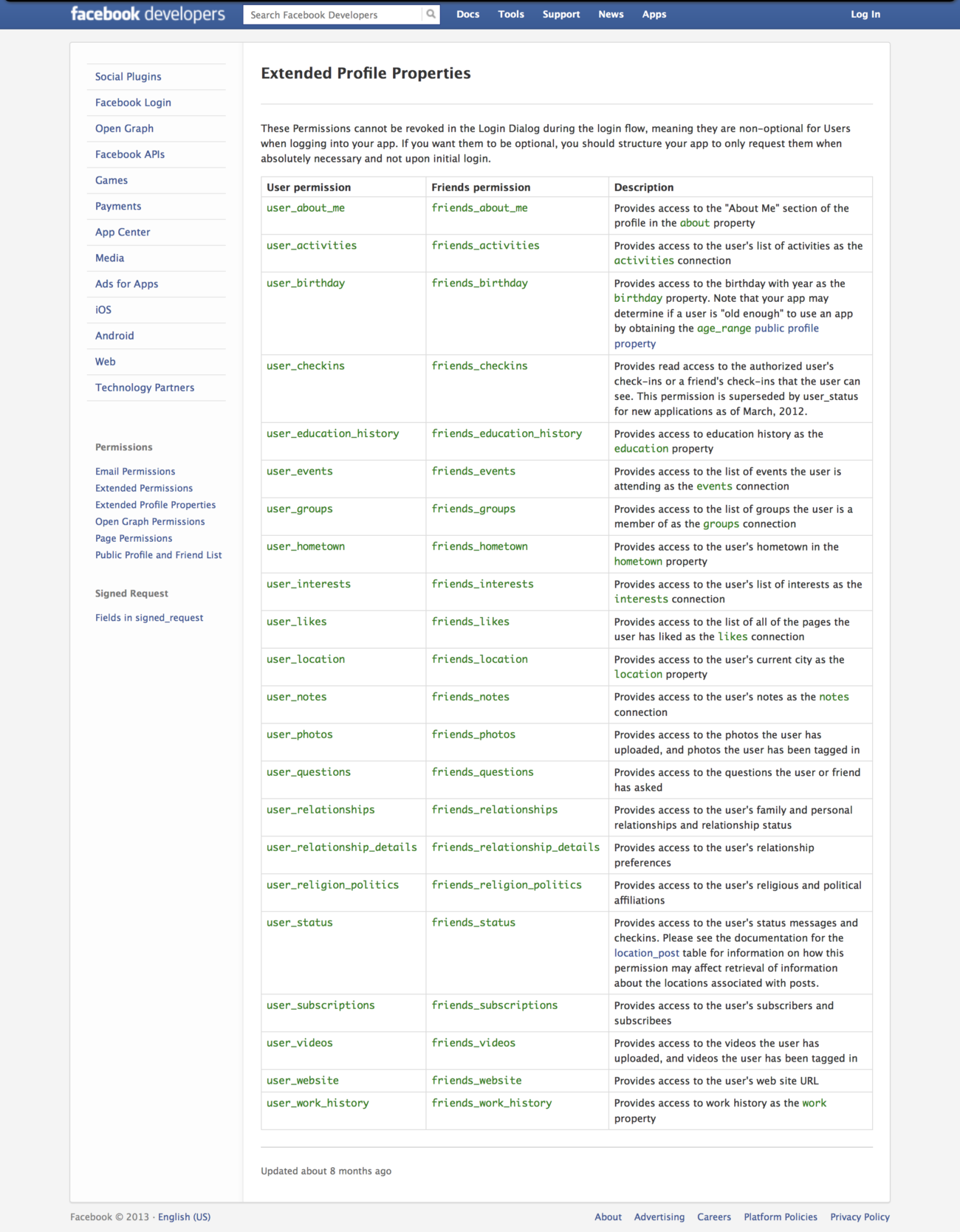

This is the crux of the issue. The problem is that when Facebook asks for "location information", the consequences of this are not being conveyed to the user. The user might think, "ah they want my location for the weather recommendations and event suggestions in my neighbourhood". They do not realise how something so "innocuous" as location information could be weaponised against them.
I used location data as an example because you could infer almost everything about a person just from that. You could know their social circle, their approximate tax bracket, which banks they use, who is their lawyer, their accountant and their wealth manager, their familiar situation, how healthy they eat, how healthy they are, whether they are chronically ill, and what type of chronic diseases they might have, what activities they engage in, what are their political leanings, I could go on, I do not think this is anywhere near an exhaustive list...
The user does not know that Facebook it going to tip off the insurance provider about the user's unhealthy eating habits or his chronic medical condition. Or maybe tip off his bank that he has substantial wealth elsewhere.