I love this bit: "I prefer to spend my college years searching, exploring, and wondering, as opposed to training to become an "asset" in the file cabinet of a "human resource" department. Rock on fellow baristas, rock on."
Translation: "I'll come out of university with no transferrable skills whatsoever. Dreadfully unintellectual dead-end jobs are where I'll be able to keep pursuing my love of knowledge".
Dude.
The author's bio is probably the most important part of this article:
"Grant studies at Wake Forest, where he majors in philosophy and economics."
Translation: "I'm passionate about half the university course I'm currently doing and have absolutely no idea how the job market will treat me when I'm done with it."
Full disclosure: I myself studied philosophy at university. I'm proud of it, but I'd never boast about how poorly it prepared me for the job market.
> I'll come out of university with no transferrable skills whatsoever
I think this reflects a common misunderstanding about either philosophy or what constitutes a "transferable skill." Philosophy teaches writing (quite intensively, in a good program) and abstract analytical skills. I have a philosophy degree and not only have I found it valuable, prospective employers have too. This especially true in my field (law), but I have heard it is true in others as well.
Of course, your experience will vary depending on the type of jobs you're looking at. Some industries will expect specific concrete skills that a philosophy degree will not teach you. And others will tend to be less populated, largely for cultural reasons, by people who understand its value. But this is no different from any other area of study: you have to have some idea of what you want to do in order to determine what field of study would be helpful.
I would argue that my Math degree made me a "better" writer than my Philosophy degree did. Writing quality in philosophy
is generally much poorer than other disciplines; you pretty much have to use passive voice everywhere, which is the first thing your college writing lab will tell you not to do.
On the other hand, in my Math classes, I had to turn in 5-10 pages of proofs every week/every other day for problem set work. It was this work that taught me how to write clearly and parsimoniously, much more so than my Philosophy courses.
This proved to be the case for myself as well, when going through medical school and practice. I discovered I have a pretty good knack for breaking things down to their core principles and presenting them in a succinct, logical manner. I gained a reputation as the guy who could help explain complex medical issues to patients clearly and simply. I credit my undergrad years as a math major with this wonderfully useful skill.
Where in philosophy is using passive voice common? At least in Anglo-American analytic philosophy, first-person active voice has been the norm for decades, since the days when in other fields it was seen as too informal to start a sentence with "I". Even today, scientists love to write things like "three types of experiments were performed to test this hypothesis". While a philosophy paper is more likely to contain active-voice, first-person sentences like "I present an internal problem for David Lewis's genuine modal realism" [1].
As a computer science major with a philosophy minor, I personally found my philosophy minor much more useful in learning how to write clearly than my CS major was.
The idea that passive voice is used in philosophy doesn't seem to be a novel idea [0].
For what it's worth, I don't think undergraduate CS degrees develop students' writing abilities at all. There are only a few proof-based courses I can think of, and those courses (e.g., Theory of Computation, Algorithms) need not necessarily be taught in a mathematically rigorous manner (which is to say, proof writing in these courses may be minimal, depending on the instructor).
Yes. My mileage definitely varied. There's no doubt that there is bad philosophical writing out there, but I've never met anyone (until today!) who thinks that philosophical writing requires or encourages the passive voice. It may be that the passive voice is harder to avoid in Philosophy than in other disciplines, but avoiding it is a useful exercise. That's how you improve!
And at any rate, I don't believe I ever claimed that a Philosophy degree was the best way to develop your writing.
What philosophy program is this? At my school the professors explicitly told us to write in active voice. Also, what material are you studying? It's been a while since I've been in school, but most analytic philosophy material I read were written in very clear and precise prose.
See, e.g., Quine's "Translation and Meaning,"[0] as well as the blog post I linked to further down the page. Not every philosophy program consists solely of analytic philosophy; continental philosophy writing is rife with passive voice.
There's a lot of poor writing in philosophy all around. Passive voice is far from the only authorial sin. Dryness, obscurity, long-windedness and lack of engagement with the audience are probably the most common.
This poor writing is certainly not limited to any particular philosophical discipline, or even to philosophy in general. Math and science tend to be just as bad (often even much worse, except sometimes on the issue of clarity -- at least as far as their intended audience is concerned).
I think the common laborous style comes from the desire to seem "objective", the tradition of presenting very long, drawn out arguments in a "logical" fashion, and the attempt to efface the author from the work (so as to make the argument seem to be self-evident given the premises, and not at all biased or based on one person's experience or opinion). That's hard to do in an engaging manner.
More recently, the practice of revealing who the author is and where he stands is starting to become a little more common. That helps to make the writing more engaging and helps the reader to make more of a connection with the author, but I think this still is very much a minority style. Most of philosophical writing is still mired in "objective" style, and it's difficult to foresee when or if it'll ever make it out.
PS: I'm guilty of this myself, and should really take some writing courses! :)
It says more about our society that the person who chooses to study philosophy. Making more money is valuable and not making much is looked down upon. But, how happy are we? What philosophy can do is expand your mind beyond what society has told you. Consider these questions in looking at your existence,
What can I know?
What must I do?
What is man?
What is God?
They're not to be scoffed at, waved away with a dismissive.. well how much do you make? You don't need much to live you'll find when you get into those questions in your life instead of how much more money can I make to buy stuff I don't need.
You are conflating "philosophizing" with "the modern academic study of philosophy." To most people, the second has nothing to do with the first.
Your grandparents, uncles, and aunts have better answers to those questions. Maybe a two semester survey of the history of philosophy and reading the great works to hear some different perspectives. Neither of these involve a full course of study in philosophy.
This kind of dismissive, condescending attitude towards philosophical concerns which are clearly important to a lot if not most people is one of the main things that really ticks me off about some contemporary analytic philosophers, and especially their predecessors, the logical positivists.
They would have the subjects they have anointed be the only True Philosophy, and anything else as mere "philosophizing". But this "philosophizing" has been largely what philosophy was for its entire existence. It's almost the definition of philosophy.
The grandparent poster mentioned four questions: "What can I know? What must I do? What is man? What is God?"
The first two are epistomological and ethical questions, and it's not like either epistemology or ethics have gotten short shrift from analytics, which currently dominate academia. Some analytics aren't interested in those questions, but that doesn't mean they're not philosophical questions or that they're "meaningless" (a favorite dismissive tactic of the logical positivists).
The last two questions could arguably have to do with ontology and metaphysics: not analytic favorites by any stretch of the imagination, but certainly traditionally considered philosophy. You don't need to go to your anunts or uncles to get a bit of "folk philosophy" (yet another dismissive term from some other analytics) but look to thousands of years of philosophical literature on the subject, or attend school in a non-analytic philosophy department (good luck with that in English-speaking countries, which are dominated by analytics). But even analytics have on occasion tackled ontological issues (see the more recent attention to Heidegger from some of them as an example).
The last question is really on shakiest ground as far as philosophy goes. It could arguably be a theological question, but again, theology is an actual academic discipline and you don't have to settle for survey of the opinions of the average person on the street, but actually go to a university and study it, even if it'll be outside a philosophy department. But there has been plenty of philosophy in history which has engaged in theological concerns in some fashion (some common examples being the existence of God, and the problem of evil). It's just not fashionable to consider those questions in academia these days, but again, that doesn't make them non-philosophical.
> You are conflating "philosophizing" with "the modern academic study of philosophy."
For me that's like having sex compared to studying porn, or like walking around the block instead of watching sports. You can belittle it while I enjoy its fruits.
The philosophy of the origins in the West and in the East did not care even a little bit about "man" or "God". It did care a lot about how to live together. It was mostly about morals and politics. I think today philosophy has sunk in metaphysics, and it is a shame because we need more than ever to learn how to live together.
I agree with argonaut. I did have a philosophy class in college. However, most of my time on it was spent reading books, discussing such subjects with people of many views, looking at real-world events to see which philosophies hold up against them, doing thought experiments, and so on.
I bet this taught me way more than an academic program with a narrow focus run by one or more people probably within same or similar political leanings. Plus, I learned business and tech skills. :)
I'd say it's a matter of perspective. Nobody ever told you barista was special, and requires years of school, etc etc. So you don't feel disappointed when you end up as a "tool". Whereas being a graduate that ends up treated like a cashier at a mall does create some deep internal dissonnance.
Creon wasn't a run-of-the-mill tyrant -- he was a respected monarch who put the good of the city over moral/religious concerns.
His dispute with Antigone is about law vs personal/religious ethics, not about him being a capricious tyrant (besides in the end he relents). Her brother was a traitor.
As long as the inhabitants agree on a specific course of things and have found them to help the city, the "good of the city" as concerning its government is meant as just following that.
So, "good of the city" as in "doing what the city deems good", not as in moral.
Perhaps in Plato's circle in Athens, where we kalokagathiates live on our rents. Otherwise, doesn't one show better with simple indifference to the matter? It seems to me that boasting demonstrates an anxiety about the world's opinion.
But I do like Yeats's line in the poem prefixed to Responsibilities: "Only the wasteful virtues earn the sun."
(Full disclosure: yes, I too was a philosophy major.)
You and the OP have a difference in opinion regarding what higher-education should be used for. You're concerned with potential job prospects while the article seems to deal with developing yourself as a main priority.
I went to an art school, studied theory there and wouldn't trade it for anything. They gave me the tools to teach myself and to understand the things around me - which I see as much more valuable than any specific job-oriented training. And from my experience employers are very impressed with these types of skills too.
> I'm proud of it, but I'd never boast about how poorly it prepared me for the job market.
This is what I don't get: why is there an assumption that what you study at university has to be in any way related to the job market? You study something because you have an interest in developing it further, being able to get a job doing it is just a secondary perk.
"See the sad thing about a guy like you, is in about 50 years you’re gonna start doin' some thinkin' on your own and you’re gonna come up with the fact that there are two certainties in life. One, don't do that. And two, you dropped a hundred and fifty grand on a fuckin’ education you coulda' got for a dollar fifty in late charges at the Public Library."
If you approach college as a consumer of the information fed by professors and books, the Public Library approach is probably a great value proposition (though I'd question whether that $1.50 provided any value at all... :-) ).
However, a good education is much more than this. It includes the opportunity to engage in back-and-forth discussions with professors and classmates, building social and professional networks that can pay innumerable dividends, and to pursue experiences that aren't immediately related to career advancement.
College shouldn't merely be about vocational training. While that's one valuable outcome, there is much more that can be gained. Of course, many colleges (and individual students' experiences) fall far short of this—I wish I thought this way when I was in school, and didn't just see it as another hurdle to full adulthood—but that doesn't mean that the concept is flawed.
I agree with you in theory about the utility of higher education, but it falls apart when you start to consider (at least in the US) the practical system in which it exists. People are taking on debt in order to go to college and the fact of the matter is that it's a terrible financial decision if you aren't expecting some vocational training that will help pay that debt back faster than never taking it at all. I agree that life shouldn't be all about money, but most people can't afford to expend thousands of dollars and 4 years of time and work for an enriching experience.
The big distinction that ends up causing all these arguments is that when people say it's a bad decision, they mean it's a bad financial decision when you go to college and take on debt to get a degree that won't lead to a well paying job. Of course everything is about context, so it might not be a bad life choice, but the debt certainly should not be ignored in evaluating that decision.
Not to mention: while public libraries are great and I love them, thy are often lacking in-depth knowledge.
My local public library doesn't have a book on advanced logic design, for example. It favors a more 'general' collection, and thus books with heavy reliance on math tend to be omitted. Same with in-depth law books, they just aren't there.
> why is there an assumption that what you study at university has to be in any way related to the job market?
Because, like it or not, the majority of people's education is the means to obtain a job in a related field. People don't go tens of thousands of dollars into debt for some l'art pour l'art interest development; they do it because they expect the benefit from the degree (i.e., as a ticket into the job market in a field related to the degree) to outweigh the cost.
>Because, like it or not, the majority of people's education is the means to obtain a job in a related field.
The community college system is more than enough for those who view postsecondary education as a mere vocational program and doesn't require going "tens of thousands of dollars into debt".
Yes. There are financial incentives to go to community college, but if people made their decisions based solely on these, then no one would attend universities.
I'm not arguing for the status quo, but let's be honest about the current state of higher education in America: a ton of people have too much debt because of the pressure to attend a 4 year university. This pressure is usually of the form, "good education => good job". Moreover, "good" is often conflated with "expensive" or "prestigious" with regards to education, and conflated with "high-paying" with regards to a job.
Also, this depends on which country you're talking about. University education in some countries is free. It's also possible to get scholarships which subsidize some or even all of your tuition. Finally, there's often financial aid of various types, from need-based to aid to certain minorities, etc.
>This is what I don't get: why is there an assumption that what you study at university has to be in any way related to the job market?
I think the problem is on the employer/recruiter side. They use college/university degrees as a signaling mechanism to weed out candidates. To make sure that everyone can get the signalling degrees the government offers student loans. The tuition costs rise for everyone including those who don't want a signalling degree. They end up paying more without reaping the benefits of the signalling mechanism.
Well, if you can afford that extra mortgage-sized payment while making minimum wage. We're not talking about studying online or at a community college or self-teaching, we're talking about a 4 year degree at a university.
> why is there an assumption that what you study at university has to be in any way related to the job market?
Because you've borrowed an extraordinary amount of money, sometimes 2 or 3 years of what many Americans would consider a great salary, to attend said institution and the bank would like that money back at some point, they outline that fairly well in the documentation none of us read.
Honestly I think it's insane that one day, your given graduating high schooler has to raise his/her hand to go to the bathroom, and the next day they're entrusted to decide more or less how the next 70 years of their life will play out with incredibly little information at their disposal.
There's nothing wrong with philosophy or any of the classical educations, they are no doubt important. But priority #1 should be making sure your university's newest graduate doesn't starve to death in the street holding a $90,000 degree with "ANYTHING HELPS" written on the backside.
I don't think he's boasting about how poorly it prepared him for the job market. Rather, he's saying studying philosophy is worth it form him despite being poorly prepared for the job market, because he's interested in "searching, exploring, and wondering" -- which he might not be able to do on the job if he got a menial job, but could continue on his own time, after hours.
I doubt he will be working as a barista, though. With his double major, he'll probably have the option to work in academia after he graduates. Economists are also valued in industry these days, and even a philosophy major could always go to law school, which tend to accept more philosophy majors than any others.
I don't think he's boasting about being poorly prepared for the job market. I think he's boasting about being much better prepared for life in general.
I studied some philosophy in college, and found the experience pretty disappointing. The field addresses some really fascinating problems, but I'm not too impressed with their answers. A typical assignment in philosophy consists of thinking about a really hard problem with no good solutions, picking one, and arguing for it. And since there are so few fixed points, almost anything is arguable. Really, it's a debater's paradise.
If I were to do undergrad all over again, with an emphasis on mental calisthenics rather than job skills, I'd study physics and history. Physics is rigorous and really builds your analytical skills. History is deep and builds your research and writing skills. But both are ultimately grounded in reality. There are none of those oh so precious arguments about whether reality is even there.
I started a course in philosophy during my first year of university. I studied CS (in the UK, where you don't typically go far outside your major) but I'd always been curious about the humanities and thought it worthwhile to learn about all fields of knowledge. I'd also read about philosophy for laymen books as a teenager.
In the first lecture, I remember being surprised at how rational and logical the lecturer was. However, in the second lecture, we started getting into the details of different theories of meta-ethics. I was interested in the topic, but the presentation was exactly as you describe, focused on hairsplitting the viewpoints of everyone who'd debated the question previously.
In the last few years I was inspired to start analysing my own ideas and began studying philosophy in my own time. I now know my undergraduate experience was typical of analytical philosophy, which dominates the English-speaking academic world. Unlike continental philosophers, they believe that there's an objective reality and that our thoughts should be logically consistent. However, they also have accumulated a pile of logical puzzles (Frege cases, Gettier problems, the Raven paradox, etc) which imply that language does not straightforwardly refer to reality, that certain knowledge is impossible, and so on. This skepticism is (imo) at the root of the "debaters paradise" you observed.
Anyone looking for an alternative should give Objectivism a serious study. It has such a bad reputation in academic circles that I dismissed it for a long time, but when I finally got around to reading serious Objectivist non-fiction, I found it held together much better with my view of reality. It's basically a version of Aristotelianism, with some of the mystical implications removed. (Introduction to Objectivist Epistemology is the book to read if you want to dive in at the deep end).
Anyone interested in Objectivism should read Nietzsche: the philosopher that Ayn Rand did a very poor job of trying to copy.
I kind of hesitate to mention them in the same sentence, however, as Nietzsche would have probably hated Rand and the Objectivists. Even Rand herself hated Objectivists. There are long rants from her about them in her interviews. But that still doesn't change the fact that Nietzsche was a big influence on Rand.
It sounds like you're parroting things you've heard second-hand.
I was heavily into Nietzsche in my late teens and early 20s, before discovering Rand. He definitely influenced her in her early years, but by the time she came to write down her own ideas she'd rejected pretty much all of his ideas. She was an Aristotelian.
> Even Rand herself hated Objectivists.
This is not remotely true. In her later years, she concluded that the organised Objectivist movement had been a mistake, but she still hoped for an informal movement of intellectuals to follow her philosophy.
Ayn Rand definitely moved away from Nietzsche (as they are very different), but I think it's hard to deny his influence on her. Some parallels, particularly her idea of the ubermensch, are very Nietzschean (though again, the actual definition of the two differ markedly). To really understand where she's coming from, and where she's getting her ideas (which are often better and more deeply explored elsewhere) you have to read other philosophy. Nietzsche is one, perhaps Aristotle is another.
As for my allegation of Rand's hate for Objectivists, it looks like I misremembered. It was actually Libertarians who Rand despised, not Objectivists.[1]
You are talking from ignorance. She doesn't have an "idea of the Ubermensch" - she esteems honest ordinary men highly, and condemns modern elites.
What is Nietzsche's solution to the problem of universals? What does he say about the is-ought problem? What does he say about capitalism and individual rights? All of these things are discussed in Rand, none are discussed in Nietzsche, who rejects reason, logic and universal truths.
Sure, read other philosophy, but to really really understand where she's coming from, you have to read her, and not confidently spout second-hand misinformation.
Rand is most known for her "virtue of selfishness" idea and her high esteem if not worship of people who she considers to be superior due to their daring, individuality, flaunting of social conventions, and self-centeredness. This is a dumbed down or "mini me" version of Nietzsche's ubermensch concept.
Rand is not known for her view on any is-ought problem or her views on universals. She may have something to say about them, perhaps it's even original in some manner, but it's generally not what most Objectivists and Libertarians flock to her for. They flock to her to get some philosophical approval for their own self-centerdness. To those people I again recommend they read Nietzsche, to learn what one of the most influential philosophers of all time though on this subject that Rand tried to co-opt.
I never claimed and do not claim that everything Rand ever thought was thought first by Nietzsche, but the central idea that she's known for and that she championed she got (in a very distorted way) from him.
I also never suggested that Rand should not be read. It is a pity that she is ignored in academia. As a result, most of Rand's fans are often effectively isolated from the rest of the philosophical community and wallow in an intellectual backwater, with little awareness that there are other philosophers, what they thought, or how Rand's ideas relate to them. It would be much better if her work was read, taught, engaged, and challenged in academia, and her place in place in philosophical history was made more overt.
Finally, I have read Rand. Not nearly as much as her fans would have me read, I'm sure. But enough to say what I say from first-hand experience.
Similar studies and experience, I also think that Objectivism is one of the strongest philosophies. It's kind of ironic that we have to talk about Objectivism without naming the main author for politic reasons.
I like philosophy but, the "debater's paradise" really gets to the problems with it. Arguments can never be settled, just dragged on. I like this quote about the history of science, before the scientific method.
>...The scholastics saying that matter was this, or that, and justifying themselves by long treatises about how based on A, B, C, the word of the Bible, Aristotle, self-evident first principles, and the Great Chain of Being all clearly proved their point. Then other scholastics would write different long treatises on how D, E, and F, Plato, St. Augustine, and the proper ordering of angels all indicated that clearly matter was something different. Both groups were pretty sure that the other had make a subtle error of reasoning somewhere, and both groups were perfectly happy to spend centuries debating exactly which one of them it was.... People are terrible. If you let people debate things, they will do it forever, come up with horrible ideas, get them entrenched, play politics with them, and finally reach the point where they’re coming up with theories why people who disagree with them are probably secretly in the pay of the Devil... Imagine having to conduct the global warming debate, except that you couldn’t appeal to scientific consensus and statistics because scientific consensus and statistics hadn’t been invented yet. In a world without science, everything would be like that.
Yes. A lot of this discussion hasn't grasped your point. Philosophy did settle a lot of questions. They became natural history, physics, chemistry, even mathematics. The ones that are taught in Philosophy courses are the ones that haven't been settled.
Mathematics existed for a long time before philosophy, although the two do seem closely related. Science does have origins in philosophy, but I don't think it was philosophical arguments that settled scientific issues, but the invention of the scientific method, which abandoned the need for them.
Anyway the main point of that quote is that without developing a consensus or the ability to experimentally test theories, debates have a tendency to drag on for centuries without going anywhere. Of course philosophy can't settle issues experimentally.
The main criticism I've heard of philosophy, is that they don't try to form consensus and encourage the dragging on. Philosophy students spend their time reading through the history of philosophy and studying old arguments and issues. Whereas in math or science, there isn't really an emphasis on history or even that much about ongoing debates.
Mathematicians don't have a way to experimentally test ideas either. Certain ideas, like the validity of infinite sets, or of Cantor's diagonal theorem, are arguably philosophical in nature as much as mathematical. And were extremely controversial at one time, with many notable mathematicians taking the side against them. But mathematicians did come to consensus on them, eventually.
The rules of logic should be applied in philosophy as in physics. If you don't do that, or there is no competent judge (e.g. teacher) things tend to get out of hand, especially with people studying philosophy because they "can't do math".
I think are overstating that, but it's worth pointing out that more than anything students in my philosophy program went on to law school and seminary...
> thinking about a really hard problem with no good solutions, picking one, and arguing for it. And since there are so few fixed points, almost anything is arguable. Really, it's a debater's paradise.
Sounds like the entire content of all non-technical jobs and a good proportion of the content of technical jobs.
I like this. It's short, and covers how influential philosophy has been. And I have no problem with snark from someone who's interest has become the butt of cheap jokes.
However, when it comes to the greater conversation, I'm less generous. I think an aspect of the supposed STEM vs Humanities divide is class, which seems like a bit of a stretch now that I write it down.
I chose the most fascinating, lucrative, TRADE I could. And damn, it pays well. And now people who had the freedom to go to an expensive University and 'explore themselves' can condescend to me while also feeling persecuted by me. And my coworkers condescend back, but I remain interested in the humanities, but it just was not a choice to go to college for the fun of it.
I was the first in my family to go to college, and from the start it was understood that this was my ticket to the upper middle class, where your parents aren't in tears figuring out how to pay their bills. (Although we did OK, Dad found another job, etc. Never actually went broke. My mom just might be the type to cry when frustrated.)
When people had the freedom to go to college to explore themselves and the humanities, and you weren't expected to justify your degree, mostly rich people went to college. As a small minded reformist Bourgeoisie, I'm OK with this. Now is better than then. Lets make college even better in the future for everyone, not just my kids, who will be free to explore themselves with post-colonial vaporwave music production.
PS My father was in a real trade, I don't actually think of Software Engineering as a trade, but I do think there is a class thing here.
The Athens of Plato's time was a society built on slave labor. They were a strictly patriarchal society (women weren't allowed to leave the house much), and to be a citizen meant you didn't need to work for a living. In short: a degree and a kind of classism we have difficulty imagining.
None of this mitigates the lessons that Plato, Aristotle, Heraclitus, Pythagoras, etc., have left behind for us, and which await us at the local library (or liberal arts college).
You're right that access to higher education is not where it should be. This is well understood, protested, discussed, etc.
But the decision to pursue more or less lucrative paths is a free decision.
You may well be coerced by issues attending economic inequality. You may face great sacrifice in order to devote yourself to something like philosophy[1]. And certainly the decision is inextricable from (let's not forget) your family life (oh, you want kids? you want to live in a real house, not a tenement house? you want healthcare and a minimal retirement fund?).
But these are decisions about what kind of life you want to lead, and the examples above are about the comforts you may want in life. It is not a coincidence that philosophy's purview lies in asking the questions that help you understand why you value what you do, and base your decisions accordingly. And it may even turn out that, in the course of better understanding why you have found something meaningful in the past, that you no longer find it quite so meaningful. You may, in fact, have turn of heart, and start a new chapter in your life.
It would be great if we had social values that translated into an economy which enabled academic pursuits instead of hampered them. (If you think this is idealism run amok, take a look at Finland[2], with the best primary education system in the world, where getting a degree in education is as competitive and prestigious as becoming a doctor; not coincidentally, those careers garner similar salaries).
But we're not there yet. Maybe what's needed are more philosophy majors.
I'm out of my edit window, but I am aware Bourgeoisie is the class, I should have said I am a small minded Bourgeois.
Post-colonial vaporwave music production is an associates degree. My children can get degrees in post-colonial power electronics music composition. Also, to apologize for that snark, post colonial theory is interesting, music composition is very interesting.
"Philosophy is the discipline whose adherents kick up a load of dust, then complain they can't see". Murray Gell-Mann.
Mind you, I do have a degree in Philosophy from a faculty very firmly in the analytic school. Logic, metaphysics and ontology have been helpful in thinking about software problems. For instance, you can think of Russell's On Denoting ("the king of France is bald") as being about null pointers, or dangling pointers. And Kripke's rigid designators are a solution to the bad pointer problem. One of my lecturers, Jeremy Butterfield, would always exclaim "because Quine is our hero" whenever he mentioned the great man. "No entity without identity" and "to be is to be the value of a bound variable" are useful rules for software design as well as ontology.
You forgot the precision of language usage and precision and clarity of definitions, which has been the foundation of math - the way to deal with meaningful abstractions, and then so called computer science, where naming, clarity and reduced to the essence (to an optimum) abstractions (ADTs) are the most important aspects.
Classification (ontology) and labeling of a human language gives us meaningful type systems (Java has nothing to do with it). Logic gave us control structures and ultimately algorithms.
The philosophy of science and epistemology gave us the absolute necessity of tests and reality checks (otherwise one ends up with Hegelian abstract nonsense or what we call theoretical physics).
And metaphysics is just nonsense for weak minded to boost their self-esteem, which gave us "everything must be Object Oriented, statically typed, absurdly verbose" crap.
Lets replace language with an arbitrary (but precise!) 1:1 token system.
After all, etymology, idiom, metaphor, anacoluthon, etc., just muddy the waters of clarity.
And if clarity is what we value above all else, then we can ply our new arbitrary signification language to make all thinking about precise denotation of external entities and their logical relations.
According to Dennet, "AI makes philosophy honest".
Philosophy benefits from the precision and enforced clarity of computer science and math.
I'm sure computer science can benefit from philosophy too, but not sure if the benefit is enough that it's worth it for a computer scientist to study philosophy in the time they would otherwise use to study computer science.
Of course it's always better to be proficient in both.
It's always made me sad when I come across people who's entire philosophical training makes them believe that philosophy is only about playing with puzzles like "the king of France is bald" or that someone like Quine's (or Russell's or Kirpke's) work is the epitome of philosophy.
It reminds me of Schoppenhaur's maxim that "every person takes the limits of their own field of vision for the limits of the world."
Dammit, there can be a lot more to philosophy than language puzzles!
Limiting philosophy to just playing with them is I think one of the main reasons that most people recoil when they come in contact with philosophy as it is practiced in most academia these days. They take that to be what philosophy is all about -- as that's how it's usually presented to them by analytics.
Most people have a lot of questions serious, which are desperately important to them, and which philosophy has traditionally engaged in. But analytic philosophy often either completely ignores them or provides only the most superficial treatment to them -- treating them as puzzles or games, or buries them in technicalities. It's really no wonder that such an attitude is a huge turnoff for people for whom these issues are real and of literally life-or-death importance.
So they recoil and go back to "folk philosophy" as some analytics condescendingly call it, and philosophy as is mostly studied in academia these days climbs every higher in to its ivory tower.
But philosophers do spend a lot of time on such formal, sober, lab coat style analysis of rational arguments and language and so on.
Just like how computer scientists spend a lot of time working on stuff like type theory (which of course has strong ties to 20th century philosophy, even to the positivists in some ways) which could be seen as anemic or formalistic or whatever.
I have sympathy for people who have burning life-and-death questions but to me it seems somewhat foolish to look for their answers in philosophy. Wearing my philosophy dabbler's hat, questions like that mostly seem like they have a feeling of urgency because they are confused and emotionally charged, and I (somewhat condescendingly, if you'll let it slide) suggest careful analysis of the premises and definitions involved, to maybe attain a less urgent and stressful state of mind.
Someone might find it extremely important to find the answer to the question of whether God is real. There are certainly philosophers who have written fervently about it, say Kierkegaard. But I think of the quiet kind of passion of someone like Spinoza, who in a way sidestepped that whole urgent question, and did it very carefully, analytically, and productively.
Mostly I think people will find their own allegiances and ways. Philosophy is very broad and diverse. If one school operates in a way you dislike, what's there to do but find another one? Or start one...
A rigid designator designates the same object in all possible worlds. Translation to software terms: a safe pointer/reference refers to the same object in all possible process lifetimes. Consider Python: everything is an object, including integers. If you look into the C implementation of CPython you'll see that the runtime creates certain commonly used object up front, rather than on demand as is the case for most objects. IIRC integers 0 to 10 are created upfront. So if we exec 'i = 0' in Python and don't change i then i refers to the same object every time we execute. It's a rigid designator!
I don't think Kripke has ever been anything but a philosopher. His work has influenced computer science, but he hasn't ever really directly worked in that field himself. The closest he's come to a CS journal or conference is publishing in a few philosophy of computing conferences, and a bunch of logic journals (but generally the ones more in the philosophical-logic tradition, not computational logic).
I'm going to reproduce a reddit post I made recently that I think is relevant:
Analytic philosophy has made my mind a razor. It forged in me the confidence and mental discipline to learn anything, and I'm now dominating the tech scene despite having little in the way of formal coursework.
I was lucky to choose one of the few disciplines that can be fruitfully studied at Brown. As any student of a rigorous discipline, I was ultimately responsible for my own intellectual growth; everything I ever truly learned has been in solitude. The less-than-brilliant technical faculty, weak course offerings, and charlatan arts professors had little negative impact on me. In fact, being forced to retreat within myself was necessary for my success, because it allowed me to look at reality more critically, unmired by the prejudices and preoccupations of the misguided or less thoughtful around me.
I have nearly everything I want in life, but I was lucky to (1) pursue rigorous scholarship and (2) be born with the abilities and personality that made such a pursuit feasible at Brown. The less intelligent[^] or more impressionable will be made failures at Brown. Those are the people I'm trying to warn.
[^] For example, those who were not invited to attend a better Ivy League university. It's very tempting for someone in this position to choose Brown over a better option simply because it is wrongfully perceived as prestigious for technically being an Ivy.
I'm not a big fan of analytic philosophy, quite the opposite. Continental philosophy is much more my speed (though there are plenty of parts of even that that I have big problems with).
I consider analytic philosophy to be a blight upon philosophy in general. It started off dominating universities in mainly English speaking countries, but has moved on to gain control over many others. It's even started to co-opt philosophers traditionally considered to be in the Continental tradition, such as Nietzsche and now even Heidegger (who used to be absolutely despised as analytics, but now is seen by some as almost one of them).
As a result many if not most philosophy students now see all of philosophy through an Analytic lens. They usually come out of their training thinking Analytic philosophy is the only "true" or "serious" way to do philosophy, and even when they encounter Continental thinkers, they view them effectively as being Analytics, usually completely missing the point.
It's not clear how much non-Analytic philosophy will still be taught in another 50 years, perhaps not very much. I think that will be very sad.
As someone famous once said, "There are more things in heaven and earth, Horatio, than are dreamt of in your philosophy." Many Analytics seem not to have learned that lesson. To be fair, neither have many famous Continentals (a certain degree of arrogance and myopia seems too often to be a prerequisite for fame in philosophy), but at least they're not taking over the world with their rather narrow perspective. I'd like it just as little, for example, if everyone who got a philosophy degree was a Heideggerian.
That said, I don't want to come off as saying that I consider training in analytic philosophy to be useless. Training in logic especially (which many analytics consider a prerequisite for doing any kind of philosophy) can certainly help to "make your mind like a razor". I'd just be careful that all that probably exclusively analytic training doesn't make your mind like a hammer and everything you see like a nail. There are other ways of looking at the world (and of doing philosophy). Some of them might even be just as valid and useful.
You have lots of metaphors and how analytical thinking is "narrow", but I didn't found your argument why continental philosophy would be better to study than analytical tradition.
I'm suddenly reminded of an acquaintance whole called me "narrow-minded" when I said chakras and horoscopes are maybe fun, but have not much to do with the observable scientific reality, so you should not be serious about them.
I mean, I reviewed the wikipedia dictionary definition [1] of major trends in continental philosophy to see to refresh my mind what it was about, again, and I'm not terribly impressed. If analytical is "narrow" viewpoint, then fine, in my opinion it's very needed right kind of narrow a rigorous and honest study of philosophy needs.
I haven't made an argument for why I saw analytic philosphy as narrow or why I prefer Continental philosophy. And, really, it takes a lot more than a little post HN or a Wikipedia article to make that argument. It takes an education.
Also, as much as I love Wikipedia, and use it every day for all sorts of things, it's not very strong on philosophy. There are tons of misrepresentations, and possibly because it's primarily an English-language encyclopedia and Analytic philosophy utterly dominates English-speaking academia, you're rarely going to get a fair or informed view of Continental philosophy from it.
You really need to go to the primary sources, at the very least. And, if you're coming from the Analytic perspective, you'll probably also need guidance from a teacher who can break you out of the Analytic blinders that will tend to make you see all of philosophy from an Analytic perspective.
Neverthelsess, here's really quick summary of what I find problematic about analytic philosophy: I see it as mostly full of mere language games and really trite analysis of various puzzles analytics prefer to focus on. And whenever they do happen to deal with issues I consider important, they do so on a superficial level (sometimes an exhaustively enumerated level, but rarely getting to the heart of the problem or addressing it as more than a puzzle).
I have my own issues with Continental philosophy, and some of it (like Derrida, who, incidentally, most Analytics despise) have somewhat a similar language-game attitude towards philosophy. But Derrida doesn't play by the same rules as the analytics, so the latter usually opine that he's not doing philosophy at all.
But be that as it may, I find both of the language-game approaches to be narrow and blinkered in that they rarely admit that there are other valid ways of approaching philosophy. It's really this exclusivist, small minded approach that I object to most, whether it comes from Analytics or Continentals. It's just most grating from the Analytics, as they are by far the most dominant and therefore usually manage to steer the discourse by just outnumbering and dismissing other perspectives.
If Derridians ruled academia, I'd have many of the same objections against them. But at least most Continentals don't have assume the pretense of being "objective" or "scientific", which are sometimes used to justify the dominance of Analytic philosophy over other approaches.
But these days Analytics rarely bother to justify themselves at all, as there often isn't anyone to justify themselves to (except maybe people not trained in philosophy, who are sometimes still impressed by the veneer of science). In the English speaking world Analytics are almost all there are, so they rarely feel the need to justify their approach to other Analytics. They all feel their approach is self-evidently correct and the only real way to do philosophy. They're like fish who are blind to the existence of water or the possibility of walking on land. It's really annoying to try to communicate with them if you do happen to be one of the few land-dwelling creatures left, as they'll either ignore your existence or deny that walking on land is possible or proper. </rant>
Analytic philosophy has made my mind a razor. [...]
Formal mathematical training (graduate) will do that to you too. I often find myself thinking with abstract algebra ideas (groups, vectors, vector spaces, commutation relations, etc).
I'm well trained in mathematics. It's certainly healthy. However, I often find that outside of their professional work, mathematicians are more willing to part with rigueur than the philosophers across the hall. Notice how most mathematicians aren't particularly interested in foundations of mathematics, for example.
I'm not sure if that's really true about mathematicians lacking rigour.
I do recall a logic professor of mine jokingly say that mathematicians were afraid of logicians, and (more seriously) that the former thought the latter were unnecessarily precise. (I hope I'm remembering this right and not misrepresenting what he said)
I'm not sure about the superiority in rigour in the rest of philosophy (even if we narrow the meaning of that term to just analytic philosophy, some of whom sure are fond of their logic, symbols and attempting to sound "scientific" or rigorous). If anything, I'd say those analytic philosophers have math (or hard science) envy.
You're right about mathematicians not being very interested in the foundations of math. That's a consequence of the failure of the great foundational project in the early 20th century. From what I understand, most mathematicians have decided that such a foundation is not possible, and view themselves as moving on to doing the very practical business of math anyway. After all, the lack of a foundation has not prevented them from achieving many interesting (and often useful) results.
That said, there has continued to be interest in foundations for math from some logicians, and (at least according to my logic professor) it still might be possible to found math on logic yet. That's quite a bit out of my league, however, so I'm afraid I can't elaborate much. But if you're interested in that, I do recommend taking some courses in symbolic logic and in the philosophy of math.
I can only assume his persona and commentary is an elaborate satirical parody of the snooty narcissistic philosopher (but you never know.. Poe’s Law and all that). To quote from saintzozo’s website:
Mathematics is easy.
If you think it's hard, you are retarded.
proof
Any true mathematical statement is logically equivalent to the axiomatic framework within which it occurs. If you do not understand such a statement, there are only two possibilities:
1. You do not understand the axioms.
Axioms are chosen so that they are evident a priori (eg. the probability of all disjoint events must sum to unity). If all the axioms are not clear to you, there is something seriously wrong with your reasoning faculties.
2. You do not understand logic.
If you understand the axioms, then the only thing that could prevent you from understanding a true mathematical statement is an inability to reason logically. Such a crippling deficiency defines what it means to be retarded.
This case analysis exhaustively proves that if you don't understand math, you are retarded. ■
corollary
Now one must be wary of students formally enrolled in programs of study devoted to mathematics (and its bastard child, computer science).
These people misunderstand mathematics (read: are retarded) to such an extent that they have resorted to paying other people money for instruction in the obvious. [...]
Axioms are chosen so that they are evident a priori
Wonder why it took 2000 years to came up with alternatives to the 5th postulate, if all three variants (Euclidean, elliptic, hyperbolic) is so evident apriori?
Sir, I own the copyright to this material and I would appreciate if you do not reproduce my work without permission. For some reason, this site no longer appears to function with my original account.
I wouldn't say there is maths envy in analytical Phil.
Stuff like modal logic , ontology and descriptive logics , a large variety of para-logical systems and epistemically logical systems, etc are all philosophy proper.
Lots of professors have a background in maths, even continentals (e.g Husserl).
I think mathematical rigour is the holy grail but the objects of the philosophical world are often not easy to coerce into such a form hence the piecemeal visage.
I don't know about willingness. There's one way to back up your point though. Philosophers learn to apply rigor in very broad situations, getting used to usisng it everywhere.
Mathematicians apply it very rigorously, but mostly in math. Applying that to other areas without specific training is difficult. For this reason, academic philosophy makes a person more rigorous in life generally.
Until you meet a math problem, of course.
Not that learning anything as rigorous and precise as math won't teach you clearer thinking - of course it will.
I'm a mathematician working in industry and I'm not at all interested in foundations. That's partly because I trust that all that stuff was worked out in the last century, and partly because there's so much more exciting stuff in math to be interested in instead.
Your belief that foundations were worked out in the last century is completely mistaken. Very serious and concerted efforts at foundations were made then, but they famously and dramatically failed when apparently unreconcilable contradictions were found at the core of these foundations. Then the foundational effort was largely abandoned and mathematicians moved on.
I suppose back around that time and up to a certain time after this happened, most mathematicians were aware of this history, but perhaps they aren't any more, if yours is a representative view.
So then it comes down to interest.
But many mathematicians were interested in foundations around the early part of the 20th Century. Now they're generally not.
This shift makes me wonder how much of mathematical foundations are actually "inherently interesting" (if there is such a thing) to mathematicians and how much has to do with fashion, and if it foundational projects among mathematicians will ever become fashionable (or "interesting") again.
"The most comprehensive formal systems yet set up are, on the one hand, the system of Principia Mathematica and, on the other, the axiom system for set theory of Zermelo-Fraenkel (later extended by J. v. Neumann). These two systems are so extensive that all methods of proof used in mathematics today have been formalized in them, i.e. reduced to a few axioms and rules of inference. It may therefore be surmised that these axioms and rules of inference are also sufficient to decide all mathematical questions which can in any way at all be expressed formally in the systems concerned. It is shown below that this is not the case, and that in both the systems mentioned there are in fact relatively simple problems in the theory of ordinary whole numbers which cannot be decided from the axioms."
From "On Formally Undecidable Propositions of Principia Mathematica And Related Systems" by Kurt Gödel, 1930
I am aware of Godel, thanks, and of course that choice / Zorn's / well ordering (not to mention CH) are independent of ZF (and in particular that's why I mentioned ZFC). I'm also willing to accept the existence of an inaccessible cardinal, which bears on ZFC's consistency.
Ultimately my belief is this: there was a very real crisis in foundations at the end of the 19th century and over the next several decades this was fixed as best as it could be. The edges of the foundation are not perfect, the edges of the foundation cannot be perfect, but the edges of the foundation have been pushed back so far that for nearly every working mathematician they're good enough. (and if the algebraic geometers need Grothendieck universes, I'm ok with that)
Comments like that are lost on Reddit. Reddit isn't about discourse, it's about upvotes. The whole "just find good small subreddits" also doesn't work unless you subscribe to their specific early-stage cults mentality. And each sub has one.
Question -- you say that you are a person who is able to learn in solitude. Would you have been able to pursue your dive into Philosophy without the environment that Brown offered you?
I ask this for a few reasons.
1) I have a fairly strong interest in the discipline, but have found rigorous self guided study to be a challenge, beyond cursory readings of the classics and a smattering of modern theorists like Singer.
2) I feel that a fortunate circumstance today that the fastest growing, lucrative profession is programming, which now has a wealth of online resources for new entrants to get started and become proficient. Many other technical disciplines require prohibitively expensive lab equipment to learn the craft. I wonder if philosophy is a discipline within the humanities that is more difficult to cultivate in a self-directed fashion than others.
You certainly don't need expensive lab equipment to do philosophy. But a lot of philosophy is about interacting with others, about learning other people's ideas, considering them, coming up with your own reactions to those, and getting feedback as they consider your reactions. That kind of feedback loop is difficult if not impossible to do on a deep level without going to school for philosophy.
I'm sure there are people who have a very deep knowledge and understanding of philosophy despite being self taught, but I would be surprised if there were very many of them these days. It used to be a lot easier in the past, when there wasn't as much to learn. But even going back 2500 years to Plato's time, there was a great role for learning in the Academy, from which modern universities descend.
Of course, it doesn't take a university education to "do philosophy". You could certainly "philosophize" without any education (and a lot of people do, often not realizing that that's what they're doing). But I guess it all depends on what your goals are, and how deep you want to go.
I've personally found discussing what I'm learning with other students and with professors to be critical for my own education. I think philosophy is often as much of an oral tradition as it is a written one.
Finally, it requires an enormous amount of self-discipline to read and write as much as you would in getting a university education in philosophy, if you're going to try to teach yourself. A lot of people think they can just teach themselves, but later find to their regret that they can't without the structure provided by classes, schedules, graduation requirements, and teachers.
I'm not the guy you're asking, but I've spent some time 'in solitude' studying without an academic institution. I'd read philosophy books whenever I have down time. Consciously replacing entertainment with books works as well.
Philosophy to me is less about studying philosophy itself as a topic but encountering different people's various personal philosophies about things. Kierkegaard's "The Present Age" and Glenn Gould's perspective on anxiety helped me a lot.
[0] "Anxiety gives way to pleasure and a passion for creative work for which the only condition is solitude."
[1] "I do feel quite convinced that one's creativity is enhanced primarily by the more-or-less single-minded pursuit and development of one's own resources without reference to the trends, tastes, fashions, etc. of the world outside."
Who studies philosophy in school when graduates becomes a historian of philosophy, not a philosopher. Requirement of a diploma to philosophise contradicts philosophy itself. One can be a historian of philosophy and a philosopher at the same time, but the former does not require the latter and viceversa.
Philosophy is not a job, it's a personal trait, like honesty, faith, generosity, aggressiveness, asocialness, timidity, etc. If you want to enhance your philosopherness, then you think about things systematically, and learn as much as you can so that you have more raw material to use as proofs --pro and contro-- your ideas when you think. Reading others' philosophy is always useful as it expands your toolbox and knowledge.
Philosophy is love of wisdom. Just like love of your significant other is not a job, philosophy is not too. No-one gets to determine whether you're a lover of wisdom or not, just like no-one gets to determine whether or not you're a lover of your s/o.
So you don't need the school nor to quit your job to philosophise.
> Who studies philosophy in school when graduates becomes a historian of philosophy, not a philosopher.
No, when they graduate, they become a degree holder in philosophy. What they do afterwards determines if they become a historian of philosophy, a philosopher, or something else entirely (or some combination.)
> Requirement of a diploma to philosophise contradicts philosophy itself.
Perhaps (though I think its more accurate to say that it contradicts some particular philosophies), but pursuing a diploma to improve your ability to do something doesn't mean that there is a diploma requirement for that task.
I mean, "requiring a diploma to do science contradicts science itself" is at least as accurate, and probably more accurate, than the version with "philosophy" in place of "science", but few people would dispute that, in many fields of empirical science, the education which goes into a diploma, particularly at certain schools, is useful to one wishing to do science well.
Similarly, formal education in philosophy can be useful to those wishing to do philosophy well.
> Philosophy is not a job, it's a personal trait, like honesty, faith, generosity, aggressiveness, asocialness, timidity, etc
No, its not. "Philosophy" has at least two related senses, one of which is a thing one does (perhaps as a job, perhaps not), and the other of which is an a label for a class of belief systems, the holding of one of which is a personal trait, but philosophy itself is not a trait that you have more or less of like the ones you named, but instead something which you have one or another specific version of. (The first sense of "philosophy" discussed previously is approximately developing, refining, and critiquing instances of the second sense.)
> Philosophy is love of wisdom.
The English word "philosophy" derives from Greek for the love of wisdom, but that's not what it means. Etymology is distinct from definition.
>> Who studies philosophy in school when graduates becomes a historian of philosophy, not a philosopher.
> No, when they graduate, they become a degree holder in philosophy.
No, what they become is a historian of philosophy. Because what they learn is the eminent philosophers and schools from the past, and the philosophical methodology. This is like studying hittitology, they get to learn the hittite language, the hittitle literature, and they practice their writing on actual stone tablets, but at the end they become hittitologist, not hittites. What the education system in a given country considers a graduate from a philosophy course of a university is irrelevant, that's just a bureaucratic title.
>> Requirement of a diploma to philosophise contradicts philosophy itself.
> Similarly, formal education in philosophy can be useful to those wishing to do philosophy well.
My words agrees yours. I don't say a diploma is futile, just that it's not a requirement, and it cannot be one. Nor do I say that it's useless.
>> Philosophy is not a job, it's a personal trait [...]
> No, its not. "Philosophy" has at least two related senses, one of which is a thing one does (perhaps as a job, perhaps not), and the other of which is an a label for a class of belief systems, [...]
>> Philosophy is love of wisdom.
>The English word "philosophy" derives from Greek for the love of wisdom, but that's not what it means. Etymology is distinct from definition.
A personal trait is a group of things one does anyways. If one is timid, he does things that makes him timid. Philosophy is such, it includes thinking, doubting, searching, discussing and deciding.
You are mostly describing a western, originally-catholic, formal and academic sense of philosophy. I do not stay within that confining context, and think that the first and foremost task of a philosopher --and a task that continually shows up in whose life-- is to define what philosophy is, a task unachievable if one just opens some dictionary's P section and accepts whatever he finds there.
> No, what they become is a historian of philosophy.
No, they don't. If they go on to practice history of philosophy, sure, they become that, but many holders of philosophy degrees don't do that.
> Because what they learn is the eminent philosophers and schools from the past, and the philosophical methodology.
That's no more true than it is to say that what a person learns when taking a science degree is the eminent scientists of the past and their scientific results. Which is to say, that is a large and important part of what they learn, but hardly the whole thing, and there is utility in knowing what others have done in the space to doing new work in it. (Obviously, knowing the past of the field is also useful to people who wish to practice as a historian of the field, but its certainly not the only thing a degree is useful for. Holding a philosophy degree makes you neither a philosopher nor a historian of philosophy, both of those describe things you might do, with or without a degree, to which a degree might be useful.)
I've done both self study and school in that order. Exposure is the problem in self study. You need some way of giving yourself a balanced representation of ideas. You may do well to pick a syllabus from s strong Uni and follow it right through .
The other thing of course is someone to call bullshit on you... Phil is a great subject with which to convince yourself that you are a genius . Especially when the people you talk to about it (friends et al) are in awe of your expositions since it's hardly common parlance . Keeping the narcissist in check is difficult for some.
Is this satire? This is pretty much the perfect expression of all the most insufferable moments and people I knew during my own analytic philosophy education. It's even wrapped up in the fondest delusion of philosophy undergrads: that you, through the sheer strength of your intellect, rose above your surroundings.
Your shit ain't that great, man. If anyone goes through four years of philosophy and is talking about their worldview like this, run away from them.
Edit: agh I read his blog and I regret to inform you all that this person really has his stuff down pat definitely a true scholar here
Huh. Their website (http://soixante-neuf.homosexual.horse/veritas/) does seem at least somewhat satirical, and yet, if they are trolling, they are quite committed to it. They do seem to post a lot on reddit about Brown: https://www.reddit.com/user/saintzozo. Although those posts seem like a lot of trolling as well. Ah, I dunno. It's difficult for me to figure out exactly the dynamics of trolling vs. other forms of satire vs. sincerity that are in play here.
Honestly? Still not sure myself. The "leave a comment for my secretary" form is either some Grade-A douchebaggery or trolling perfected. But if this whole thing is intentional satire then it's too many layers deep to make its point.
Right?? I think trolling and satire are different, now that I'm looking at this bud — satire needs to be obvious lest it further the goals of the thing it's making fun of. Trolling actually needs you to buy into what it's saying, which seems to be the goal here.
I'd guess trolling, which is even more unfortunate than genuine pomposity. Not the only personality in this thread where it's legitimately difficult to tell, either.
"Consider that my penis is nine inches long with a girth I am unwilling to divulge even here — a characteristic with strongly positive social consequences.
I have to have my pants specifically tailored to obscure the size of my genitals in public, lest women follow me home, send me unnecessary gifts, and assemble with cameras outside of social venues in which I am spotted."
After taking some in college, philosophy to me was more like a stepping stone in critical thinking to embracing the light of science. I've noticed on so many youtube forums for example, people postulate things without external verification in nature, "if this then that" where tautologies and vin diagrams and the like are held as absolute truths. It never was sold on that as there are more dimensions to reality than our simple minds can grasp within a cleverly worded statement.
The main point being is observing nature always trumps anything philosophy will ever invent on its own. Philosophy is a nice way to help frame hypothesis if you keep in mind that's all it can ever do and not take it too seriously. I do give philosophy the proper respect it deserves for starting the fire of thinking deeper so I could grasp what quality information actually was, but then you must step off of it as something unreliable unto itself.
Yes, absolutely. As an extreme example, we also started from lower versions of apes as well but we keep progressing and refining. To quote Marvin Minsky, "We stand on the shoulders of giants, but we should also know when to get off." when he was referring to philosophy in particular.
Science can certainly be an interesting pastime, can provide lots of interesting and intellectually stimulating results, is arguably responsible for the technical advances we see around us, and you're likely to make more money and get more respect as a scientist than as a professional philosopher, but how much we're learning about the wold through science is very much open to debate.
For one, the scientific study of perception itself (not to mention the study of chemistry and physics) brings in to question how much of what we perceive is real. The solid-seeming table not really being at all as solid as it seems, or the small trees in the distance not really being small being some of the commonest and simplest examples. There are plenty of other examples, from optical illusions to a wide variety of phenomena detected through experimental aparatus but not usually available to our senses, such as x-rays, viruses, and so on.
Such phenomena and the stories scientists use to explain them have lead to the widespread questioning of the reality of the world as we commonly experience it, and even to questioning if the world itself is a simulation -- questions from physicists, no less. These are philosophical questions, but ones I'm not convinced that science is equipped to answer. I'm not sure what experiments could ever be performed to determine whether ultimately, deep down, whatever scientific instruments detect or theories postulate is "really real" or just illusion. At the most basic level, it's questionable whether science ever even "gets closer to" some kind of ultimate "truth", or whether they're always just attempts to explain mere apperances.
There are many other objections to the claim that science is the only true, valid, or legitimate way of acquiring knowledge, and to the claim that scientific results are either true or approaching truth. But I'll spare you in the interest of not making this post in to a book or boring you any more than I already have. I'll just point to you these articles on Skepticism[1], Epistemology[2], and Scientism[3] and move on to pointing out that even were we to grant that the practice of science gives us access to truth, there are still some realms off-limits to it, such as (more specifically) ethical questions, and more generally telling us how we should act when given a choice. There are no experiments which can be performed that can show us which is the "right", "moral" or "ethical" choice in any given situation. One could certainly survey some population, but that would only tell you what some people think is right, moral, or ethical, not what actually is (unless you think what the majority believe must be true, which is yet another philosophical position and up for debate). So this is yet another example where science just stands mute, and I don't see any way it'll ever be able to speak on these subjects.
I think most well educated scientists realize these limits of science, and consequently don't make grand claims for the Truth of what they're discovering or the superiority of science over other fields. In fact, those subjects and such claims are off-limits in most if not all scientific journals. It's outside scientific journals, and one could say outside of science proper that such claims are heard, and they're often made either by science fans who are not scientists, or by scientists who really haven't studied the philosophy of science much and get a little too carried away with the popular view of science.
I noticed you failed to mention utilitarianism, which asserts that there is no better guiding principle for ethical choices than the greatest potential well being (or happiness) of all affected sentient individuals. [This is the one Sam Harris gets accused of 'ripping off' without mentioning it by philosophy types who dislike him.] I've heard and read a whole lotta bluster from people who have nitpicky issues with it, but I find it pretty satisfying.
That is wondrously hilarious. I am saving it, thank you.
Yes, there are some good counter-arguments (such as the one the comic refers to), but in my mind they more indicate potential pitfalls that need to be discussed and worked around rather than completely destroying the theory.
Most of this stuff doesn't translate into real world scenarios effectively regardless, I look at it more as helping guide complex decisions which have to be made in a chaotic and fast moving world that is difficult or impossible to reduce down to pure data.
Dime store philosophy. Some just want to be seen as philosophers and regurgitate what others told them about anothers work.
I always had a passion for philosophy, I read massive amounts before even going to college. I would read the ancient greek books that had english on one page greek on the other then use a concordance to basically teach myself ancient greek while making sure I had the context correct and not miss anything in translation. Just for fun, All of Plato, Platonist, Gracian, the Gita, Miyamoto, Zen koans, I Ching, Aurelius and many more before even stepping foot in college.
I find there is a huge difference between a philospher and someone who studied philosphy. You can always tell by their copy and pasted thoughts and the disconnect between their mostly modern definitions and what was actually the definition when the terms "started". Those who regurgitate others words in the wish to appear worldly and wise are such a bore compared to those who are actual philosophers. Dime store philosophers give the real ones a bad name.
I'd say philosophers study philosophers... Not sure when that wasn't true? Aristotle being the most famous academic philosopher ...
The thing that annoyed me was the number of philosophers that don't study anything else but proceed to talk about it.
Stuff that hinges on politics or psychology for example where philosophers just assume that something is human or social nature . Or when we assume that justice is somehow primary in ethics . Etc
I would disagree and say philosophers study philosophy and I use study in a loose sense meaning "look into". I dont think you can read your way or study your way into philosophy. To me that is studying someone elses work not philosophy.
Oddly enough I find aristotle a bore, he was too myopic and clinical when philosophy is no such thing. He was firmly rooted in the shadow cast on the wall and not what was casting the shadow for my taste.
I would fall in the same camp as you and be annoyed by the "philosophers" that dont study anything else and proceed talk about it. I find most "philosophers" to not even be philosophers, they just like to be considered so.
It'd seem that you have an implicit criteria for what constitutes doing philosophy. What do you mean exactly? In school you read the philosophy of others and write papers to try and add something to the arguments. Are you thinking more the old school systems guys like Liebniz, Spinoza, Descartes, etc who did other jobs and werent academically affiliated?
"I find aristotle a bore, he was too myopic and clinical when philosophy is no such thing. He was firmly rooted in the shadow cast on the wall and not what was casting the shadow for my taste."
So which philosopher, in your view, got at what was casting the shadow?
Many of those secondary sources contain valuable information. That you read some stuff in the original doesn't make you more of a philosopher! Probably that appellation should be reserved for those who have made an original contribution.
Agreed that many of those secondary sources can cointain valuable information. Heck dumpsters can contain valuable information. I also agree that reading some stuff in the original doesnt make me more of a philosopher. I dont think reading anything makes one a philosopher actually. As for the appellation, thats something the bores worry about. There are people dead and gone who never wrote a word or were studied and they were more of a philosopher than many. I define a philosopher as someone who is correct, the ones who arent are just fools.
Anecdote: The smartest, intellectual, brilliant software developer / computer programmer I've ever come across taught Logic II as an adjunct. He had his PhD in Philosophy and could drown us with Second Order of Calculus so fast we didn't know how it happened. He was so gracious it was almost comical. He could look at the board, look at the class, and sort of attempt to explain but it was clear he could see things ways we couldn't. I don't wish to go into much detail but I will state he - single handed (which I believe) - built an entire Regional Real Estate software suite from scratch over the years and was constantly upgrading it to keep with the times. No maintenance mode junk. He was the real deal.
> But hey, is it really worth it to spend upwards of $60,000 a year to read books that will still be around after graduating? Well, for some with eyes for graduate school it may be.
> Rock on fellow baristas, rock on
Finally, my dream of being a graduate student working at a coffee shop...
I studied a bit of philosophy in high school, but it didn't really interest me at that time. But getting older, I realize that philosophical questions are pervasive. A lot of our contemporary debates and our disagreements are rooted in philosophical questions.
Unfortunately, I find philosophy to be very arid and I'm sure it doesn't have to be that way.
For one thing, a lot of philosophy books discuss past philosophers ideas. Of course, some of their thoughts are still valid, but they're very obfuscated and hard to follow for a modern reader. It's like if we were asking math students to read Euclide to learn about geometry.
I like some parts of philosophy like Whitehead, Dennett, and Rachels but beyond them I really find most philosophers to be intentionally too murky. So, I'm impressed when someone dares to slog through philosophy and come up with something of substance from it. But honestly, I think people are better served by majoring in math and only taking a minor in philosophy if they weren't hard set on any given field of study.
Philosophy's got a lot of different schools, and there are plenty of people who major in it and still stick to the dry and analytic (confusing because it uses way too many numbers and greek letters) and avoid the continental style (confusing because it uses way too many made up words and rambling anecdotes.)
I can barely tolerate Foucault. And I've tried Derrida but I've always wind up giving up since he just makes no sense to me. Then there's Zizek. That's one person I just can't bother to listen to because I don't know what the hell he's on about half the time (I tried reading his essay on transgender politics and wound up giving up after the first paragraph).
It doesn't make sense to you probably because you haven't had enough education in philosophy. The thing is that philosophy rarely happens in a vacuum. Usually philosophers build on and respond to the ideas of other philosophers.
So to really understand and see where they're coming from, you have to understand their predecessors and the dialogue which has been going on for thousands of years.
To understand the trickier philosophers like Derrida or some other Continentals, you're probably also going to need the help of a talented teacher who understands these philosophers themselves -- someone you're unlikely to find in Analytic philosophy departments where contempt for Continentals reigns. At best, you're going to get a strongly distorted view of Derrida as Analytics see him. That will not do justice to his thought.
That said, I'm not a fan of Derrida myself. I much prefer Nietzsche and Heidegger. Foucault's cool too, though, for his attempts to address power, punishment, mental illness and marginalized portions of society -- all subjects that other philosophers ever touch. I should read more of him.
Ah, a double-major. Good times, lots of fun. I minored in studio art at Wake Forest myself: impractical for money, but helps keeps you sane, and it's nice to do something that's very Physical after you've been on computers all day.
All of those people are in careers infamous for being oversaturated and almost impossible to make a living off of or went on to get graduate degrees in law.
We techies better be careful how we treat the humanities. The fact that our skills are in high demand is an accident of history. The powers that be find us very useful now, but that can change. There can come a time when the only reason to code or study math/science is out of passion, and then we'll be in the same boat as the philosopher. Then we'll have no moral high ground to stand on because we cannibalized the humanities in universities.
Of course, if you're just in STEM for the money, then by all means chase the next thing when that time comes.
In general: if everyone is telling you not to do something, then there's probably a good reason. Even if you're 100% sure that you're right and everyone is wrong.
It seems that the benefits of majoring in philosophy are confounded by the difficulty of the subject.
Let me explain. There are subjects, say Philosophy or Physics, that are some of the more demanding undergraduate majors and yet have limited job markets. Simply getting through a Philosophy major signals that one is capable of deep thinking, abstract thought, the ability to read book after book of long complex argumentation and understand it in its historical context. Physics places similarly difficult (but differing) demands upon its students.
A major in Philosophy signals to potential employers that this person can read, write, and think clearly; a major in Physics does the same with an emphasis on math and science. Such employees can be valuable because they are almost certainly have high intelligence, they have demonstrated discipline, and have a good work ethic.
The downside is that it isn't entirely obvious of what use they are to an organization; they will require training and time to learn for many potential jobs. I would consider something like a Philosophy or Physics undergraduate degree combined with a Masters in CS to be a perfectly adequate, although drawn out, education for the job market.
I recently discovered an interest in philosophy, and found this book a great introduction. There's lots of different types of philosophy - maybe you're interested in what makes a government good, or maybe you're more into the whole "what is reality" part of it - and this book provides an introduction to the different types, as well as the major philosophers from the last 25000 years.
Most of the criticism i have regarding the humanities and philosophy in particular does not apply to the american situation as people there pay for their own education.
if a private individual wants to spend some time developing as a human being, reading classic texts, admiring thinkers of past ages and polishing his rhetoric and is willing to pay. then i say that's a good choice and power to him.
if a government pays for someone to train in something which serves no economic purpose, then the government is wasting its money.
i do like philosophy. i love a good argument. i read 'philosophy magazine'. but i don't think the garbageman should have to pay for my habit.
So how do you square that with the fact that a lot of secondary education is not remotely "useful" for most jobs?
The most common argument I've heard for universal secondary education is that some amount of liberal education is necessary for a functioning democracy. Which I think is definitely true, and the only question is where to draw the line. It's clear to me that we shouldn't draw the line prior to literacy and basic numeracy, but it's not clear why the current position of the line -- right between secondary and higher education -- is more meritorious than any other position.
usually it's some combination of parents and government backed loans or grants
even when people pay for their own education in the form of future loans, they're doing so with highly imperfect information about what it will mean to pay them back
(which I don't think is necessarily an argument against studying philosophy, learning to think rigorously can be highly practical)
Sounds great if you can afford to avoid a more marketable degree. In better economic times this might seem more sensible to me but if you want to learn how to be a better human there are cheaper ways.
he appears to have done a bit of freelance writing and editing, but generally not gotten very far into a "real job" as most of us would understand it. this is not a criticism. he's very young and seems to be off to a reasonably good start for a career in writing.
that said, the author seems to have strongly emphasized his social media clout (twitter account mentions "most viewed philosophy/existentialism on Quora" or some other inane thing like that) as if that was some sort of accomplishment. maybe this is just a generation gap thing. I'm > 10 years older than this fellow and I really don't relate to that at all. Damn kid's today. Get off my lawn.
so what's my point? that Philosophy as a major seems roughly equivalent to ANY non-technical major you might take as an undergrad. that's to say, it doesn't fuckin matter. if you enjoy it and feel comfortable spending all that money on your degree for it, then go ahead, but as far as career goes it probably has no greater value than any other humanities major.
I know I know, sample size n=1. I'm not trying to generalize from this anecdote. My previous paragraph is meant as a statement of opinion only. Still, it is readily observed and I think many others would corroborate it. In other words I disagree with the point of the linked article. There is no good reason to study Philosophy in school. I say this as a person who dropped out of a philosophy major in school, spent years living in "fun-employment" (that means poverty if you didn't get it) and then went back to school for computer science and got a real job. I never lost my interest in philosophy. If anything I've read more, learned more, and had better discussions as a non-academic amateur enthusiast than I ever did while studying this stuff in school.
Studying philosophy is all well and good. In my opinion, in 2016 in America, it is probably no longer a good idea to do this in the academy. The benefits of this study (gaining deep insights that inform how we live) are available to anyone who can read and find a decent forum (online or meatspace) to participate in. The academy is no longer necessary and may now be an impediment to studying philosophy, because it's so unreasonably expensive, and our society has shifted towards expecting university education to be career/money/job skills oriented.
It's the difference between common people education, and really reach people education: common people need to learn things that will help them make a living, like programming; reach people already have the money so they get the best education, the one that really opens your mind, like philosophy, history, arts etc., plus some to help them keep power. It's just how things are.
I have a great respect for philosophers, and I consider myself a philosopher too. Look at Alex Karp at Palantir (Doctorate level in Philosophy) and Stewart Butterfield at Slack.. both were trained philosophers, and ended up building very successful companies that are relatively outside of what they studied in school.
False: philosophy majors don't/can't have any marketable skills - they can write books and make a living on controversial subjects.
True: Philosophy is a way towards impeccable logic and humanity - thanks for saving us technically oriented purists from destroying ourselves and eating eachother alive.
I waited to have a established career and money to pursue a Philosophy degree just for the sake of it.
Many Americans obsess about graduating in their "dream field" before they're 22. It's much better not to worry about food, roommates, books, and so forth.
> For some of us philosophy majors, we are just genuinely curious about some notions in life that are often taken for granted. For instance, is our ability to have rational thought just a product of our brainwaves, the interaction of different neurotransmitters? Or is there something more going on, something "supernatural" that allowed humans the capacity for rational dialogue?
What a shame a philosophy education confers no ability to address such a question meaningfully.
Whether it does or it doesn't is itself a philosophical question. If you are interested in that question, you are interested in philosophy.
The same goes for a lot of other questions that people might not at first blush consider philosophical questions, such as most any questions containing the word "should".
I've found it interesting to see what extreme negative reactions a lot of people have to the very idea of studying philosophy or even being interested in philosophical questions. They're really outraged and think it's a complete waste of time, usually not realizing how much of what they believe and of the world around them has been and continues to be shaped by philosophy and philosophers.
A lot of philosophy departments are very poor[1] (nothing surprising here, a lot of CS departments are also very poor).
On top of that, it seems to me that, at least outside the most prestigious schools (e.g. Ivy's), philosophy departments at schools with respected CS programs, are even less likely to be high quality. This is exacerbated when you compare the quality of the CS program to the quality of the philosophy program, since we are already talking about schools with quality CS programs.
This means that the average HNer likely went to a school where the quality of the philosophy department is much lower than the CS department. So when an HNer says "A philosophy education sucks" they really mean "A poor philosophy education is worse than a quality CS education"
This is exacerbated by the fact that the first several philosophy courses one might take typically focus on gaining a groundwork in philosophy. It's not unlike someone finishing elementary school thinking math is just boring arithmetic.
At the school I went to, the smartest student in a philosophy class was typically an engineering dropout, and the intellectual rigor of the classes was poor because they weren't allowed to fail 50% of the students (unlike engineering, where that fraction would be high, but not eyebrow raising). For most of the time I was an undergrad, I thought that all philosophy majors were less intelligent than STEM majors and philosophy was not at all intellectually rigorous.
1: When I say "poor" I am being a bit vague, but consider it a qualitative mix of the faculty, curriculum, and students. Of course these 3 things are very closely interrelated as curriculum difficulty is adjusted to the level of the students, faculty has some control over the curriculum, and having quality faculty and curriculum will attract better students.
It's possible to be interested in philosophy while criticizing the field as it is taught. If you want to know how and whether the workings of the brain can produce rational thought, you'd be better off pursuing a neuroscience education.
I've been enjoying these comments, particularly the ones by pmoriarty. I'm not really adding anything meaningful here: I used to have a negative reaction to philosophy. Somewhere in the past few years as I was getting into my mid-30s, I've been finding myself studying it more.
I will say though, I'm approaching philosophy from Eastern studies. It's my understanding that a philosophy degree in an American university is heavily focused on Western philosophy. I know nearly nothing about Western philosophy (that is, nothing more than the average Joe on the street).
However, whenever I read something written by people who are trained in philosophy, I marvel at the clarity of the writing, even if I don't always agree with them.
Thank you for your kind words. I have a great interest in Eastern philosophy, and think it undeservedly gets very short shrift in Western universities.
That seems to be getting somewhat better in modern times, however, as common ground is discovered between Eastern and Western philosophy, and it's beginning to be recognized how much the former has influenced the latter and how much more there is to learn.
Well, I think some part of the negative reactions stem from the fact that the scope of philosophy is incredibly narrow these days, and largely limited to speculative analyses.
For example, experiments that detect electro-chemical impulses in the brain and compare them during various moods would classically have been squarely in the center of a philosopher's work. But today, they are part of biology, or psychology, or some other science that has split away from what was once philosophy. As a result, (referring to the original example), literally "Whether it does or it doesn't" is the only problem that is under the aegis of philosophy -- everything else has been delegated to some science or the other.
What a shame a philosophy education confers no ability to address such a question meaningfully.
The counterpoint, of course, is that over the course of human history, philosophy has a better track record than anything else at producing fruitful inquiry and results. It's just that the results always end up branded as entirely new fields of study, meaning that what's left in the "philosophy" bucket is the stuff which hasn't yet been productive enough to spawn an entire separate field.
This kind of speculation is hardly the preserve of philosophy students, either. It has to be one of the top 10 topics of drunken (and stoned) conversations among undergraduates of all disciplines.
I hope you realize that your statement is absolutely loaded with philosophical undertones. A few examples:
- Is being deluded bad? If so, what is it that makes being deluded bad? You might say "Oh come on! Of course it's bad! We can all see that!" But is that just your opinion, or is it objectively bad? If it's objectively true that I ought to have an accurately informed view of reality instead of being deluded, what is this ought-making property? What grounds it? Is it a moral duty (e.g., I ought not murder), or an intellectual duty (e.g., I ought to think Austin is the capital of Texas)? Is there a difference between moral and intellectual duties?
- Why is philosophy for delusional people, instead of rational people? Surely you recognize that "philosophy is for delusional people" is itself a philosophical statement!
- Being deluded assumes a theory of truth, and an epistemological theory (how we come to know what we know). You seem to know that philosophy is for delusional people -- on what grounds do you know it? What counts as justification for this belief, and how would you account for Gettier counterexamples to warrant?
- I imagine you don't count all fields of study as being reserved for the delusional. What about math or science? If it is the case that math and science are legitimate sources of knowledge, but philosophy is not, how do you justify this claim? You can't prove it mathematically, or verify it in a laboratory. Thus, this scientistic view is self-refuting -- and surely that's for really delusional people!


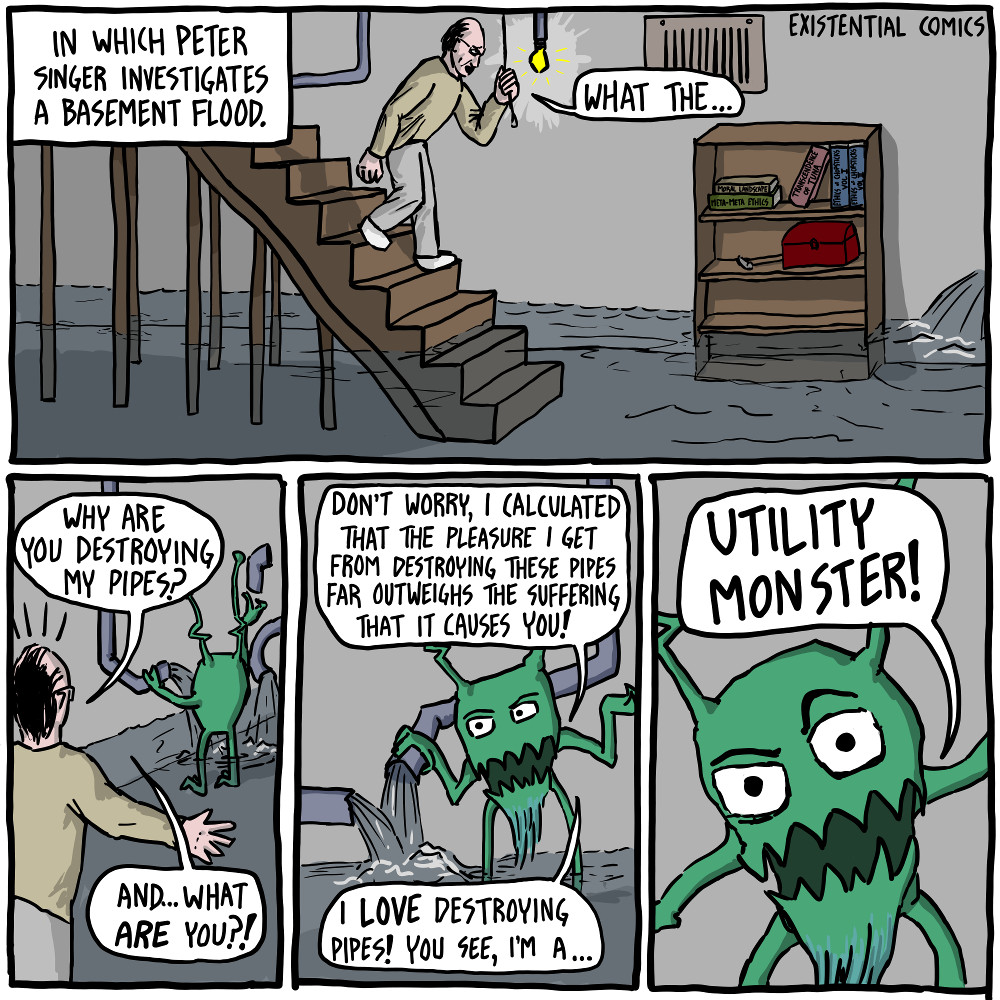

Translation: "I'll come out of university with no transferrable skills whatsoever. Dreadfully unintellectual dead-end jobs are where I'll be able to keep pursuing my love of knowledge".
Dude.
The author's bio is probably the most important part of this article:
"Grant studies at Wake Forest, where he majors in philosophy and economics."
Translation: "I'm passionate about half the university course I'm currently doing and have absolutely no idea how the job market will treat me when I'm done with it."
Full disclosure: I myself studied philosophy at university. I'm proud of it, but I'd never boast about how poorly it prepared me for the job market.