This gets an A for quality agit-prop art in my mind; I immediately started coming up with objections as if I was actually going to be using one. My first was "what if I want people I know in my photos?" My second thought was "You could just include a highly rated photo someone else took in your photo roll," followed by "But what about licensing?"
We could also imagine Camera Commons: distributed by EFF and Google and Yahoo, and encourages you to take photos places that have no CC-licensed photography that rates highly on flickr, but all your images are CC0 licensed. The better your average rating, the more frequently they send you new models.
The camera could take his one stage further - when you pick the camera up in a well-photographed location, it just downloads the most popular shot from there. This would save you the effort of framing your shot entirely, and you'd always end up with a perfect picture :)
For a less absurdist but similar idea, it would actually be really neat to have a tool that can take a group of your photos and match them with one popular CC-licensed one that adds more context to the scene.
e.g. you and your friends at the base of the Eiffel Tower, and the album automatically has a suitably well-framed picture of the landmark as a whole added as a backdrop, that kind of thing.
Why is everyone missing the point? Yea sure this doesn't accurately determine whether a picture is original. Of course it's not practical. Of course you would not buy this. That isn't the point. This project is itself art.
I think they're "playing along" and trying to make a piece of performance art about people not recognizing performance art or art criticism, a statement against lack of artistic creativity, or whatever.
It's art, but is it /good/ art? Its intent is to draw attention to some rather crappy laws being proposed and/or implemented, but the project's implementation instead brings discussion as to how even items photographed thousands or millions of times can show new facets based on one photographer. Is the banal art?
This project would have been better had it used much more digital processing to censor a random person, a random building, etc. That would have led to a much better discussion on the issue of copyrighting buildings.
I enjoyed the idea, particularly around the observation that thousands of people are photographing the same statue when you can just look up a much better picture on the internet. I saw the censorship angle as a sidenote, and a warning that tools developed for one purpose (in this case the retractable button) can be re-purposed as tools for oppression. It's better art than most. I don't see the need to be hypercritical of it.
A nice theoretical exercise but I slightly disagree with the rationale. In a popular area, an artist could have a different view from others. Perhaps it's the late-morning mist, another person in the view, sun rays at a different time, or maybe a new lens and different settings that lets you view the space in a totally different perspective.
Also taking a picture in a new or unpopular area doesn't make it more worthy than other pictures. Perhaps the place is unappealing and bland.
And dramatically underestimates the need for additive photography. Ferguson riots, Baltimore riots, New York during and after 9/11, etc., would all be blocked out by this.
Moreover, my vanity photos would almost certainly be excluded. I'm certainly not the first guy to take a photo of Haleiwa during the Triple Crown of surfing, but my photo is likely the only one that has me in them, and that, along with the memories that photo will evoke, are definitely not things I want to exclude from my life.
Understanding that this is probably a political statement (of which I'm not entirely clear yet), it's certainly a damned disturbing one.
    > this is probably a political statement (of which I'm
    > not entirely clear yet)
From the article:
    <title>... disobedient

    > The European Parliament recently voted against a
    > controversial proposal that threatened to restrict
    > the photography of copyrighted buildings and
    > sculptures from public places.

    > The camera could be funded or subsidized by public
    > and private sector institutions with an interest in
    > regulating photography in certain places.
Thanks. I mean, I see that, I'm just not entirely sure how this is a response to it. Probably I'm just missing the link between copyright and 'already photographed', and/or whether or not that itself is a part of the commentary, or if it is just an implementation detail.
I was about to comment the above too. The world isn't static. This also discounts time of year shots, as fall trees vs snow covered hills vs spring blooms make a world of difference too (they do mention that geo-tagging isn't the only way).
Despite the entry point for photography as art being relatively low, this also discredits the idea that there are good and bad photography and the defining factor is rarity.
Agree. I solve this problem not with technological barriers, but by going to places that tourists don't go. In fact I often look at the Lonely Planet maps, cross off everything mentioned, and then go to the remaining parts of the map, assuming it's a safe area.
thanks I was going to make a similar comment. Additionally it's like I should pay for a product that will let me know if I am taking a photo of popular tourist destination? i get that it tries to solve a problem of too many photos of the same thing but there is 0 benefit to individual users of it, and they're expected to pay for it.
thinking about it more, it would be far more useful if it gave you a counter of photos taken of current place at any given light level (this should give a rough time series). That way it would provide metadata instead of a binary shut off valve. still not sure how it would handle slightly different angles and zoom.
FWIW, you could classify this as "Interrogative Design," a practice accelerated by Krzysztof Wodiczko, who lived under communist oppression in Poland, but now has had cushy positions at MIT and Harvard [1 ]
He focuses a lot on projections now, but in the past and his students have, made lots of "fake devices" or in Chris Csiksmihalyi's practice "edgy products" which typically misfunction in order to start conversations or get us to see things outside our usual waking trance. In a way, they're like small hacks that hackers do which invert or reveal power relationships.... (the big difference is these art projects don't usually always actually work -not that they really have to though, but if it often creates confusion and/or animosity from real hackers). Anyway, there are lots of great pieces in this category, see [2] and there are many more.
Protip: Once you start to see things through this lens, you'll realize that so many other actual projects have unintentional profiles as Interrogative Designs
Almost all photos are copyrighted and not licensed for my use. In practice I rarely worry much about it, and I doubt it is very common to think "I must take my own photo of the Washington Monument, because how else will I get permission to decorate my travelogue?" but still. It is great that image data is so abundant, but it's a shame that it's also artificially scarce.
You want to restrict the number of similar pictures, not the number of pictures taken at a specific spot. So you should decide based on the what's in the view of the lens, or after taking the picture.
Imagine a polaroid camera that shreds the picture if it's deemed not original enough :)
As it happens, on Sunday I posted a photo to my photography club's G+ page. Another member noted the location, and replied with another photo she'd taken months ago of the exact same subject, standing maybe 15 feet from where I'd taken my photo.
Although we know that the subject of both photos are the same, what's interesting is that to a first approximation, they appear to be pictures of entirely different things. We were commenting how radically different can be the interpretation of two different artists when seeing the same thing.
The error that the OP makes is that what makes the photo is what you're taking a picture of. At least in the art of photography, that's barely the beginning of it. A photograph is something that the artist creates, not something that he takes of a particular thing.
"A photograph is something that the artist creates, not something that he takes of a particular thing."
To be pedantic, it can be either.
I do hobby photography that I take fairly seriously ( http://gmcbay.com/ ), but sometimes I really just take a snapshot of a thing just to document that thing, without thinking about the lighting or the composition or anything -- just want to post it up on ebay or facebook or whatever for illustration, not trying to have it be "art".
Many (probably most?) photographs are in the "taken" group as opposed to the "created", I'd think.
Of course not. But please note that all cameras that do not include the GPS restriction feature to ensure that they are not being used to photograph either copyrighted or protected scenes will now have a protection tax that will be used to cover the litigation and enforcement costs resulting from the misuse of such cameras. Regulation is also currently being purposed to require the sale of cameras which can so easily be abused to be restricted only to licensed individuals. To ensure your best experience with these new anti-terrorism measures, your ownership of existing cameras will be grandfathered in.
You might also be excited to know that we are currently working on updates that will also help protect children by ensuring that no photo of a child can be taken without his or her parents' express approval! More details will be released soon!
That would be fantastic - I'd love a system that would stop someone taking more photos if they already had too many similar pictures in their own camera roll. Just think of the time it would save when someone is boring you with their 1000s of holiday snaps :)
Thats addressing the problem at the wrong end. I take many photos of the same subject often, but Im only ever going to show the best one or two to anyone. People need to learn to edit! There is a side benefit that you look like a much better photographer when people only see your best. They dont even think about all the rejects.
That could be useful in all sorts of comments. A music composition app that destroys any work that's too derivative. A Twitter client that blocks repetitive tweets. Maybe Hacker News comments could benefit.
A hacker news bot that auto-posts common messages would save us lots of arguing time. e.g. Whenever a submission references some c/c++ code, the bot could auto-post a whole thread of arguments about 'why are people still using this insecure language?', thus saving HN denizens from posting and arguing over the same thing...
The path to innovation shouldn't need rails. Maybe what I'm trying looks pretty similar to things that have come before, but perhaps it's different in some way I understand and which a machine does not. Rather than a destructive feedback mechanism which would only discourage brainstorming, I'd rather see some kind of "genericity meter" to provide real-time feedback without stopping the artist from going down a path that is at least new to them.
I don't know if it constitutes a trend, but I've noticed several thought experiment projects like this that attempt to automate decision making in some way. The other one that comes to mind is the cell phone signal-blocking chair [1] that's somehow more convenient than turning off your phone (?)
It's kind of funny to watch us all try to use technology to save us from the adverse effects of technology.
I'm not sure this project does "automate decision making." I'd argue that the intent is to encourage you to expand your photographic reputare beyond generic tourist snaps and other bland over-done photos.
My biggest criticism isn't the intent which I think could be legitimately useful. My issue is that they make assumptions about a photo's originality based purely on GPS coordinates, which is too simplistic.
I've taken terrible photos in unusual locations (e.g. taking pictures of pretty flowers in a field). I've also taken amazing photos in tourist traps by finding a different perspective, or just happened across a great picture opportunity.
In an ideal world this camera would use GPS and aim to determine how generic your picture really is (e.g. shooting straight up into the bottom of the Eiffel tower isn't original, sorry. But shooting the Eiffel tower with a bunch of toy Eiffel towers on a souvenir stand in the foreground is at least a little).
What I meant by "automate decision making" is that there should be some measure of critical thought that goes into taking a photograph. How will I compose the frame? What am I really trying to capture?
This camera answers "Do a lot of other people take photos here?" which, as you point out, is an overly simplistic measure of a good photo.
But if you take this idea a little further and run some of that fancy deep-learnin' stuff of on your photos to search for common photography tropes (Oh, a macro shot of a flower? Pfft. Been done!), then you're just relegating more of your critical thinking to a machine.
I just see it as a way to snap people out of their patterns.
I try to be a photographer, and I know I myself get caught in patterns of shitty bland photos that I look at a year later and roll my eyes ("this thing has RUST on it!!! [snap] [snap] [snap]."
We both agree it may not work, but the concept is compelling if nothing else.
PS - To be frank however, if you really want to escape patterns one of these "one photo a day" challenges for a year that give you specific themes might be a better answer. If the themes are thoughtful it can help.
I kind of wish it worked the opposite way: only allowing you to take pictures near other photo locations. That way you have to make a 'photo-journey' to get new locations in, and you'll leave a trail of experiences in your wake.
Then maybe someone could find a way to stitch those photos together.
I had the same agitated reactions upfront. However, the same software presented differently, and suddenly youve a fun option to travel around a city and expand your photography. It could be a fun option for some, and obviously could be used maliciously as a form of control. All that said, though, this being the highlight of the camera is ridiculous. The times I want a regular camera with normal societal uses greatly outweighs the fun of this: Furthermore, I am an artist, and would find that this would greatly reduce my photography - sometimes surreal things happen in mundane but popular places.
Many social platforms exist because of the power of their restrictions (twitter, snapchat, etc). I wouldn't be surprised to see this trend spread to rest of technology. I don't want technology that can make me anyone/anything; I want technology that will help me to be exactly who I want to be, and nothing else.
Why cannot photographs be simply for the reason of memories?Not everyone person who clicks them uses them for blog posts and aims for maximum number of shares. If I like particular moment,I would like to click a picture a of it.I would like the picture to be my own ,because I would have a descriptive commentary in my head for the picture.A single location being photographed 'too much' is really not an issue which needs solving does it.I like the use-case which requires the parent's permission for a child's picture.
But apart from that,I see this feature being exploited quite a fair bit.
PS : I am not trying to add destructive comments here.But imagine going on a 20k vacation with a 5k camera being told you are not allowed to click a picture.
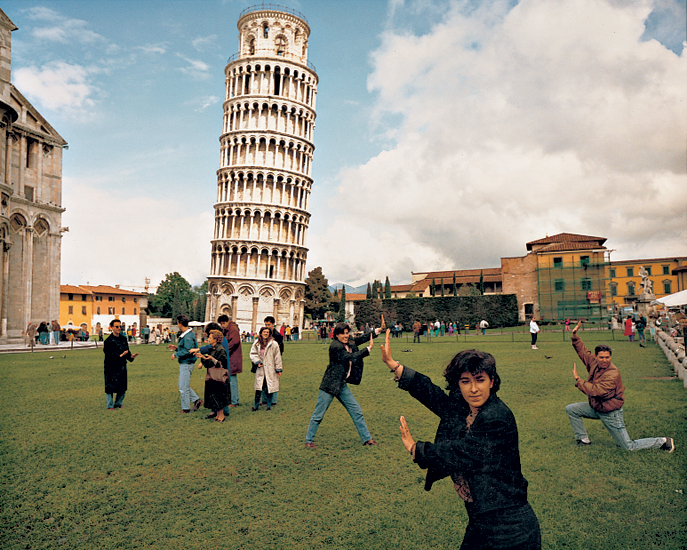
This reminds me of the wider-angle tourist shot of all the dozens of people taking the same "Look, I'm holding up the Leaning Tower of Pisa!" pictures at the same time.
While that is certainly ridiculous, and this camera would prevent it, I am not a fan of buying tools that restrict how I may use them. You would have to pay me to use it.
I think a better way to accomplish a similar goal would be for the camera to give you a score for your photos. Zero points for duplicate photos. Lots of points for a photo that has never been taken before. Give out prizes and badges to the people who top the leaderboards.
But no, if I see "photography prohibited" on my camera, it's getting pwned and patched, or it's going in the trash.
I won't comment on the pragmatic side of this. But it is flawed even on the idea level, as it completely disregards time.
And as we all know it "You could not step twice into the same river".
By "disobedient tool for taking unique photographs" I was expecting a camera that added some sort of noise/glitches/features to pictures to make them unique.
As an art project, it sounds provoking to restrict a fellow photographer to reinterpret an ordinary/popular scenery.
Looking through the lenses of an engineer, the GPS alone won't tell accurately enough the direction at which you are pointing. Would be nice to take that into consideration, forcing a building to be photographed from every angle.
How about an augmented reality viewer that shows exactly where every known photo has been taken (say, showing the image planes floating in their space)? or a "photosynth" virtual camera that deduces, from other pictures taken nearby, what a photo would likely look like if taken from that spot (opposite of camera restricta, have camera deducia)?
I wonder what the creator's thoughts are about Microsoft's Photosynth project - which relies on multiple photos of the same thing (like tourists would take).
I think this is an awesome attistic statement, especially going the extra mild to build the camera. People might actually use this if it was an iPhone app. "400 people took photos of sushi in this location, proceed?". That would be really kind of a funny way to limit shitty photographs.
It's bizarre that a photographic artist would want a tool that would essentially stiffle creativity (various lightings, lens filters, other artsy effects) ... I don't understand the point they are trying to make.
The point is explained in the article. It's a protest of (now failed) legislation restricting photography of copyrighted public works. It uses the number of photographs taken in the immediate area as a proxy for the likelihood that something in the frame is a popular, publicly available copyrighted work.
Yeah, I have absolutely no idea why anyone would buy this.
"Oh, it's a camera that won't allow me to take whatever picture I want. And it makes staticky, clicky noises, sounding like an ill dolphin. Just what I've always wanted in a camera!"
Can anyone give me a compelling reason why I should consider buying this thing?
Its not even presented as a product for sale. Its just a project for the sake of discussion. Look at the discussion it inspired in this thread. Its art in and of itself.
Why should I support so-called "art" that wants to restrict what I can do? Why should I spend any money on this garbage, when a digital camera from any Big Box store is clearly superior?
It was made as a political protest of legislation that was intended to block the amount of photography of buildings whose design was copyrighted. Unfortunately, it wasn't really a /good/ protest of such, so the discussion has become more a discussion as to if there's artistic quality in the banal.
Is someone forcing you to support it? Do you feel pressured by us to support it? I think it exists independently from our support - it's not looking for backers or donors or consumers.
I want the internet to increase freedom, not restrict it. This is one camera I would never use. Besides, a GPS location is not a satisfactory representation of a photography's uniqueness.
I think the coolest part is the Geiger counter for number of images taken in an area. Having that playing while you walk around a new city could be a lot of fun.
It would be interesting to have a map of this and explore a new city by going to the spots with the most photos. It'd mainly be the tourist spots but it'd be more exciting than regular sight-seeing as you'd never know what you were on your way to see.
What if someone wants to take a snapshot on vacation as a way of remembering when they were last there? Maybe make an exception for photos with new faces. Also, who takes selfies/snapshots with a camera anymore? Everyone has a smartphone. Someone should pitch this to Apple.


We could also imagine Camera Commons: distributed by EFF and Google and Yahoo, and encourages you to take photos places that have no CC-licensed photography that rates highly on flickr, but all your images are CC0 licensed. The better your average rating, the more frequently they send you new models.