Now I understand why NVMe flash drive prices have rocketed up to triple the normal in the last few months! The AI hyperscalers aren't just sucking up the wafer runs for memory, they're also monopolising the wafers for SSDs.
Sam Altman bought 40% of the world's supply of DRAM in an underhanded, secret deal with two large manufacturers. It will take years for supply to recover.
The best part is the wafers are being bought with no plans to use them; just to keep them in storage so that competition cannot easily access RAM. Supervillain shit, should have been the last straw for PG to publicly denounce Sam and for OpenAI to be sued by the US government for anticompetitive practices. All this does is harm the consumer. Of course that ks never going to happen.
He didn't actually buy it, nor does he have the money to. He just "committed" to buying it at a later date to disrupt the supply chain for his competitors. It's scams all the way down.
My acid test for provisioning automation products is asking: Can it rename deployed resources?
Practically none can, even in market segments where this is highly relevant. For example: user identity and access management products. Women get married and change their name all the time!
The next level up is the ability to rename a container such as an organisational unit or a security group.
Then, products that can rearrange a hierarchy to accommodate a merger, split, or a new layer of management. This obviously needs to preserve the data. “Immutable infrastructure” where everything is recreated from scratch and the original is dropped is cheating.
I’ve only ever seen one such provisioning tool, the rest don’t even begin to approach this level of capability.
An “Americanism” I noticed in the show Heroes first but now I see everywhere is that every hero just wants to be normal. Claire Bennet — who’s only special ability is healing — whines about the burden of this for several seasons! Just shut up already! You have what everybody wants and there’s basically no downside! Just put away the costume and get an office job if you want to be a normie.
Conversely, any metahuman that fully maximises their extra abilities is almost invariably labelled as evil. Magneto is the obvious candidate here, but Wolverine is even better: same powers as Claire Bennet but he leans into them… so he’s got to be an anti-hero type.
The major hyperscalers all offer a plethora of virtual machines SKUs that are essentially one entire two-socket box with many-core CPUs.
For example, Azure Standard_E192ibds_v6 is 96 cores with 1.8 TB of memory and 10 TB of local SSD storage with 3 million IOPS.
Past those "general purpose" VMs you get the enormous machines with 8, 16, or even 32 sockets.[1] These are almost exclusively used for SAP HANA in-memory databases or similar ERP workloads.
Azure Standard_M896ixds_24_v3 provides 896 cores, 32 TB of memory, and 185 Gbps Ethernet networking. This is generally available, but you have to allocate the quota through a support ticket and you may have to wait and/or get your finances "approved" by Microsoft. Something like this will set you back [edited] $175K per month[/edited]. (I suspect OpenAI is getting a huge effective discount.)
Personally, I'm a fan of "off label" use of the High Performance Compute (HPC) sizes[2] for database servers.
The Standard_HX176rs HPC VM size gives you 176 cores and 1.4 TB of memory. That's similar to the E-series VM above, but with a higher compute-to-memory ratio. The memory throughput is also way better because it has some HBM chips for L3 (or L4?) cache. In my benchmarks it absolutely smoked the general-purpose VMs at a similar price point.
I noticed that the M896i is so obscure and rarely used that there are typos associated with it everywhere including the official docs! In once place is says it has 23 TB of memory when it actually has 32 TB.
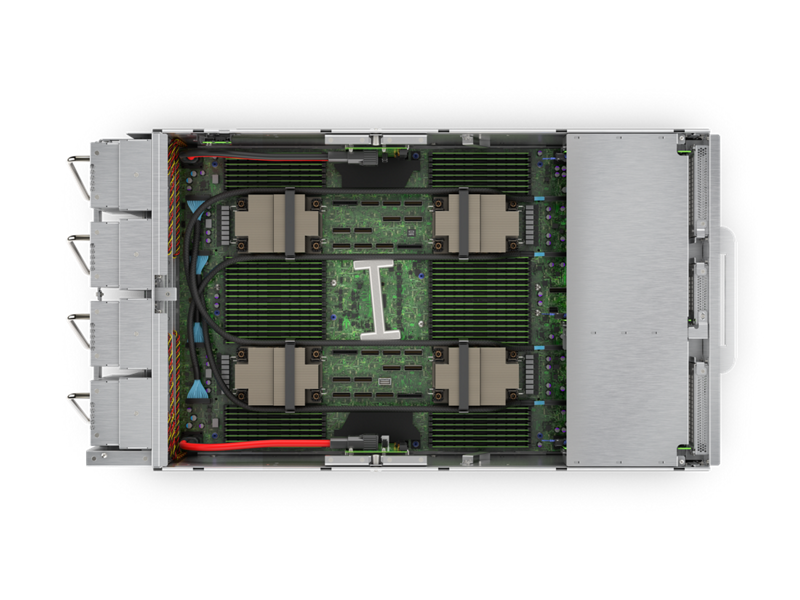
I'm pretty sure both Azure and AWS are merely reselling the same HPE Compute Scale-up Server 3200 chassis with some variations. Azure seems to have only the 16-socket model, but AWS has the 32-socket model.
To anyone wondering about these huge memory systems: avoid them if at all possible! Only ever use these if you absolutely must.
For one, these systems have specialised parts that are more expensive per unit compute: $283 per CPU core instead of something like $85 for a current-gen AMD EPYC, which are also about 2x as fast as the older Intel Scalable Xeons that need to go into this chassis! So the cost efficiency ratio is something like 6:1 in favour of AMD processors. (The cost of the single large host system vs multiple smaller ones can get complicated.)
The second effect is that 32-way systems have huge inter-processor cache synchronisation overheads. Only very carefully coded software can scale to use thousands of cores without absolutely drowning in cache line invalidations.
At these scales you're almost always better off scaling out "medium" sized boxes. A single writer and multiple read-only secondary replicas will take you very far, up to hundreds of gigabits of aggregate database traffic.
> For example, Azure Standard_E192ibds_v6 is 96 cores with 1.8 TB of memory and 10 TB of local SSD storage with 3 million IOPS.
Is a well-stocked Dell Server going for ~50 - 60K capex without storage before the RAM prices exploded. I"m wondering a bit about the CPU in there, but the Storage + RAM is fairly normal and nothing crazy. I'm pretty sure you could have that in a rack for 100k hardware pricing.
Multiple of these can be linked together with “NUMALink” cables, which carry the same protocol as the traces that go between sockets on the motherboard. You end up with a single kernel running across multiple chassis.
I used to think so too, but they've been increasing the per-core licensing fees while simultaneously hardware core counts have been increasing exponentially. The upcoming AMD EPYC 6-th generation servers will have 512 cores in a dual-socket configuration! The MS SQL licensing for that will start to approach the GDP of some smaller nation states.
The argument always was that it's worth paying the MS licensing tax because their proprietary engine is so much faster and the hardware is so expensive that the result is a net win. In other words, the "total cost of ownership" argument made by the Microsoft sales people was actually valid. In the era of two to twelve core servers, this was true! Not any more. Open source database engines at the same dollar spend levels run circles around MS SQL.
More importantly, MS SQL is falling behind on features. It has a handful of inexperienced developers keeping it on life support. Its 2025 release added just a handful of major features (Regex, better JSON support, and an AI index). None of these are "core" changes, they're all things that a junior dev can "tack on" to an existing product relatively easily and safely. Meanwhile, fundamental limits remain unchanged for decades and are starting become big problems:
1. The MS SQL parallel executor can't utilise more than 64 threads per individual query. On the aforementioned 512-core boxes, this limits it to 12.5% of the capacity of one rack mount server!
2. It can't natively use modern SSD drives with greater than 4 KB atomicity. This is practically all server-grade SSDs, including Azure Premium SSD v2 and all v6 or later VM SKUs! This leads to absurdities, like the Windows 2025 + SQL 2025 Azure Marketplace images reporting "not supported" on database-optimised Azure VMs and refusing to install.
3. Terrible support for external data in blobs, such as parquet files in data lakes. Just compare the "effortless" approach in something like DuckDB to the mess that is CETAS and the like in SQL PolyBase. All development effort in this space is being sunk into the cloud-only Microsoft Fabric product. The on-prem database engine is being left entirely behind.
Etc...
I wouldn't start new projects on MS SQL in 2026. The Titanic is starting to tilt a bit now, the lights are still on and the music is playing, but the smart people know it is time to go find a life boat.
I've been curious about this myself, and I listened to some pro-Trump people who seem otherwise intelligent that tried to explain this effect.
One common theme has been that farmers are by necessity highly independent. They can't rely on government services as much as city folk, because everything and everyone is potentially an hour's drive away. They don't see the effect of their taxes being spent, because their local roads are dirt roads, there's no traffic lights, no police cars[1] or ambulances zipping by on the regular, etc...
Conversely, they do get frustrated by the likes of the EPA turning up -- invariably city folk with suits and dress shoes -- telling them what to do. "You can't burn this" or "You can't dump that!". More commonly "you can't cut down trees on your land that you thought were your property".
Their perception of government is that it violates their God-given rights regularly and gives little in return.
The further the seat of power, the worse their opinion of it. Local councils they might tolerate, state governments they view with suspicion, and the federal government may as well be on another planet.
Hence, their votes are easily swayed by the "reduce federal government" rhetoric.
We all know this is as an obvious falsehood: Trump grew the size of the federal government with his Big Beautiful Bill! So did every Republican government before him for quite a while now!
That doesn't matter. Propaganda works. The message resonates. The voters will vote against their own interests over and over and over if they keep hearing something that resonates with what they feel.
PS: A great example of this are the thousands of unemployed people that lost their coal mining jobs. Trump lied through his teeth and told them they would get their mining jobs back. Hillary told them they could be retrained as tech support or whatever. They. Did. Not. Like. That. They wanted their jobs back! So they voted for Trump, who had zero chance of returning them to employment because they had been replaced by automation and larger, more powerful mining machines. Their jobs were gone permanently, so they doubled down by voting against the person who promised to pull them out of that hole. Sadly, this is a recurring theme in politics throughout the world.
[1] As an example, this is why they're mostly pro-gun! They know viscerally that if someone broke into their property, they'd have to defend themselves because the local police can't get there in time to save them.perception.
I buy all this, and I think your analysis is spot on. There's z log of cognitive dissonance going on here.
>> One common theme has been that farmers are by necessity highly independent.
I think they like to think of themselves as highly independent. But in truth of course they are highly dependent, on city customers for their product, on foreign countries for exports, on federal govt for subsidies (both direct and indirect), on suppliers for machinery, seed and fertilizer, and in some cases on immigrant labor.
Just as we are dependent on farmers. It's all interconnected.
Ironically they may tolerate local govt, and had federal govt, but they are most dependent on fed govt policies.
They do of course have many legitimate grievances, but I'm not sure that voting for the party that seems to hate them is a winning strategy.
Why tho do you feel the need to defend big agri businesses skirting employment law and pressuring wages downward by bringing in illegal people?
I find it a bit weird looking at the US how they seem to kneejerk into different camps depending on what the other side does with some old outliers like bernie who retain their line.
>Ironically they may tolerate local govt, and had federal govt, but they are most dependent on fed govt policies.
I live in a much smaller country but here there's similar pressures at play.
I feel like a more nuanced take that farmers either don't voice or don't voice well here is that the federal and EU gov has benefited these big corporate farms they compete with because they're by far the best at siphoning off these various subsidies that farmers supposedly depend on.
At the same time gov requirements make it almost impossible to run an smaller independent farm or one that doesn't depend on one of these middlemen to an extreme degree.
I worked for a meat conglomerate here in belgium and plenty of the farmers they dealt with didn't own their own cows (and plenty went under). They essentially rented their business to the company which owned the animals on their land, provided the calf feed made by their subsidiary, employed a load of vets, had an international transport company, had me and others writing software that would automate the mindbogglingly stupid forms and rules for transport (which were interpreted comically differently by regional departments of the federal food safety agency so depending on the jurisdiction you had to do radically different things).
Just the paperwork to run a competitive farm was/would have been impossible to deal with for many of these people and it was so clearly made up by people who never had to deal with the consequences directly.
On the other hand there's also plenty of examples of things like the gov rugpulling with environmental legislation in the netherlands.
Things like caping farms at past nitrogen emissions (benefiting the big ones) after first encouraging farmers to take loans and invest insane amounts into equipment to reduce those emissions.
> Why tho do you feel the need to defend big agri businesses skirting employment law and pressuring wages downward by bringing in illegal people?
It is interesting that you immediately jumped to "illegal people". When I read it, I thought about the US H-2A via for temp farm hands. This page: https://www.ers.usda.gov/data-products/chart-gallery/chart-d... ... says 385,000 visa holders in 2024. That is a lot!
Since you are based in Belgium, how many native-born Belgians are still performing low-skill manual labour on a farm? Probably very few. Most of them are probably from the poorest parts of EU or some kind of temp farm hand visa. Specifically: Fruits and vegetables require lots of low-skill manual labor for harvest and packing.
> At the same time gov requirements make it almost impossible to run an smaller independent farm
Call me cynical, but I am not nostalgic for the "smaller independent farm". If farms want to be smaller and independent in the 21st century, they need to distinguish themselves with product (usually: organic or "free range"), branding, and value add (example: create a cheese brand that only uses your special organic cow's milk). If they cannot or will not, then they will need to sell their business to the mega agg corps.
> It is interesting that you immediately jumped to "illegal people".
USDA estimated 42% of farm hands is doing illegal work few years ago. Other sources estimated to 50-60%. That is a fuckton and has an incredibly significant impact on wage pressures.
It was also brought up in the context of GOP policy "the party that hates them" which has focused heavily on illegals and caused quite the uproar. It's hard to not jump to it in that cotnext and also more than those "US H-2A via for temp farm hands" i believe.
>how many native-born Belgians are still performing low-skill manual labour on a farm?
It's mostly migrant work indeed same as in the meat industry I observed.
They proudly had giant old black and white wall covering pics of locals doing the work decades ago but now among more than a hundred there were maybe 2 belgians on the factory floor at any given moment.
That said here in belgium I suspect the amount of illegal work in agriculture is lower than in the US and places like Italy.
>Call me cynical, but I am not nostalgic for the "smaller independent farm". If farms want to be smaller and independent in the 21st century, they need to distinguish themselves with product (usually: organic or "free range"), branding, and value add (example: create a cheese brand that only uses your special organic cow's milk). If they cannot or will not, then they will need to sell their business to the mega agg corps.
Call me cynical as well but that doesn't help for the most part.
I follow some such farms that do exactly that.
2 examples from sweden I know jump trough hoops for those organic and "free range" labels.
Hoops that are made specifically for the massive operations. So the giant poultry halls get to add some square meters of semi outside space, pull in a big proportional subsidy and aquire the free range label whilst the guy trying to differentiate himself has to add elaborate construction to his chicken tractors for his free roaming chickens to follow the spirit of the law made for the massive operation.
I personally know and helped a peppers/tomatoes and respective seed operation. All heirloom, mostly organic and they too almost had to close their books because they suddenly needed seed passports and a load more paperwork and the legislators apparently hadn't considered that this was something that was also done by corporations that count with numbers smaller than 1mil. That's not me being hyperbolic. They straight up confirmed they hadn't thought it possible that someone might run an operation without boatloads of employees or an upstart.
Also small is relative in the context i described. Many of these were still big expensive operations making investments costing hundreds of thousands, operating a lot of land. Just run by a normal family rather than a big coporate structure.
Mind you the meat company i worked for was also a family operation but the family all drove Brabuses that cost more than my house and had spare money to invest in retirement homes, etc....Puts it a bit in perspective.
> If they cannot or will not, then they will need to sell their business to the mega agg corps.
I do not wish to live in a corporatocracy nor do i fancy a form of capitalism where healthy competition is impossible since nobody can enter or maintain in certain vital sectors.
> Just the paperwork to run a competitive farm was/would have been impossible to deal with for many of these people and it was so clearly made up by people who never had to deal with the consequences directly.
You are assuming this is an unintended effect, but it is very much the intended effect of bureaucratic rules and the reason large companies and conglomerates constantly lobby for them: they can afford the overhead costs (until the inevitable external disruptor comes around and totally eats their lunch, see europe) and smaller players cannot. These rules are moats built by big companies.
Doubly so for subsidies tied to complex filing and reporting requirements: large companies easily do this (they have department(s) just for handling these larger than whatever department in the government is handling the paperwork), small players can't and miss out.
Shouldnt they at least have to try? Who else gets to throw up their hands before even trying to raise wages and offer an attractve (as much as is possible) employment offer to domestic labor before they get to skip all that to get to the good stuff where they get to pay even shittier wages, afford less rights or access to judicial review for their workers, and basically totally control them thru deportation threats should they get to uppity on Freedom Land's supply?
You can try, but the unemployment levels in the USA have not generally been low enough to find enough workers in total in recent decades. Worse, even the last few % of unemployment is a deliberate policy choice to prevent a rapid cycle of wage inflation as everyone competes for a limited supply of workers:
The farmers would have to pay enough for "seasonal work spending all day doing manual labour in the sun without any AC" to compete with "year round work spending all day stacking shelves in supermarket where the temperature is at consistently in the range that doesn't put off the customers". And if the farmers got the former shelf stackers, then the supermarkets need to find more people to do the stacking. Food prices go up, both wholesale (because the farmers have to pay workers more) and retail beyond that (because so do the supermarkets).
I keep seeing stories about poorer Americans struggling with food prices even without this kind of cycle; but it doesn't end with just those two examples, it's all the low-pay jobs that are inherently more comfortable than farm labour, and if they find themselves short of labour and raise wages they too have to raise prices to balance their books, and whichever professions they in turn get labour from have the same choices, it ripples across the entire economy. Which may be good or bad for other reasons, but it's a massive impact across the entire economy, not something which is an easy one-liner.
Also, despite all those issues, look at this from the point of view of those workers: They've got seasonal work that pays them somewhat more than they'd earn in their home countries, and until very recently that work would not have come with a risk of being deported to a completely different country than they'd come from.
It seems to me like it would initially make inflation spike a lot if applied abruptly but regardless of the timeline would also increase the standing of the lower classes doing menial work substantially.
This also has an effect on those other cushier low wage jobs as they then have to compete with the previously unattractive fieldwork.
And they bloody well have to compete because food prices would rise and people are sensitive to that.
There's more to it of course and maybe it's in some way good but there's no way the current way of doing things with half or more of farmhands being illegally employed does not provide downward wage pressure for americans. We don't have to be wishy washy about that bit.
>look at this from the point of view of those workers
The government has no mandate to benefit them over it's own citizens beyond the obvious (foreign aid, disaster relief, etc) though.
> The government has no mandate to benefit them over it's own citizens beyond the obvious (foreign aid, disaster relief, etc) though.
Yes, absolutely, I'm just pushing back there against "basically totally control them thru deportation threats should they get to uppity on Freedom Land's supply"; this was, previously, a mutually beneficial relationship despite being… I was about to write "second class citizen", but no, less than citizen even then.
That said, current regime clearly regards foreign aid, disaster relief as not worth supplying, they either don't understand the soft-power benefits to the USA or don't care.
Because their (in)dependence was questioned on various fronts in the context of the american bipartisan system and more specifically the republican party and it's policies aka "the party that hates them".
Wrt the subsidies, consumer market and all that i don't have much to add but wrt the migrant workers the point of contention to my knowledge is mostly illegals (regardless of the actual number deported, the perhaps brutal way in which this is done, etc), ICE, etc.
It's also my understanding that illegals are far far more present in farm work and a few other industries in the US (and to lesser extent in europe) to the extreme extent that those without legal work authorisation make up nearly half or more of the farmhands. (USDA estomated 42% few years ago but others had good reason to suspect between 50 & 60% or a even more)
So yeah there's no real way to not think of illegal farm work there.
In that context and the opposition there's some elements like Bernie that seem to stick to their line and call this kind of faux open borders a right wing position whilst the rest of the democrats and their base seem to kneejerk the other way in response to recent events and republican standpoints and suddenly seem to have started supporting illegal entry, employment, etc
I was a bit tongue in cheek in my response. Yes, you're right that (almost famously) farm work is done by a disproportionate amount of illegals, but conflating those with immigrants as a default does injustice to the hardworking people that followed the rules.
>Yes, you're right that (almost famously) farm work is done by a disproportionate amount of illegals, but conflating those with immigrants as a default does injustice to the hardworking people that followed the rules.
I think that shifts a bit when there's potentially more of the former than the later (or even just anything vaguely close to that).
Especially when that's the aspect that's been drawing so much focus in this context.
>Why tho do you feel the need to defend big agri businesses skirting employment law and pressuring wages downward by bringing in illegal people? I find it a bit weird looking at the US how they seem to kneejerk into different camps depending on what the other side does with some old outliers like bernie who retain their line.
Margins are tight for produce, I don't think it's that immigrants are depressing the wages its more so consumer preference and competition. Yes, if it was more punishing for companies caught hiring people without verification it would increase wages, but it would also increase the price of food, something which has been wildy unpopular with the voter base
>Just the paperwork to run a competitive farm was/would have been impossible to deal with for many of these people and it was so clearly made up by people who never had to deal with the consequences directly.
This is a problem, I hate that with the so called "digital era" that paperwork and online forms have replaced human contacts, why do governments not care about having subsidiary brokers who are invested in both preventing fraud and talking to people who require assistance, doorman fallacy i guess.
> The voters will vote against their own interests over and over and over if they keep hearing something that resonates with what they feel.
Most large farm owners are very well off and are absolutely voting in their own interests for the party whose primary goal is to cut taxes on the wealthiest while cutting government support for the poorest.
The rural working class and poor on the other hand are however often voting against their economic interests, but their economic situation has long been ignored by both partie, so having given up hope for economic change, they often vote on culture/identity issues.
> They are quite aware of taxes because 13.5% of their income on average comes directly from federal subsidies paid by taxes on "city folk".
I have some investments that will go up and down $10K on a daily basis. That's just a number in a mainframe somewhere, I don't even notice unless I go look, and even then it doesn't "feel" real. If I have to hand over an extra $1 for my coffee in cash, I feel it viscerally. I grind my teeth. I hate it.
The immediacy and in-person nature of an EPA fine feels a lot worse than some grant that may be little more than an annual electronic deposit in a bank account.
> Most large farm owners are very well off and are absolutely voting in their own interests for the party whose primary goal is to cut taxes on the wealthiest while cutting government support for the poorest.
To be fair to farmers, it's more complicated than that. A lot of farmers are wealthy because the poorer farmers have been squeezed out, often because of the actions of the very governments they voted for. This has caused a lot of consolidation into large conglomerates, which utilise their tax breaks to outcompete smaller farmers, further squeezing them.
> To be fair to farmers, it's more complicated than that. A lot of farmers are wealthy because the poorer farmers have been squeezed out, often because of the actions of the very governments they voted for.
Of course, it's not so different in that way than other oligopolistic industries, like tech.
Most family farms (From my area) are land rich. The land is worth a lot, but they never sell it. The farming essentially pays for the land, and maybe a little to live off of. They are NOT raking it in.
Also almost all of them have notes on this land, not owned outright.
What % of farms in your area are small family farms (either by count or economic %)?
In the country it’s like 40% of the farms and 20% of the value. That stat alone shows the real problem, big agricultural is wildly more efficient (without wading into the externalities). And big agricultural gets the lions share of the benefit of the subsidies.
I’m not even sure that’s a bad thing but half the reason these conversations are so circular is that small family farms are not what most agriculture in the US is yet we vote like it is.
I'm not sure the definition of "family" farms, you can have a family name corporation that is still $100M+ in value. Even then I have no idea who all of them are.
My family farm is small enough they alone cannot support a entire family upper-middle class lifestyle, but the land is still worth millions. But they all have notes, good years mean the crop pays the bank and maybe some supplies for next year.
> My family farm is small enough they alone cannot support a entire family upper-middle class lifestyle, but the land is still worth millions.
This makes no financial sense to me. I call this: "asset rich, but cash poor". It is like living in a house that you inherited worth "millions", but working a job that "alone cannot support a entire family upper-middle class lifestyle". Simple solution: Sell the house. Cash out and invest in the stock market or rental real estate. You should do the same. If what you say is really true, then call Dave Ramsey (or someone similar) and ask for their advice. They will say the same.
Small farmers are generally aware that this makes no financial sense. They're participating in a multigenerational family tradition. There are also typically relatives urging those still farming to sell the farm so they can get their share (which may not be that huge, when all is divvied up).
The USDA where I pulled that stat defines it as farms that have less than 1M in income (gross) per year. A farm that makes that much is going to only support at most 1 full time farmer. The further subdivide farms under 350k which clearly falls into some terrible definition of hobby.
Which tracks with my experience. I don’t know any family farmers where farming is their only, or even primary, occupation.
"because everything and everyone is potentially an hour's drive away."
Which only 1h because of federal subsidies as rural communities learn. Without health subsidies many hospitals will close, and it's no longer a 1h drive but a 5h drive.
People often live in a delusion on why things are the why they are - their explanation often is the one that suits them most (also see USAid).
I try to get almost all of my information from long-form interviews. From what I've seen, few people (mostly professional politicians) can lie non-stop for several hours in a row in a consistent fashion.
96% of the world’s population and 75% of its nominal (but not PPP adjusted!) GDP is metric.
All science is metric.
Other arguments simply don’t matter. How fine the Fahrenheit vs Celsius scales are or whatever is pointless, irrelevant debate.
Join the rest of us, or slowly fade into irrelevance. There is no third option.
You’re that one mansion with the doddering old cranky fool still lighting their place with town gas while everyone else has been using electric lighting for decades.
The next time the street is dug up, your pipes won’t be reconnected.
“So what if our spaceships occasionally crash into Mars at full speed because we got mixed up with our units… again? We can afford it!” — apologists.


reply