Ah one more paid subscription service to consume more content and waste more time...no thanks! I think as more of these services are launched, torrents will gain more popularity. Not everyone is going to subscribe to everything. Maybe a group of friends will share accounts but that is it
It doesn't matter if a platform has more content than anyone can watch on their lifetime. What matters is, how much content worth watching a platform has.
Think about this - for watching GoT I had to subscribe to HBO and to watch some Marvel movie I go to Disney Plus. I keep on switching.
Do facebook Like button really matter anymore? I mean my page has over 5000 likes but there's almost nil traffic on my blog through my page. I have removed like button from my website and nothing has been impacted
It matters for Facebook tracking users in exchange for the "opportunity" of increasing traffic. Of course most of this traffic only occurs if you pay for it.
One thing that bugs me, is you cannot promote groups directly... you have to create a Page for your group... even if the page is a useless placeholder.
Ha true. and you HAVE to download facebook's app on your phone (500MB app) to prove your not a russian troll. Do not even bother with the page, pages are facebook's way to trick you into paying endlessly to "boost your post"
It's about time they broke Google up. Google alone has too much power on our news and information. How do we not know they are not abusing their power?
Traditional TV news channels actually have too much power and nobody to question their outright bias. This situation is so bad in India. Nobody questioning them for fake news, doctoring content etc.
And in what way,G has "too much power on our news and information.". In my case, the articles in my Google Feed have actually helped me discover many different articles etc. Yes they have too much power but not in News, imo. For news,info it would be Facebook.
Facebook is a one-man show. Zuckerberg owning 60% of the company and no one can say anything to him. Moreover, one man has the entire monopoly over our entire online social life. Other networks have come and failed. Anti Trust regulators should seriously open Facebook's file and break it.
> one man has the entire monopoly over our entire online social life
You chose that. I don't need Facebook/Insta/What's App to have an "online social life." Literally nobody is forced to participate in that nonsense. Use Snap, iMessage, Twitter, Pinterest, Reddit, Slack, IRC, 500px, Vimeo, Signal, email, SMS, phone calls -- there are plenty of options.
FB, Insta, What's App aren't the entirety of the social media universe. You can't be "mad" at Facebook and then continue to use it. That's a bit hypocritical. If this situation is really that important, then stop using those services! It seems like the same thought patterns seen in abusive relationships: he beats me, but I can't live without him. That's bullshit. Leave those platforms. You see it as a "monopoly" because you allow it to be.
I used to use Snapchat previously, but all my friends (school, college, etc) started posting on IG stories rather than on Snapchat. My snapchat became a ghost town, and I shifted as well.
Still active on Reddit, but its more of community than a tool for personal relations. Android user so no iMessage. Slack & IRC not good to connect with school friends.
What I mean to say is the country I am in Facebook has a complete monopoly in our social life. And I am sure even in the US people cannot leave FB ecosystem.
No, they're voting shares... He owns the majority of voting shares, but they aren't worth the majority of the value of company, and therefore he doesn't "own the majority of the company".
I think the shares people buy without voting rights are not ownership, they are a weird financial instrument that should flat out be illegal. If you honestly think he doesn't own the company, despite having full uncontestable control of all it's resources, I believe you're one of the many to have been duped, friend.
Not really, think of Chromium as a developer version of chrome. It may be open source but it still maintained by Google. Only alternative shift to Firefox.
You can change Chromium but you cannot change Chrome. The majority of Chrome is Chromium, but there are parts of Chrome that are not Chromium. Particularly the branding. Furthermore if you're actually forking Chromium like suggested and taking it in another direction to assuage any grievances you might have with Chrome, then you have certainly "left Chrome".
I was not recommending that anybody switch from Chrome to Chromium. Personally I do not find that Chromium fixes what I consider broken about Chrome, which is what I was alluding to when I said "whether or not switching to Chromium accomplishes what you want to accomplish by leaving Chrome is another matter." The negative reaction I received for that post makes me think people believe I was recommending Chromium. I do not; I recommend Firefox.
If this becomes a reality, we as a tech community must do our part. We must personally leave chrome, ask all our friends and family to stop using chrome and switch to Firefox or Brave. Really show Google what we as a community can do.
Agreed, except Brave is a closed source wrapper for Chromium and you can't be sure if it's really as safe and private as they say. Also, it's married to a cryptocurrency scheme and that alone is reason to stay away.
Thanks, I wasn't aware they had finally produced source code with an open source license for the wrapper code. Still, I don't see anything on their Github about the servers that run the backend of their ad-serving and cryptomining services. Until I see otherwise I'll assume that is closed and proprietary and that all browsing activity is monitored, logged, and monetized per their advertising model.
I think the mindset that crypto = stay away when looking at Brave is silly. The idea is novel, they have a working product, and IMO they really aren't "locked in" to crypto. I imagine they could pretty easily transition the ad payouts, tipping, and auto-contribution features from BAT to traditional currency. Building the platform around BAT to start just allowed them to cash in on an ICO at the peak of the craze.
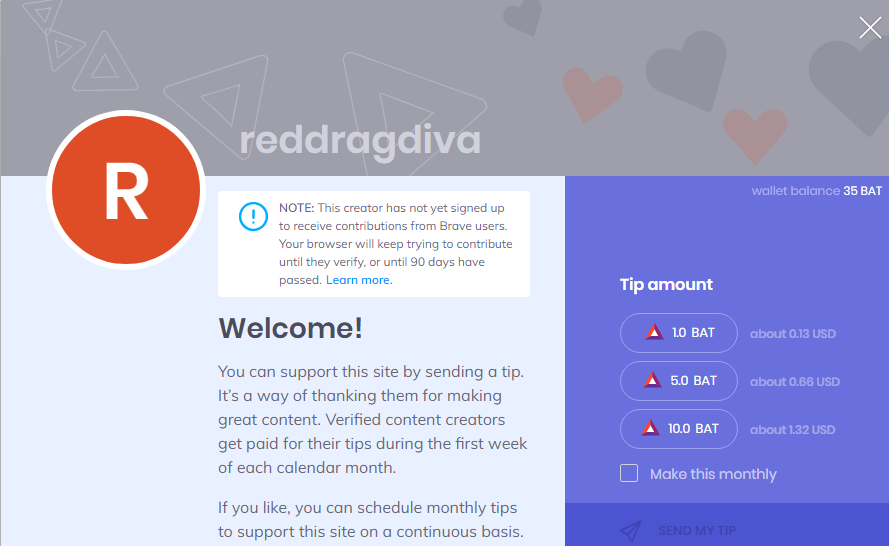
If they aren't opted in to the program then you're not giving them anything. As far as I know Brave is still accepting tips on behalf of people even if they're not opted in. Also, these tips are in an altcoin that Brave created and not the currency of the content creators.
Everyone I tip to is verified. And the BAT sits in an address until that creator does verify. And yeah of course the tips are in BAT, the whole point is to increase the value of the network. Also, people are donating BAT that they've gotten from ads. No one is tipping people with BAT that they've bought with their own money as far as I'm aware.
>And the BAT sits in an address until that creator does verify.
To my point - you're not tipping the content creator at all until they claim (edit: although as you say, tipping to verified does tip them). Also, these tips that are done with BAT that came with the promotion of Brave is sent back to Brave if they remained unclaimed for a set amount of time. Seeing as Brave has complete control of the tips they can change the rules and take the BAT back at any time.
>the whole point is to increase the value of the network.
This is kind of a pain point, isn't it? Many content creators have established ways to donate (Patreon, Twitch built in methods, Paypal, etc). Why should they opt-in to an altcoin created by Brave? There's no incentive for content creators to "increase the value of the network."
>Also, these tips that are done with BAT that came with the promotion of Brave is sent back to Brave if they remained unclaimed for a set amount of time. Seeing as Brave has complete control of the tips they can change the rules and take the BAT back at any time.
That's true for unclaimed tips. I don't believe they have any control if someone is verified, but I could be wrong.
>This is kind of a pain point, isn't it? Many content creators have established ways to donate (Patreon, Twitch built in methods, Paypal, etc). Why should they opt-in to an altcoin created by Brave? There's no incentive for content creators to "increase the value of the network."
I'd imagine the incentive to grow the network would be more tips through Brave. I don't donate through patreon or paypal since I find that to be a personal pain point. But I will be using Brave. I'd imagine there are others like me.
The same friends and family that we convinced a couple of years ago that they should stop using that shitty Firefox and switch to Chrome, which is so much more performant and don't worry about Google?
Firefox was in a pretty bad spot when I switched about 10 years ago. I would not have recommended to anyone who didn't have an excessive amount of RAM.
I only switched from firefox to chrome, many years ago, for two reasons:
1. Better dev tools
2. Better WebGL performance
But today, Firefox has upped their game on both, and really, I don't play much with WebGL anymore so it doesn't matter that much to me.
I am kinda sick of this whole back-and-forth thing, though. I'm also getting tired of seeing the way the web is going; monetized and walled off. More and more, I'm starting to look into and toward distributed solutions.
Give me back the internet I remember from the early 90s. If I can't have that, then I might just return to BBS-ing over ssh...
The “back and forth thing” is the market force keeping the browsers from stagnating. Even though it’s a hassle, you really don’t want the world where it doesn’t happen.
Actually, the internet has become too commercialized. But the problem is the top 1% driving all the revenue. And they are using this revenue to shape the web which is profitable to them.
People don't really have an alternative to Facebook currently. Even if I leave Facebook, I still am tied to their ecosystem - Instagram, Whatsapp. And let's be honest, everyone is there. If you want to be in touch with someone you need to be on Facebook's platform. But Google is much easier to leave. Make Firefox your default browser and make DDG your default search engine.
Instead of complaining I'm going to make a suggestion.
What if we had a middle ground where we build a browser to fight ads by putting forth responsible ads with responsible tracking and used the revenue to fight for a responsible web.
I don't know if this is what you're getting at (probably not), but I've often thought a lot of the "ills" we see with the current web ecosystem (particularly so-called "fake news", disinformation campaigns, propaganda, etc - the whole stinkin' mess) could be solved if it were required that everyone identifies themselves - almost like a driver's license to use the web.
Make people truly responsible for their words and actions online, and maybe politeness and civility might return. Let anonymous actors still communicate, but they would be known as such, and the browser or whatnot could identify that and mark them as such, so that others can know whether or not to put their trust in them.
But then - that also goes against my real belief that the internet should be free and anonymous; it also goes against reality, as we've seen real-life examples of people who are toxic, divisive, insincere, hateful, etc - being perfectly forthright with their identity online and people flocking toward them by the thousands. Conversely, there are also plenty of completely anonymous personas and characters out there that people also believe and hold their words to be true; in some cases more true than objective reality.
I don't know what the real solution to all of this is, at least in the short term. In the long term, better education for everyone would be the ideal solution, but with that also being vilified and worked against by individuals and groups who have an agenda to prevent such betterment, pushing that solution and having it work long term is increasingly becoming seemingly non-viable. Even in a perfect world, though, where such a thing weren't being molested, it might still take a generation or two before any results were potentially seen.
I think long before this is solved, the solution may present itself in the utmost form: A worldwide civil war, that'll make both WW1 and 2 look like skirmishes.
Yes, but chromium isn't removing the feature completely- since it's still allowed to be used in enterprise versions the code is all still there. Brave has already committed to making sure it continues to work.
The Brave Ads are opt-in, disabled by default. The idea is that they will incentivize users to enabled the proprietary ad notifications by paying those users (minuscule amounts to be fair) every time they view the ad.
Or Safari, which, for my family that uses iPhones, is completely sufficient for their needs - and has good privacy settings (AND sane default privacy settings.)
People warned for years here that exactly this was going to happen. But the HN tech community was "no, no, you are just a hater, Google IS GOOD, it's a company run by engineers, not by suits, they will NEVER betray us, this is totally different than the IE situation"
Google is a clear monopoly, there's no doubt about it. It has a 70% browser market share, 70% market share in the search ecosystem. Even though their service is good and people are happy, I think they need to be broken down for the sake of keeping an open internet. Even Facebook for that matter. That's my opinion
Those 70% numbers undersell it. It's basically impossible to use the internet today without touching Google servers. Even if you, personally, completely eschew all Google services, almost everyone you want to communicate with will be on a Google service. Sending an email? Watching a video? Reading a blog? Chances are good that Google's involved.
I agree...I am talking about the data releaed by Google to prove its not a Monopoly. The only reason Google is not considered a Monopoly in laws eyes is that people have the option but they are not shifting. Like chrome supports changing of Search engines. The only argument can be raised against is Google is on Chrome, that everyone is using Chrome and Google products are not working properly on non-Chrome based browsers
I don't know what you can do about browsers besides use Firefox.
But as far as other stuff, I hope people will give distributed p2p possibilities some consideration in terms of usage or development.
For example YaCy works pretty well as a p2p search engine. There are some others that I haven't tried.
Back to the browser stuff. The problem is the browser has a full operating system in it at this point. There are too many APIs to compete.
What could make competing browsers viable might be something like the following. Imagine a web browser that does not support JavaScript. Instead it emphasize fast rendering, has a state of the art web assembly implementation, and some kind of ABI/API for things like UI, UDP, etc. such as OpenGL (or a simpler UI system). It only allows a subset of CSS and HTML, maybe only Flexbox or something. It it could be just restricted to old-fashioned HTML rendering. But anyway it won't be able to have the scope of Firefox and Chrome.
I guess the biggest problem is if you don't support the whole ginourmous HTML5 featureset (starting with JavaScript) then most websites will not work at all. They either will not load or will be totally scrambled.
Maybe some kind of p2p content-centric web could become popular and have it's own streamlined and simplified browser.
Or maybe there could be a new browser tailored for augmented reality that could become popular and compete with Chrome.
I've been putting some design work into a minimalist browser like you describe, but starting from a different angle, namely starting with javascript as a first-class citizen, and a React-style virtual DOM as the rendering model. Javascript (or, I could be convinced, web assembly) is the primary interaction model with the browser, with HTML and CSS supported via polyfills.
The additional HTML5 suite of APIs would theoretically be supported by a plugin model, but given the depth of integration of some of the APIs, this might be a great deal more work than it sounds, and even more difficult to prevent the proliferation of questionable plugins to this backend. It would probably have to resemble something closer to the Linux distribution model; where an installed instance of the browser would come with a set of whitelisted plugins, with no real ability for the non-expert user to add plugins.
More important to me is the idea of making use of client certificates to attest identity more strongly, together with masking the use of those certificates over third-party channels. So if I went to facebook.com I would present a cert "abcd" (a self-signed certificate), and if I went to yelp.com I would present "bcde". If yelp loaded content from facebook.com, I would present "cdef". Similarly for cookie handling, at least initially.
My hope would be that websites would associate multiple client certs with a given "user" on their site, but unless the user explicitly associates a cert with an identity there's no way (outside of fingerprinting, etc.) to make that association; all third-party interactions show as incognito sessions. Eventually the goal would be that (if this technique is widely adopted) that cookies become kind of useless in favor of strongly attested server-side identity (rather than using bearer tokens in the form of cookies) that can be associated with session data.
YaCy works and in my experience that's pretty much the extend of it. I never (not a single time) found what I was looking for, vital sites like StackOverflow and Wikipedia aren't properly indexed, the pages that are, are wildly out of date. That plus it's incredibly slow.
Your proposal for an alternate browser universe sounds sort of like a project I'm working on.
It makes use of a regular browser (Chrome, Firefox) in the backend but provides a customized experience to the user and over the final hop to the user.
It supports a plugin development where you can use plugins to change the page before it is sent over the final hop to the user, and the JavaScript on the page is never executed on the user's machine, but only run in the cloud backend.
I actually built it for webcasting and scraping, and then needed a lower bandwidth access over my 4G connection while oversees so added a plugin to remove everything except for the essential HTML.
I'm actually looking for feedback right now on what to improve next, as I've got 50 issues I found myself but not sure what's most important to others. You can try it on https://staging.litewait.io and use a stripe test card number.
Mail me for issues and I'll try to help you. In profile.
AdWords and other Google platforms have more reach than that, even Microsoft serves up Adsense ads on MSN. Analytics is so heavily tied to AdWords, it's practically impossible to run an effective campaign without it. I'm more concerned about the advertising market Google has a strangle on. Analytics is everywhere, they have so much behavioral data that everyone pales in comparison, and no one can give as much insight into the ad market.
Im surprised facebook was an afterthought for you. I immediately think of facebook whenever i think of bad things involving the internet. Google doesn't even really cross my mind, it's just the most prominent internet thing so of course it's bad in some ways, that's just entropy.
Has this course of action ever actually worked? I can't say US telecoms are a great example of competition. I'm not anti-regulation but it seems like simply enforcing open standards might be more effective.
I hope your joking because US Telcos are the result of a monopoly broken up (AT&T). And even then it's not the healthiest telco market due to the rise of local monopolies and market entrenchment.
You should reread my post more carefully. That is my point exactly. Clearly, I'm aware of the history or I wouldn't have brought up telecos. My point is breaking up a monopoly is not a panacea as you can see.
Just having dominant marketshare, especially in the presence of easily-accessible competitors (e.g. Safari, Mozilla, Opera, etc.), is definitively not a monopoly.
It more or less is, from a legal stand point, or atleast when referring to anti-trust laws.
That doesn't mean that they are doing anti-competitive stuff and are viable for enforcement, being a monopoly in an open market is not illegal, it does mean that with that level of marketshare they have some legal limitations that their competitors don't have. Usually it's a limit on merges, acquisitions, price setting and bundling.
In the EU you don't even need market dominance to break anti-trust law, while in the US you do. In either case, Chrome is not committing anti-competitive behavior nor is it the only option on the market, hence it is not a monopoly.
Being a popular product in a market full of consumer options is not a monopoly. If Chrome prevented you from downloading other browsers, then that would be monopolistic behavior, but Chrome is not doing that.
Your argument would be easier to receive if you enlightened your reader with what you think a monopoly is, rather than just framing it as something it is not.
I just explained it - monopoly is not a complex economic principle. When consumers have easy access to multiple competing products or services in a market supply, there is not a monopoly by the definition of the word monopoly. This is semantics, not an argument: https://www.google.com/search?q=define%3Amonopoly
It's not well received because, as GP said, people have the opinion that Chrome is a monopoly because they lack the empathy to understand that consumers are choosing something they don't like, and they would prefer it was a monopoly because they want a reason to break it up.
You did the same thing again (defining something by what it is not). This does not help another person understand you, which I'm assuming you want since you seem to care a lot about this subject.
I've told you twice what would help me understand, so at this point I'm going to have to respectfully decline to discuss it further. I hope you have a nice day.
The last point. I think its the number 1 thing every new founder should know. Getting success on the first try is tough and very rarely people achieve that. In fact, Microsoft was Bill's second business